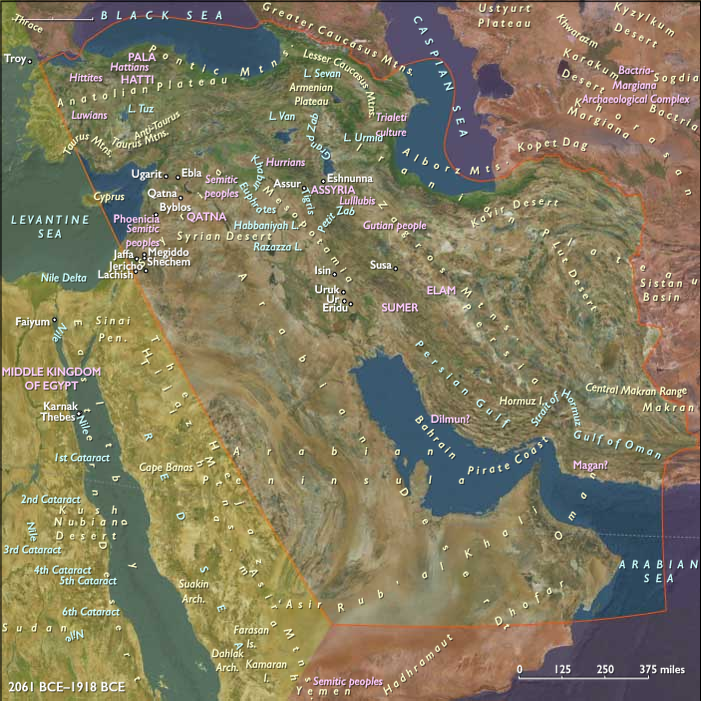
Dilmun retains its position as a major…
2061 BCE to 1918 BCE
Dilmun retains its position as a major center of sea trade into the early second millennium BCE.
Sometimes described as "the place where the sun rises" and "the Land of the Living,” Dilmun is the scene of some versions of the Sumerian creation myth, and the place where the deified Sumerian hero of the flood, Utnapishtim (Ziusudra), was taken by the gods to live forever.
Dilmun is also described in the epic story of Enki and Ninhursag as the site at which the Creation occurred.
Ninlil, the Sumerian goddess of air and south wind had her home in Dilmun.
It is also featured in the Epic of Gilgamesh.
However, the main events in the early epic Enmerkar and the Lord of Aratta, which center on Enmerkar's construction of the ziggurats in Uruk and Eridu, are described as taking place in a world "before Dilmun had yet been settled.”
Archaeology has failed as of 2008 to find a site in existence from 3300 BCE (Uruk IV) to 556 BCE (Neo-Babylonian Era) when Dilmun (Telmun) appears in texts.
The earliest known site is Qal'at al-Bahrain, which is dated no earlier than c. 2200 BCE according to Flemming Hojlund, despite the scholarly consensus that Dilmun encompasses three locations: (1) the eastern littoral of Arabia from the vicinity of modern Kuwait to Bahrain; (2) the island of Bahrain; (3) the island of Failaka east of Kuwait.
Failaka was settled after 2000 BCE following a drop in sea level according to Daniel Potts and Harriet Crawford.
No settlements exist in the Arabian littoral 3300-2000 BCE according to Hojlund.
Thus, despite Dilmun's appearance in ancient texts dating from 3300-2300 BCE archaeologists have failed to find a site for Dilmun dating to this period.
Hymns regarding the Sumerian god Enki of Eridu in Sumer speak of his assaulting and deflowering Dilmun's maidens as they stand by a river bank, he reaching out of nearby marsh to clasp them to his bosom.
Of Bahrain, Failaka, and the eastern littoral of Arabia, none possess marshes and a riverbank.
Dilmun, furthermore, is said to lie "in the east where the sun rises," a situation that does not apply to the eastern Arabian littoral, Failaka or Bahrain, all of which lie south of Sumer and Eridu.
Theresa Howard-Carter (1987), realizing that these three locations possess no archaeological evidence of a settlement dating 3300-2300 BCE, has proposed that Dilmun of this era might be a still unidentified tell near the Shat al-Arab between modern-day Qurnah and Basra in modern day Iraq.
In favor of Howard-Carter's proposal, she noted that this area does lie to the east of Sumer ("where the sun rises"), and the riverbank where Dilmun's maidens would have been accosted aligns with the Shat al-Arab which is in the midst of marshes.
The "mouth of the rivers" where Dilmun was said to lie is for her the union of the Tigris and Euphrates at Qurnah.
Topics
Regions
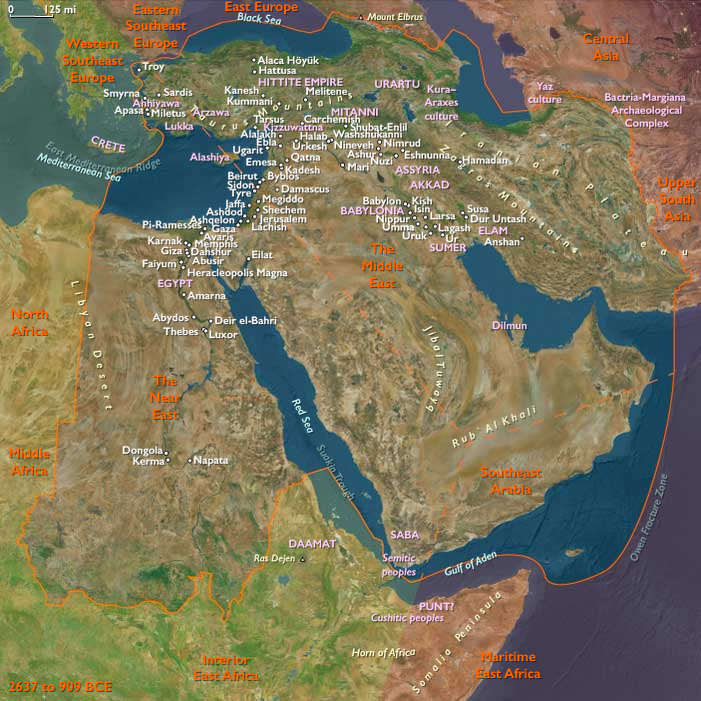
The Near and Middle East
View →Subregions