
The conclusion of the Java War marks…
1828 CE to 1839 CE
The government in Batavia sharply reduces the lands under the courts' control, and the fiction of Mataram finally gives way to what are now termed merely the vorstenlanden (principalities) and seen as comparatively minor vestigial powers.
The Javanese elites acquiesce, although not without some resentment, in part because another war is inconceivable and in part because they calculated that acquiescence is necessary if they are to retain anything at all of their privileged socioeconomic status.
At the same time, the end of the war makes equally clear that a new era has begun—not only for Java, but for the broader archipelago—an era in which the government of the Netherlands assumes full sovereignty.
It begins to oversee its territories through the new Ministry of Colonies (established in 1834), and takes a strikingly different attitude toward indigenous peoples.
As J. C. Baud (1789-1859), the first governor general of the Netherlands East Indies with full executive authority (1834-36), states succinctly, "We are the rulers and they are the ruled."
The resulting colonial state does not come suddenly into existence, however, but will develop n stages, from hybrid arrangements of convenience to a modernizing administrative structure, over the course of more than a century.
People
Topics
Regions
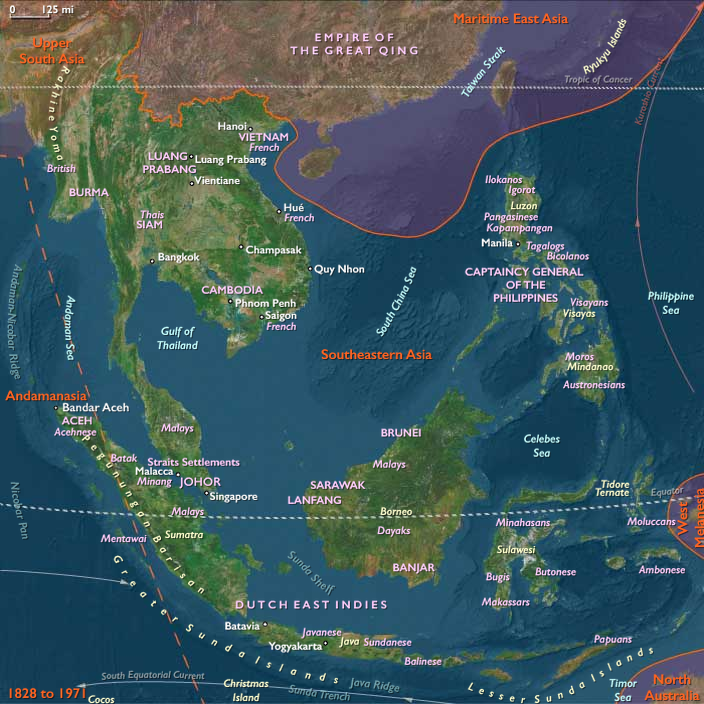
Southeast Asia
View →Subregions
