Dirck Volckertszoon Coornhert, a Dutch poet, translator,…
1586 CE
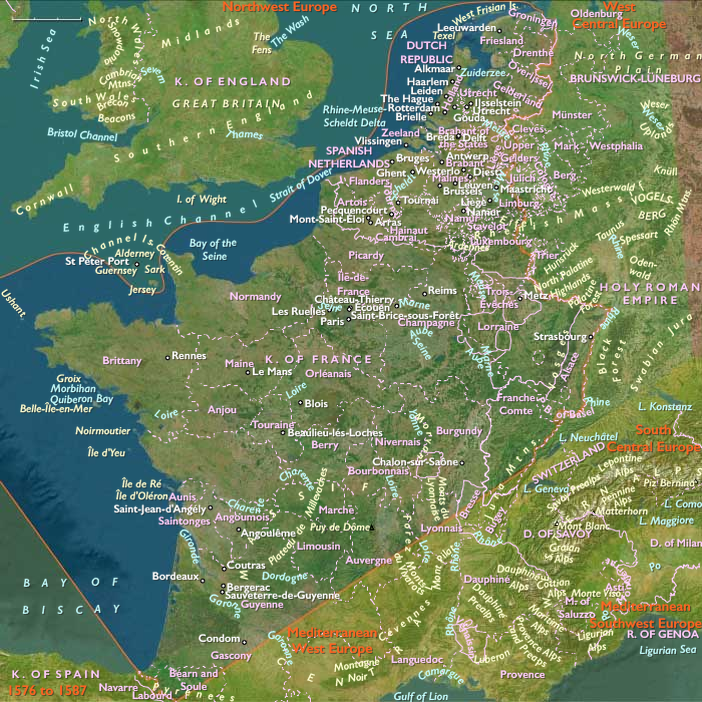
Dirck Volckertszoon Coornhert, a Dutch poet, translator, playwright, and moralist, had settled as an engraver on copper in Haarlem, where he had published Dutch translations of Cicero, Seneca, and Boethius.
His translation of the Odyssey—De dolinghe van Ulyss (1561)—is the first great work of the Dutch early Renaissance.
Here Coornhert's powers of imagery and sensuous description are fully evident, while in his original poetry the religious–humanistic intent precludes any stress on figurative language.
Holding positions in the city's government, he had thrown himself into the struggle against Spanish rule and in 1566 drawn up the manifesto of William of Orange.
He had been imprisoned at The Hague in 1568 but escaped to Cleves.
Although he had been recalled to Haarlem in 1572, his aversion to warfare had led him back to Cleves, where he continued in William's employ.
Setting down Humanist values for the first time in the vernacular, his clear, unpretentious prose style contrasts with that of the contemporary Rederijkers (rhetoricians) and will serve as a model to the great seventeenth-century Dutch writers.
All his works testify to his belief in a loving God.
His dramas are allegorical and didactic: the Comedie van Israël (1575) attacks the worldly, hypocritical Netherlands of his time.
Coornhert stands for toleration and opposes capital punishment for heretics.
His book of songs Liedekens (1575) shows his determination to choose a form for the content and not vice versa.
His best known prose work is the moralist tract De wellevenskunste (1586; “The Polite Art”), in which he holds that the true path can be found only through spiritual love.
Locations
Groups
Subjects
Regions
West Europe
View →Subregions