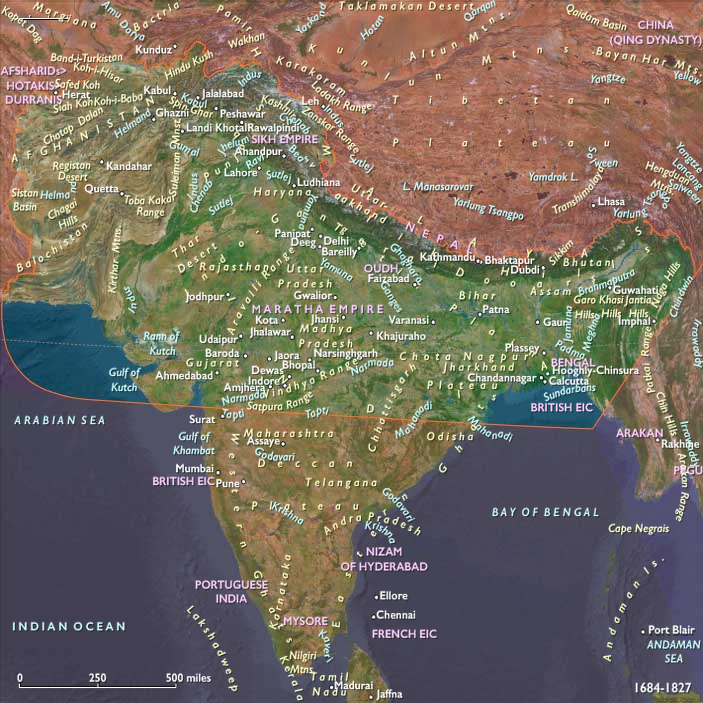
The mountain areas to the north of…
1684 CE to 1827 CE
The mountain areas to the north of the Kathmandu valley and the Kiranti region to the east are, by the seventeenth century, the only areas that maintain traditional tribal communal systems, influenced to various degrees by Hindu ideas and practices
In the west and the south of the three kingdoms, there are many petty states ruled by dynasties of warrior (Kshatriya) status, many claiming an origin among princely, or Rajput, dynasties to the south.
In the near west, around the Narayani River system (the Narayani is one of the seven Gandak rivers), there is a loose confederation of principalities called the Chaubisi (the Twenty-four), including Makwanpur and Palpa.
In the far west, around the Karnali River system, there is a separate confederation called the Baisi (the Twenty-two), headed by the raja of Jumla.
The confederations are in constant conflict, and their member states are constantly quarreling with each other.
The kingdoms of Kathmandu, Patan, and Bhadgaon periodically ally themselves with princes among these confederations.
All of these small, increasingly militarized states are operating individually at a higher level of centralized organization than ever before in the hills, but they are expending their resources in an almost anarchic struggle for survival.
There is an awareness of the distinct culture of the Himalayan area but no real concept of Nepal as a nation.
Locations
Groups
Topics
Subjects
Regions
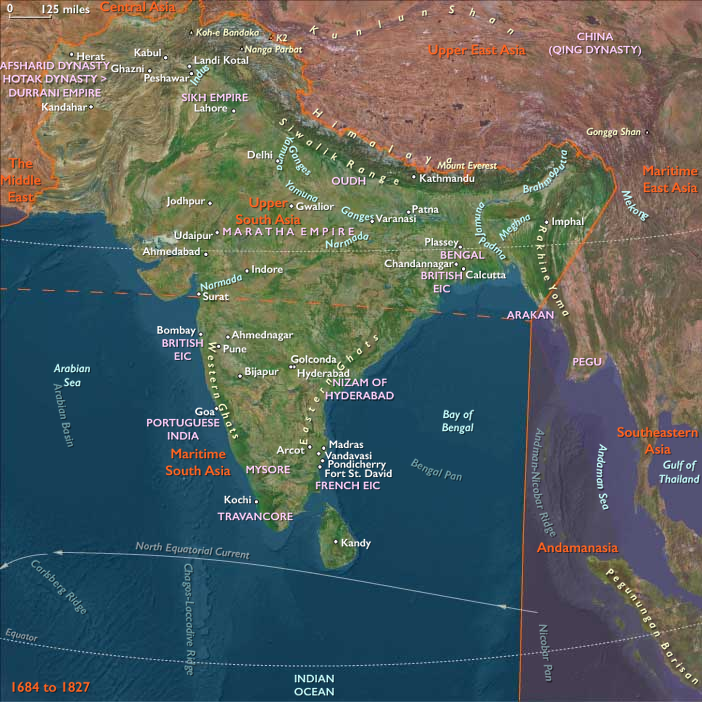
South Asia
View →Subregions