
The Northern Xiongnu, during the early part…
65 CE
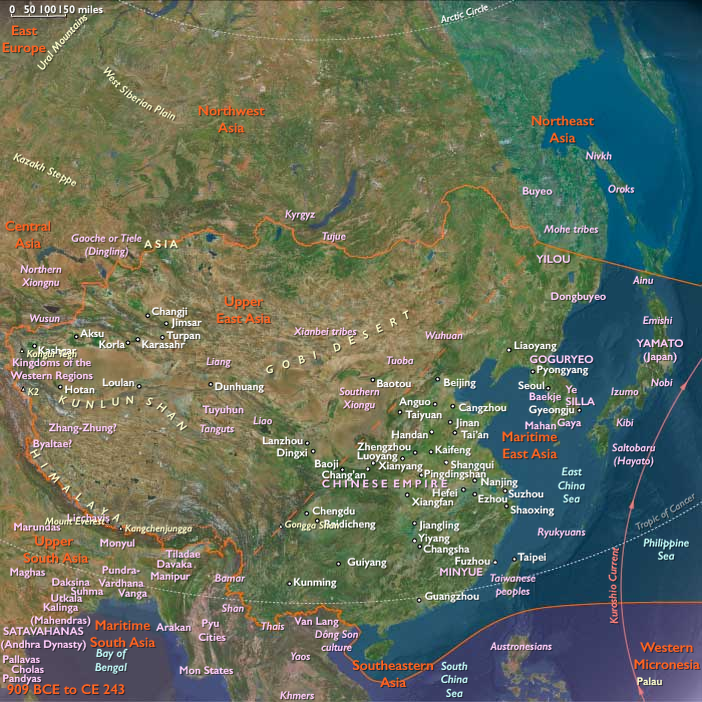
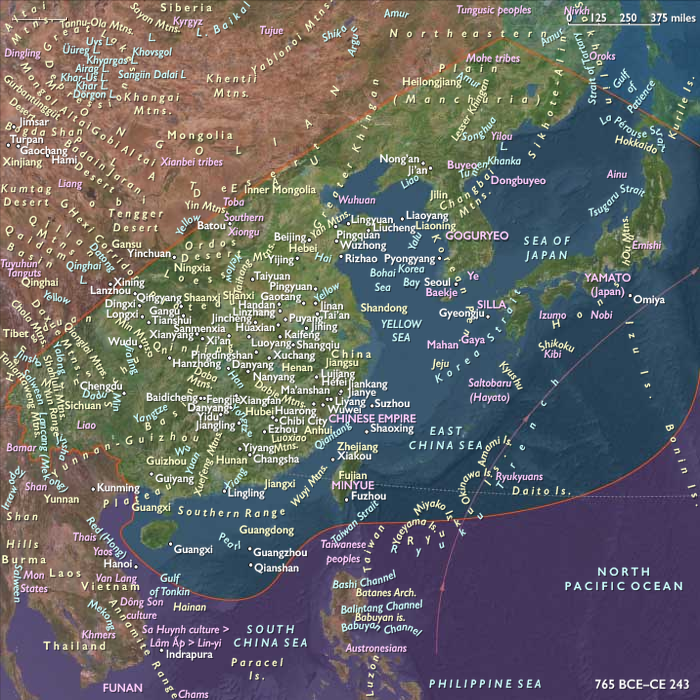
The Northern Xiongnu, during the early part of the reign of Emperor Ming of Han, continue to be a constant threat to both the Han dynasty and her ally the Southern Xiongnu.
Emperor Ming engages in a variety of military and economic tactics, largely successful, to try to maintain peace with the Northern Xiongnu.
In 65, he establishes a permanent border defense force, known as the Duliao Army, charged with protecting the northern boundaries and the Southern Xiongnu, and to prevent the people of the Southern Xiongnu from defecting to the Northern Xiongnu.
Under the Later Han, monumental stone sculptures appear, such as one depicting a horse trampling a barbarian underfoot.
People
Groups
Commodities
Subjects
Regions
East Asia
View →Subregions
Maritime East Asia
View →Related Events
No active filters.
Showing 10 events out of 61669 total
Berenice, the daughter of King Agrippa I, attempts to ease Judeo-Roman tensions in 65, but she and other moderates prove unable to control the increasingly desperate populace.
The cost to rebuild Rome is immense, requiring funds the state treasury does not have.
Nero devalues the Roman currency for the first time in the Empire's history, reducing the weight of the denarius from 84 per Roman pound to 96 (3.85 grams to 3.35 grams).
He also reduces the silver purity from 99.5% to 93.5%—the silver weight dropping from 3.83 grams to 3.4 grams.
Furthermore, Nero reduces the weight of the aureus from 40 per Roman pound to 45 (8 grams to 7.2 grams).
Nero’s economic policy is a point of debate among scholars.
According to ancient historians, Nero's construction projects were overly extravagant and the large number of expenditures under Nero left Italy "thoroughly exhausted by contributions of money" with "the provinces ruined."
(Tacitus, Annals) Modern historians, though, note that the period was riddled with deflation and that it is likely that Nero's spending came in the form of public works projects and charity intended to ease economic troubles.
Nero also sings at the second quinquennial Neronia in 65.
It is said that Nero craved the attention,but historians also write that Nero was encouraged to sing and perform in public by the Senate, his inner circle and the people.
Ancient historians strongly criticize his choice to perform, calling it shameful.
Poppaea had borne Nero one daughter, Claudia Augusta, born on January 21, 63, who died at only four months of age.
At the birth of Claudia, Nero had honored mother and child with the title of Augusta.
The cause and timing of Poppaea's death is uncertain.
According to Suetonius, while she was awaiting the birth of her second child in the summer of 65, she quarreled fiercely with Nero over him spending too much time at the races.
In a fit of rage, Nero kicked her in the abdomen, so causing her death.
Tacitus, on the other hand, places the death after the Quinquennial Neronia and claims Nero's kick was a "casual outburst."
Tacitus also mentions that some writers (now lost) claimed Nero poisoned her, though Tacitus does not believe them.
Cassius Dio claims Nero leapt upon her belly, but admits that he doesn't know if it was intentional or an accident.
Modern historians, though, keep in mind Suetonius, Tacitus and Cassius Dio's severe bias against Nero and the impossibility of them knowing private events, and hence recognize that Poppaea may have simply died due to fatal miscarriage complications or in childbirth (in which case the second child also did not survive).
Nero, in any case, goes into deep mourning.
Her body is not cremated but stuffed with spices, embalmed, and put in the Mausoleum of Augustus.
She is given a state funeral.
Nero praises her during the funeral eulogy and gives her divine honors.
It is said that Nero "burned ten years' worth of Arabia's incense production at her funeral.
By 65, senators complain that they have no power left; this leads to the Pisonian conspiracy, in which Gaius Calpurnius Piso, a Roman statesman, organizes a conspiracy against Nero with the help of Subrius Flavus and Sulpicius Asper, a tribune and a centurion of the Praetorian Guard.
According to Tacitus, many conspirators wished to "rescue the state" from the emperor and restore the Republic.
The freedman Milichus discovers the conspiracy and reports it to Nero's secretary, Epaphroditos.
As a result, the conspiracy fails and its members are executed including Lucan, the twenty-six-year-old epic poet and nephew of Seneca the Younger, Nero's previous advisor.
Seneca is ordered to commit suicide after admitting he discussed the plot with the conspirators.
Lucan leaves his unfinished Bellum Civile, sometimes called the Pharsalia, an account of the Roman civil wars between Julius Caesar and the senatorial class.
Nero’s executions increase in 65, when an assassination plot is uncovered; he allegedly kicks to death his scheming second wife, Poppaea.
Vespasian’s success as the legate of a legion had earned him a consulship in 51, after which he had retired from public life, having incurred the enmity of Claudius' wife, Agrippina.
He had come out of retirement in 63 when, at 54, he was sent as governor to Africa Province.
According to Tacitus (ii.97), his rule was "infamous and odious" but according to Suetonius (Vesp.
4), he was "upright and, highly honorable".
On one occasion he is pelted with turnips.
Ex-consuls usually view governorships as opportunities to extort huge amounts of money to regain their wealth that they had spent on their previous political campaigns.
Corruption is so rife, that it is almost expected that a governor will come back from these appointments with his pockets full.
However, Vespasian has used his time in North Africa making friends instead of money; something that will be far more valuable in the years to come.
During his time in North Africa, he had found himself in financial difficulties and was forced to mortgage his estates to his brother.
To revive his fortunes, he had turned to the mule trade and gained the nickname mulio (mule-driver).
The first imperial university in Chinese history has its foundation in a Confucian school at the capital Luoyang built by Emperor Ming in 66 for the children of high officials and marquesses.
The children of South Xiongnu nobles also attend.
There has been a long tradition of hostility between the large Hellenized populations of Palestine and the Jews (also a problem in the Diaspora, most notably at Alexandria during the reign of Caligula).
Gessius Florus, the Roman procurator of Judaea, upon taking office in Caesarea in 64 had begun a practice of favoring the local Greek population of the city over the Jewish population.
The Greeks, noticing Florus' policies, have taken advantage of the circumstances to denigrate their Jewish neighbors.
One notable instance of provocation occurs while the Jews are worshiping at their local synagogue and a Hellenist sacrifices several birds on top of an earthenware container at the entrance of the synagogue, an act that renders the building ritually unclean.
In response to this action, the Jews send a group of men to petition Florus for redress.
Florus, despite accepting a payment of eight talents to hear the case, refuses to listen to the complaints and instead has the petitioners imprisoned.
The son of the Kohen Gadol (high priest) Eliezar ben Hanania, in reaction, ceases prayers and sacrifices for the Roman Emperor at the Temple.
Protests over taxation join the list of grievances and random attacks on Roman citizens and perceived 'traitors' occur in Jerusalem.
Joseph returns to Jerusalem on the eve of a general revolt against Roman rule.
Florus further angers the Jewish population of his province by having seventeen talents removed from the treasury of the Temple in Jerusalem, claiming the money is for the Emperor.
In response to this action, the city falls into unrest and some of the Jewish population begins to openly mock Florus by passing a basket around to collect money as if Florus were poor.
Florus reacts to the unrest by sending soldiers into Jerusalem the next day to raid the city and arrest a number of the city leaders.
The arrested individuals are whipped and crucified despite many of them being Roman citizens.
The pro-Roman king Agrippa II has expended large sums in beautifying Jerusalem and other cities, especially Berytus.
His partiality for the latter has rendered him unpopular among his own subjects, and the capricious manner in which he has appointed and deposed the high priests make him disliked by the Jews.
Agrippa fails to prevent his subjects from rebelling, and urges instead that they tolerate the behavior of the Florus.
But in 66 the Jews expels him and his sister Berenice, who, fearing the worst, flee to Galilee.
Urged on by the fanatical Zealots, the Jews oust Florus and set up a revolutionary government in Jerusalem that extends its influence throughout the whole country.
Along with many others of the priestly class, Joseph counsels compromise but is drawn reluctantly into the rebellion.
Cestius Gallus, the legate of Syria, brings a legion, the XII Fulminata, and auxiliary troops as reinforcements to restore order.
All available troops in autumn 66 are mustered, formed into a column and sent to confront the rebellion’s perceived center.
Ideally, such a show of force would have allowed the Romans to regain the initiative and prevent the rebellion from developing and growing stronger.
Gallus conquers Bezetha, in the Jezreel Valley, soon to be the seat of the Great Sanhedrin (Jewish supreme religious court), but is unable to take The Temple Mount.
The Roman forces invest Jerusalem, then for uncertain reasons, withdraw back towards the coast, closely pursued by rebel scouts.
The organization of the Jews is better than it had been previously.
As the Romans near the pass of Beth Horon, they are ambushed and come under attack from massed missile fire, and are then suddenly rushed by a large force of infantry, twenty-four hundred Zealots led by Eleazar ben Simon.
The Romans cannot get into formation within the narrow confines of the pass and lose cohesion under the fierce assault.
The equivalent of an entire legion is destroyed.
Gallus succeeds in escaping with a fraction of his troops to Antioch by sacrificing the greater part of his army and a large amount of war material.
After the massacre, the Jewish Zealots go through the Roman dead, stripping them of their armor, helmets, equipment, and weapons.
Eleazar, returning to Jerusalem with substantial loot, will use the wealth acquired in this decisive victory as political leverage during the battle for power in Jerusalem in 67-69.
The battle of Beth-Horon is one of the worst defeats suffered by regular Roman troops against a rebelling province in history, encouraging many more volunteers and towns to throw their lot in with the rebels.
A full-scale war is now inevitable.
The rebel government in Jerusalem assigns command of both Galilee and the Golan to Yosef Ben Matityahu (the future Josephus) who (if his own untrustworthy account may be believed), is obstructed in his efforts at conciliation by the enmity of the local partisans led by John of Giscala.
Though realizing the futility of armed resistance, he nevertheless sets about fortifying nineteen of the most important towns of the north against the forthcoming Roman juggernaut.
The mountaintop fortress of Masada occupies the entire top of an isolated mesa near the southwest coast of the Dead Sea, First fortified either by Jonathan Maccabeus or by Alexander Jannaeus, both of the Hasmonean dynasty, the site was chiefly developed between 37 and 31 BCE by Herod the great, as a refuge for himself in the event of a revolt.
After Herod's death, the Romans occupied Masada, but a group of Jewish extremists, the Sicarii, overcomes the Roman garrison of Masada in 66.
The steep slopes of the mountain make Masada a virtually unassailable fortress.
Simon bar Giora, who had first become notable when Roman troops marched towards Jerusalem in 66, had helped in defeating the advance by attacking from the north.
He had put the hindmost of the army into disorder, and had carried off many of the beasts that carried the weapons of war, leading them into the city.
However, he had been rejected for a command position by the Jerusalem authorities, for they did not want a popular leader of a rebellious peasantry if they were to moderate the revolt and negotiate with the Romans.
As a result, Simon has gathered a large number of revolutionaries and starts robbing houses of wealthy people in the district of Acrabbene in Samaria.
Nero, the fifth Roman emperor, undertakes a long visit to Greece at the end of the year 66 that is to keep him away from Rome for fifteen months, and during his absence he entrusts the consulate to one of his freedmen.
On this trip, Nero engages in new displays of his artistic prowess, and he walks about garbed as an ascetic, barefoot and with flowing hair.
His enthusiasm for Greek culture also prompts him to free a number of Greek cities in honor of their glorious past.
Vespasian, on returning from Africa, tours Greece in Nero's retinue, but loses Imperial favor after paying insufficient attention (some sources suggest he fell asleep) during one of the Emperor's recitals on the lyre, and finds himself in the political wilderness.