
Stephen, a son of Emperor Louis IV,…
1360 CE to 1371 CE
Stephen, a son of Emperor Louis IV, had served as vogt of Swabia and Alsace during his father's reign.
The Emperor had acquired Brandenburg, Tyrol, Holland and Hainaut for his House but he had also released the Upper Palatinate for the Palatinate branch of the Wittelsbach in 1329.
Stephen, together with his five brothers, had succeeded his father in 1347 as Duke of Bavaria and Count of Holland and Hainaut.
Louis IV had reunited Bavaria in 1340 but in 1349 the country had been divided for the emperor's sons again into Upper Bavaria, Lower Bavaria-Landshut and Bavaria-Straubing.
Stephen II had ruled from 1349 to 1353 together with his brothers William I and Albert I in Holland and Lower Bavaria-Landshut, since 1353 only in Lower Bavaria-Landshut.
After the temporary reconciliation of the Wittelsbachs with Charles IV, Holy Roman Emperor, who had finally confirmed all Wittelsbach possessions, Stephen had joined Charles' expedition to Italy in 1354, but soon the Golden Bull of 1356 caused a new conflict since only the Palatinate branch of the Wittelsbach and his brother Louis VI the Roman as margrave of Brandenburg were invested with the electoral dignity.
Stephen II is the last son of Emperor Louis IV, who was in 1362 absolved from excommunication.
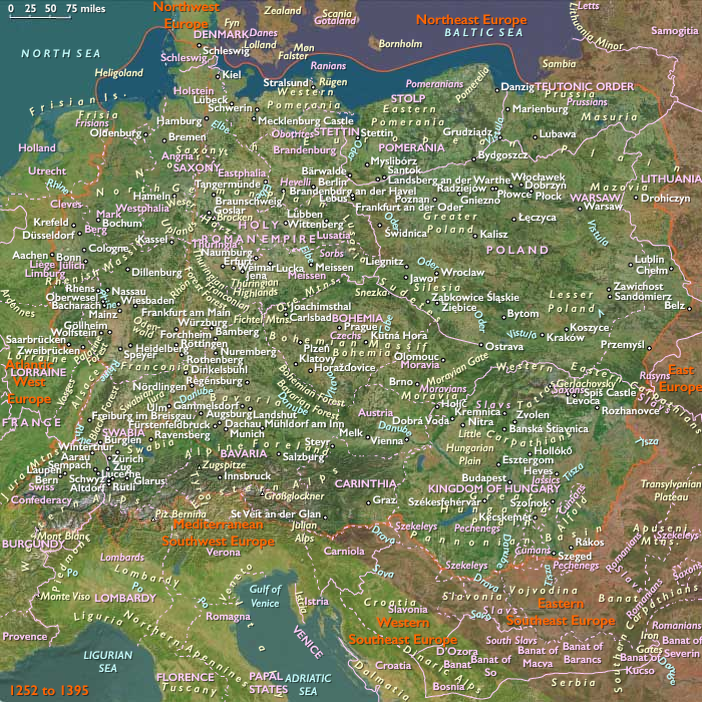
When Duke Meinhard, the son of his older brother Louis V the Brandenburger dies in 1363, Stephen II succeeds also in Upper Bavaria and invades Tyrol.
To strengthen his position against Rudolf IV, Duke of Austria he confederated with Bernabò Visconti.
Rudolf had entered into a contract of inheritance with widowed Countess Margaret of Gorizia-Tyrol upon the death of her only son Meinhard III, which will actually bring the County of Tyrol under Austrian rule only after her death in 1369, when Stephen finally renounces Tyrol to the Habsburgs with the Peace of Schärding for a huge financial compensation.
Locations
People
Groups
Commodities
Regions
Central Europe
View →Subregions
