
East Central Europe (1396–1539 CE): Dynastic Crossroads, …
Years: 1396 - 1539
East Central Europe (1396–1539 CE): Dynastic Crossroads, Hussite Fires, and Ottoman Shocks
Geographic & Environmental Context
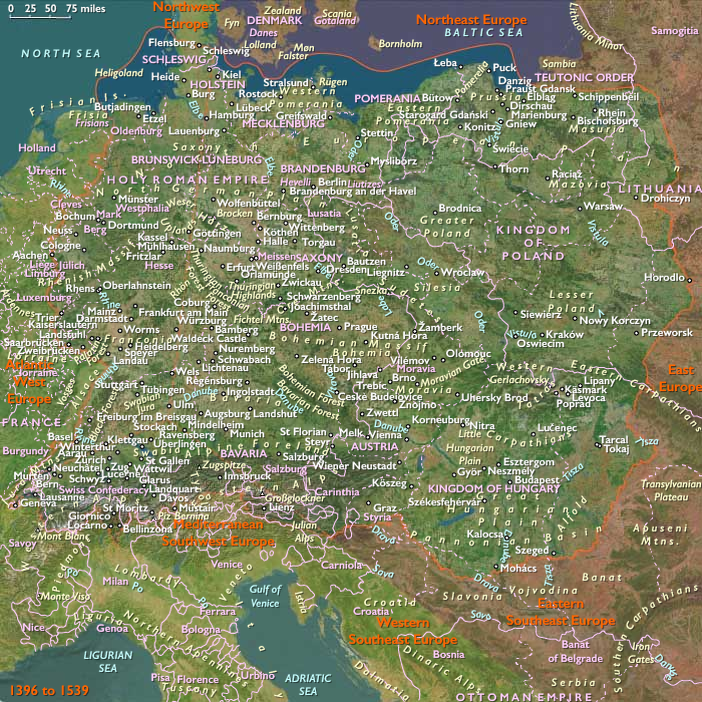
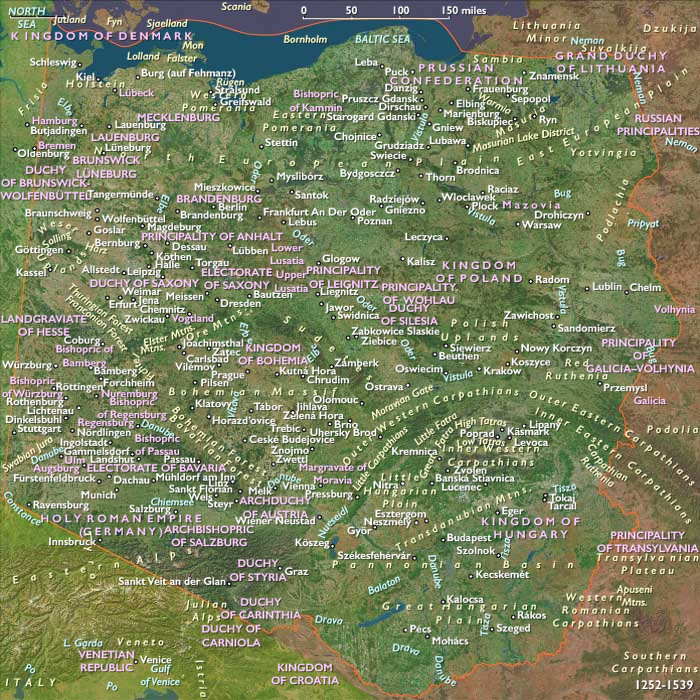
The subregion of East Central Europe includes modern-day Poland, Czechia, Slovakia, Hungary, and the eastern parts of Germany (including most of Bavaria) and Austria east of 10°E and northeast of Carinthia. Anchors included the Vistula basin (Warsaw, Kraków, Gdańsk), the Danube corridor from Vienna through Pressburg/Bratislava and Buda to Szeged, the Carpathian arc of Slovakia and northern Hungary, the Hungarian Great Plain, the Elbe and Oder headwaters in Bohemia, Saxony, and Silesia, and the Alpine highlands of eastern Austria and Bavaria. These landscapes bound together fertile river basins, upland pastures, alpine valleys, and strategic frontiers bridging the Baltic, Adriatic, and Black Sea worlds.
Climate & Environmental Shifts
The Little Ice Age deepened extremes:
-
Alpine and Carpathian highlands: longer winters, harsher snowpack, late thaws; floods and landslides after spring melt.
-
Vistula basin & Polish plain: variable harvests of rye and wheat; bumper crops alternated with shortfalls.
-
Hungarian plain: droughts and floods shaped cattle herding and grain cycles.
-
Bavarian & Austrian Alps: cooler summers reduced grape yields, but alpine pastures thrived for cattle and sheep.
Subsistence & Settlement
-
Rural economies: Rye, oats, and barley in Poland and Silesia; wheat and millet on the Hungarian plain; vineyards in Moravia, Hungary, Austria, and Bavaria; cattle herding widespread.
-
Mining & metallurgy: Silver and copper mines in Slovakia (Kremnica, Banská Štiavnica), Bohemia (Kutná Hora), and Tyrol–Salzburg; salt at Wieliczka and Hallstatt; ironworks in Bavaria and Styria.
-
Urban centers: Prague, Kraków, Vienna, Buda, Nuremberg, Augsburg, and Regensburg; merchant guilds and universities flourished.
-
Forests & mountains: Logging and charcoal for mines, alpine dairying, and highland pastures tied peasants to both subsistence and trade.
Technology & Material Culture
-
Agriculture: Heavy plows, watermills, three-field rotations; vineyards terraced in Moravia, Hungary, and Bavaria.
-
Mining tech: Water-driven bellows and stamping mills; deep shafts with timbering; new coinages financed states.
-
Architecture: Gothic cathedrals (Prague’s St. Vitus, Kraków’s Wawel), castles, walled towns; Renaissance forms began seeping in.
-
Print: By the early 16th century, Kraków, Vienna, and Nuremberg became major printing centers; humanist texts and Reformation pamphlets circulated.
Movement & Interaction Corridors
-
Vistula river: Grain and timber moved to Gdańsk and into Baltic–Hanseatic circuits.
-
Danube corridor: Vienna–Buda–Belgrade linked German, Hungarian, and Balkan markets, but faced Ottoman pressure.
-
Alpine passes: Bavarian and Austrian routes tied Venice to Augsburg, Regensburg, and Vienna.
-
Carpathian passes: Salt, wine, and cattle moved between Hungary, Poland, and Transylvania.
-
Hanseatic connections: Kraków and Poland linked via Gdańsk into North Sea trade.
Cultural & Symbolic Expressions
-
Catholic Christendom: Monasteries, cathedrals, and feast days structured social life across Poland, Hungary, Austria, and Bavaria.
-
Hussite movement (Bohemia): Sparked after Jan Hus’s execution (1415); Hussite Wars (1419–1434) reshaped Czech religious life; moderate utraquism endured even after defeat.
-
Humanism: Universities in Kraków, Prague, Vienna, and Ingolstadt; Copernicus studied in Kraków; Erasmus’s works circulated from Basel and Nuremberg.
-
Dynastic courts: Jagiellon dynasty ruled Poland–Lithuania, Bohemia, and Hungary; Habsburgs consolidated Austria and eyed Hungary.
-
Music & art: Courtly polyphony, panel painting in Bavaria and Bohemia, illuminated chronicles, and humanist scriptoria.
Environmental Adaptation & Resilience
-
Peasants: Rotated cereals, intercropped legumes; stored grain in communal barns.
-
Highlanders: Practiced transhumance; cheese-making, wool, and hides buffered shortages.
-
Mining towns: Diversified with craft guilds; imported grain when crops failed.
-
Urban networks: Redistributed surpluses through fairs in Leipzig, Kraków, and Nuremberg.
Technology & Power Shifts (Conflict Dynamics)
-
Hussite wars: Wagon forts, hand-guns, and disciplined infantry innovated military tactics; legacies shaped Central European warfare.
-
Jagiellon power: At its height c. 1500, the dynasty united Poland–Lithuania, Bohemia, and Hungary.
-
Ottoman threat: Hungary shattered at Mohács (1526); King Louis II killed, splitting Hungary between Ottoman pashaliks, Habsburg Royal Hungary, and Transylvanian voivodeship.
-
Habsburg rise: Claimed crowns of Bohemia and Hungary after 1526, transforming Vienna into a bulwark of Christendom.
-
Polish–Teutonic frontier: Secularization of the Teutonic Order (1525) created Ducal Prussia as a Polish fief.
-
Bavarian & Austrian Reformation: Lutheran ideas spread in German and Austrian lands; dukes and bishops began suppressing or tolerating reform selectively.
Transition
By 1539 CE, East Central Europe had moved from dynastic zenith to fracture. Poland–Lithuania prospered as a grain-exporting kingdom; Bohemia remained divided between Catholic and utraquist traditions under Habsburg suzerainty; Hungary lay partitioned after Mohács; Austria and Bavaria were absorbing Lutheran ideas amid Catholic pushback; mining and grain surpluses supported urban life but frontiers with the Ottomans seethed. The region’s destiny was shifting toward confessional division and Habsburg–Ottoman rivalry.
People
- Casimir IV Jagiellon
- Jan Hus
- Jogaila (Władysław II)
- Matthias Corvinus
- Sigismund
- Wenceslaus IV of Bohemia
Groups
- Germans
- Hungarian people
- Wends, or Sorbs (West Slavs)
- Christianity, Chalcedonian
- Bavarians (West Germanic tribe)
- Passau, Bishopric of
- Germany, Kingdom of (within the Holy Roman Empire)
- Holy Roman Empire
- Slovaks (West Slavs)
- Carinthia, Duchy of
- Czechs [formerly Bohemians] (West Slavs)
- Hanseatic league (informally organized)
- Hungary, Kingdom of
- Bamberg, Prince-Bishopric of
- Poland, Greater
- Mazovia, Duchy of
- Austria, Archduchy of
- Brandenburg (Ascanian) Margravate of
- Bohemia, Kingdom of
- Styria, Duchy of
- Ordensstaat (Monastic state of the Teutonic Knights)
- Lübeck, Free City of
- Brunswick-Lüneburg, Duchy of
- Regensburg (Ratisbon), Imperial Free City of
- Cammin, Prince-Bishopric of
- Anhalt-Bernburg, Principality of
- Anhalt-Zerbst, Principality of
- Regensburg, Prince-Bishopric of
- Holy Roman Empire
- Galicia–Volhynia, Kingdom of
- Brunswick-Wolfenbüttel, Duchy of
- Salzburg, Archbishopric of
- Saxe-Ratzeburg-Lauenburg, Duchy of
- Saxe-Mölln-Bergedorf, Duchy of
- Poland of the later Piasts, Kingdom of
- Bavaria, Wittelsbach Duchy of
- Lithuania, Grand Duchy of
- Mecklenburg, Duchy of
- Bavaria-Straubing, Wittelsbach Duchy of
- Ottoman Empire
- Bavaria-Landshut, Wittelsbach Duchy of
- Saxony, Electorate of
- Crown of the Kingdom of Poland
- Poland of the Jagiellonians, Kingdom of
- Lithuania, Grand Duchy of
- Bavaria-Munich, Wittelsbach Duchy of
- Bavaria-Ingolstadt, Wittelsbach Duchy of
- Anhalt-Köthen, Principality of
- Anhalt-Dessau, Principality of
- Saxe-Lauenburg, Duchy of
- Ottoman Empire
- Brandenburg, (Hohenzollern) Margravate of
- Hussites
- Ottoman Empire
- Regensburg (Ratisbon), Imperial Free City of
- Bavaria, Wittelsbach Duchy of
- Protestantism
Topics
Commodoties
Subjects
Regions
Subregions
Years: 1396 - 1539
People
- Casimir IV Jagiellon
- Jan Hus
- Jogaila (Władysław II)
- Matthias Corvinus
- Sigismund
- Wenceslaus IV of Bohemia
Groups
- Germans
- Hungarian people
- Wends, or Sorbs (West Slavs)
- Christianity, Chalcedonian
- Bavarians (West Germanic tribe)
- Passau, Bishopric of
- Germany, Kingdom of (within the Holy Roman Empire)
- Holy Roman Empire
- Slovaks (West Slavs)
- Carinthia, Duchy of
- Czechs [formerly Bohemians] (West Slavs)
- Hanseatic league (informally organized)
- Hungary, Kingdom of
- Bamberg, Prince-Bishopric of
- Poland, Greater
- Mazovia, Duchy of
- Austria, Archduchy of
- Brandenburg (Ascanian) Margravate of
- Bohemia, Kingdom of
- Styria, Duchy of
- Ordensstaat (Monastic state of the Teutonic Knights)
- Lübeck, Free City of
- Brunswick-Lüneburg, Duchy of
- Regensburg (Ratisbon), Imperial Free City of
- Cammin, Prince-Bishopric of
- Anhalt-Bernburg, Principality of
- Anhalt-Zerbst, Principality of
- Regensburg, Prince-Bishopric of
- Holy Roman Empire
- Galicia–Volhynia, Kingdom of
- Brunswick-Wolfenbüttel, Duchy of
- Salzburg, Archbishopric of
- Saxe-Ratzeburg-Lauenburg, Duchy of
- Saxe-Mölln-Bergedorf, Duchy of
- Poland of the later Piasts, Kingdom of
- Bavaria, Wittelsbach Duchy of
- Lithuania, Grand Duchy of
- Mecklenburg, Duchy of
- Bavaria-Straubing, Wittelsbach Duchy of
- Ottoman Empire
- Bavaria-Landshut, Wittelsbach Duchy of
- Saxony, Electorate of
- Crown of the Kingdom of Poland
- Poland of the Jagiellonians, Kingdom of
- Lithuania, Grand Duchy of
- Bavaria-Munich, Wittelsbach Duchy of
- Bavaria-Ingolstadt, Wittelsbach Duchy of
- Anhalt-Köthen, Principality of
- Anhalt-Dessau, Principality of
- Saxe-Lauenburg, Duchy of
- Ottoman Empire
- Brandenburg, (Hohenzollern) Margravate of
- Hussites
- Ottoman Empire
- Regensburg (Ratisbon), Imperial Free City of
- Bavaria, Wittelsbach Duchy of
- Protestantism
Topics
Commodoties
Subjects
Regions
Subregions