
East Central Europe (1852–1863 CE): Neo-Absolutism, Industrial …
Years: 1852 - 1863
East Central Europe (1852–1863 CE): Neo-Absolutism, Industrial Expansion, and Rising National Tensions
From 1852 to 1863, East Central Europe—covering modern-day Poland, Czechia, Slovakia, Hungary, and the eastern portions of Germany and Austria lying east of 10°E and northeast of the defined southeastern boundary—experienced significant political consolidation under conservative rule, intensified industrialization, and growing nationalist aspirations. This era set the stage for major conflicts and political realignments in the late nineteenth century.
Political and Military Developments
Austrian Neo-Absolutism under Franz Joseph
Emperor Franz Joseph I firmly established his conservative regime following the upheavals of 1848–1849, adopting policies of neo-absolutism, which rejected constitutionalism and centralized imperial governance from Vienna. The empire, including Bohemia, Moravia, and Hungary, witnessed tightened bureaucratic control and censorship.
Prussian Consolidation and Influence
In the German territories, Prussia consolidated its dominance, pursuing military and industrial modernization. Prussian statesmen, notably Otto von Bismarck (appointed minister-president in 1862), promoted aggressive policies aimed at consolidating Germany under Prussian leadership, foreshadowing future conflicts.
Polish Nationalist Sentiment
In the Kingdom of Poland (Congress Poland), under Russian rule, and in Austrian-controlled Galicia and Prussian-held Polish regions, nationalist movements intensified. Polish intellectuals and activists promoted cultural revival and clandestine political organizations, preparing the ground for the January Uprising (1863).
Hungarian and Czech National Aspirations
Hungarian nationalism re-emerged vigorously, as figures like Ferenc Deák championed a negotiated constitutional arrangement with Vienna. In Bohemia, Czech intellectuals furthered the Czech national revival, intensifying demands for political representation and linguistic recognition within the Austrian Empire.
Economic and Technological Developments
Industrial Revolution and Railway Expansion
Rapid industrialization dramatically reshaped regional economies, especially in Bohemia, Silesia, Hungary, and Saxony. Textiles, coal mining, iron production, and heavy industries flourished. Extensive railway construction improved regional integration, facilitating economic growth and urbanization in Prague, Vienna, Budapest, Leipzig, Wrocław, and Kraków.
Agricultural Modernization
Continued agricultural advancements and reforms transformed rural economies, further dismantling feudal remnants and promoting market-oriented farming practices. This modernization increased productivity and accelerated migration to urban industrial centers.
Cultural and Artistic Developments
Cultural Nationalism
Cultural nationalism surged, expressed vividly through literature, music, theater, and visual arts. Hungarian, Polish, and Czech artists and writers celebrated national identity and history. Notable figures included the Czech composer Bedřich Smetana, Polish poet Cyprian Norwid, and Hungarian literary figures such as János Arany and Sándor Petőfi (posthumously revered).
Revivalist and Historicist Architecture
Significant urban expansion was accompanied by revivalist architecture. Neo-Gothic, Neo-Renaissance, and Neo-Baroque styles became prominent, exemplified by grand public buildings and monuments in cities such as Vienna, Prague, Budapest, and Kraków, symbolizing national pride and imperial grandeur.
Settlement and Urban Development
Accelerating Urbanization
Industrial and railway growth spurred rapid urban expansion, notably in Vienna, Prague, Budapest, Leipzig, and industrial centers like Ostrava, Wrocław, and Łódź. These cities emerged as critical hubs of commerce, industry, culture, and administration.
Social and Religious Developments
Emergence of Modern Social Classes
Industrialization and urbanization fostered the expansion of a significant urban working class, intensifying demands for social reform, better working conditions, and political representation. The middle class simultaneously expanded, increasingly influential in politics and culture.
Continued Influence of the Church
The Catholic Church remained influential, especially in Poland, Austria, Bohemia, and Hungary, balancing conservative support with limited engagement in social issues, education, and welfare, seeking to counterbalance rising secular nationalist movements.
Long-Term Consequences and Historical Significance
The period 1852–1863 entrenched conservative neo-absolutist governance while simultaneously nurturing nationalist and liberal tensions that shaped subsequent decades. Accelerating industrialization profoundly reshaped economic and social structures, fostering urban growth and demographic shifts. Intensified nationalist movements, especially among Poles, Czechs, Hungarians, and the German states, set the stage for major conflicts and political reconfigurations, including the upcoming Austro-Prussian and Franco-Prussian wars, the Ausgleich (Austro-Hungarian Compromise of 1867), and broader transformations in the latter half of the nineteenth century.
People
Groups
- Hungarian people
- Poles (West Slavs)
- Czechs [formerly Bohemians] (West Slavs)
- Austria, Archduchy of
- Protestantism
- Hungary, Kingdom of
- Bohemia, Kingdom of
- Prussia, Kingdom of
- Russian Empire
- Galicia and Lodomeria, Kingdom of
- Austrian Empire
- Saxony, Kingdom of
- Bavaria, Kingdom of
- France, constitutional monarchy of
- German Confederation
- Holy Alliance
- Poland, Congress Kingdom of
Topics
- Great Emigration, (Polish)
- Western Architecture: 1840 to 1852
- Western Music: Early Romantic
- Berlin Revolt in Prussia
- Hungarian Revolution of 1848
- Czech Nationalists Uprising
- Austrian Revolution of 1848-49
- 1848, Revolutions of
Subjects
- Commerce
- Writing
- Architecture
- Performing Arts
- Conflict
- Government
- Custom and Law
- Human Migration
- political movement
- workers' movement
Regions
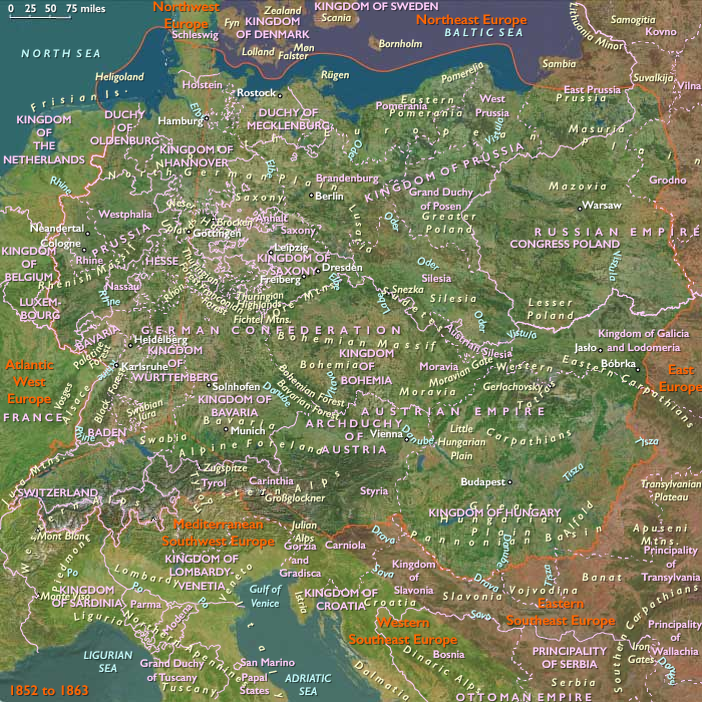
Subregions
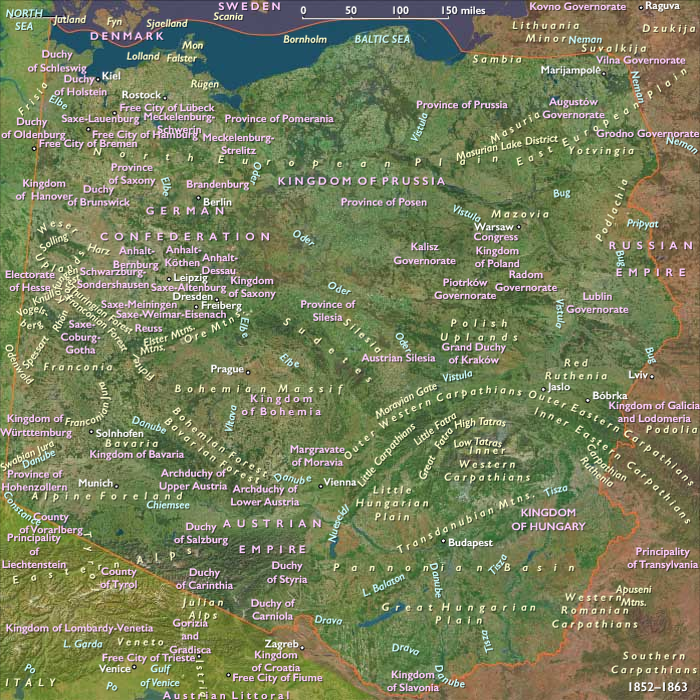
Years: 1852 - 1863
People
Groups
- Hungarian people
- Poles (West Slavs)
- Czechs [formerly Bohemians] (West Slavs)
- Austria, Archduchy of
- Protestantism
- Hungary, Kingdom of
- Bohemia, Kingdom of
- Prussia, Kingdom of
- Russian Empire
- Galicia and Lodomeria, Kingdom of
- Austrian Empire
- Saxony, Kingdom of
- Bavaria, Kingdom of
- France, constitutional monarchy of
- German Confederation
- Holy Alliance
- Poland, Congress Kingdom of
Topics
- Great Emigration, (Polish)
- Western Architecture: 1840 to 1852
- Western Music: Early Romantic
- Berlin Revolt in Prussia
- Hungarian Revolution of 1848
- Czech Nationalists Uprising
- Austrian Revolution of 1848-49
- 1848, Revolutions of
Subjects
- Commerce
- Writing
- Architecture
- Performing Arts
- Conflict
- Government
- Custom and Law
- Human Migration
- political movement
- workers' movement
Regions
Subregions