
East Central Europe (1864–1875 CE): Austro-Prussian War, …
Years: 1864 - 1875
East Central Europe (1864–1875 CE): Austro-Prussian War, German Unification, Austro-Hungarian Compromise, and Polish Resistance
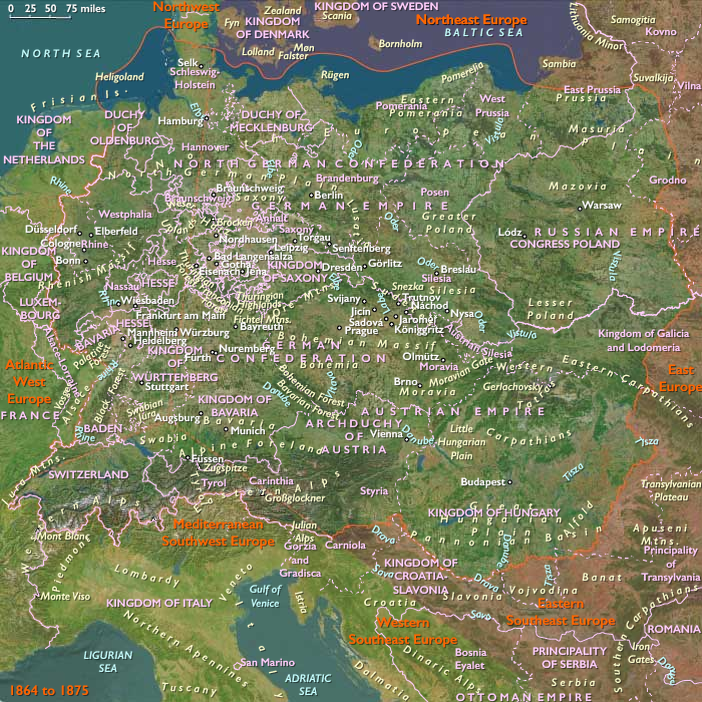
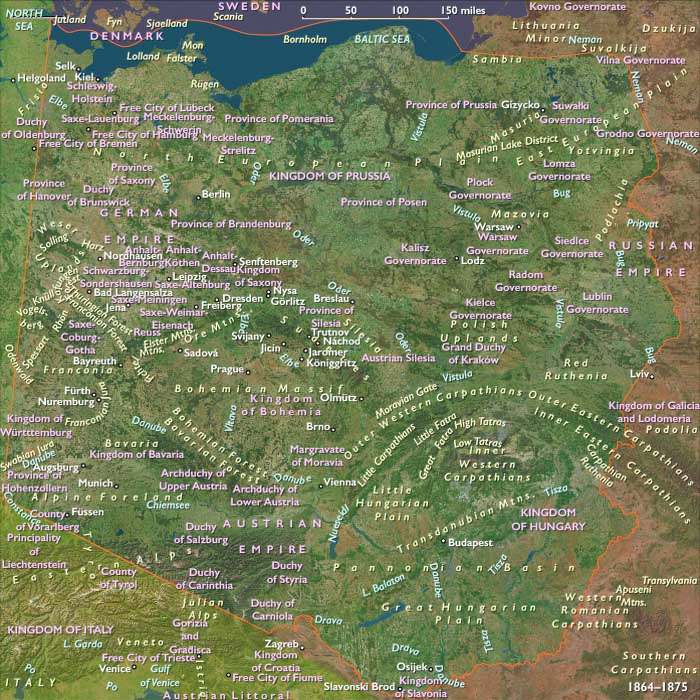
Between 1864 and 1875, East Central Europe—including modern-day Poland, Czechia, Slovakia, Hungary, and the eastern territories of Germany and Austria east of 10°E and northeast of the defined southeastern boundary—underwent decisive transformations, reshaping its geopolitical, economic, and social landscape. Dominated by the Austro-Prussian rivalry culminating in war, the subsequent rise of a unified German Empire, the Austro-Hungarian Compromise (Ausgleich), and the suppression of Polish uprisings, this era significantly redefined regional power structures.
Political and Military Developments
Austro-Prussian Rivalry and the War of 1866
Rivalry between Austria and Prussia reached a climax in the Austro-Prussian War of 1866. Following Austria's decisive defeat at the Battle of Königgrätz (Sadowa), Prussia emerged dominant, decisively shifting the balance of power in the German-speaking world.
Formation of the North German Confederation and the German Empire
The victorious Prussia, under Chancellor Otto von Bismarck, swiftly consolidated its influence by establishing the North German Confederation (1867). By 1871, following Prussia’s victory in the Franco-Prussian War, the German Empire was proclaimed at Versailles, unifying most German-speaking territories under Prussian dominance, significantly impacting the German states within East Central Europe (Saxony, Brandenburg, Mecklenburg, Silesia, Thuringia).
The Austro-Hungarian Compromise (Ausgleich of 1867)
Austria, weakened by defeat, pursued internal reforms. The Austro-Hungarian Compromise of 1867 created the dual monarchy of Austria-Hungary, granting significant autonomy to Hungary while maintaining centralized imperial authority from Vienna over other territories, including Bohemia, Moravia, and Galicia. This fundamentally reshaped the empire’s governance, giving Hungary co-equal status within the dual monarchy.
Polish January Uprising (1863–1864) and Subsequent Repression
The January Uprising in the Russian-controlled Kingdom of Poland (1863–1864) saw a major national rebellion brutally suppressed by Russian forces. Harsh repression followed, intensifying Russification and further stimulating Polish nationalism across Prussian, Russian, and Austrian-controlled areas.
Economic and Technological Developments
Industrial Expansion and Integration
Rapid industrialization accelerated, driven by extensive railway construction, coal mining, metallurgy, textiles, and manufacturing growth, particularly in Silesia, Bohemia, Saxony, and Hungarian industrial hubs like Budapest and Miskolc. German unification further integrated regional economies, fostering market expansion and industrial innovation.
Agricultural and Land Reform in Hungary and Austria
Following the Ausgleich, Hungary implemented land and economic reforms, modernizing agricultural productivity, strengthening landowner rights, and promoting capitalist agriculture. Austria, particularly in Bohemia and Galicia, similarly undertook reforms to stimulate economic modernization.
Cultural and Artistic Developments
Intensified National Cultural Movements
Nationalist fervor increased cultural production, notably in Czech, Polish, Hungarian, and German contexts. Composers like Antonín Dvořák and Ferenc Liszt, writers like Polish novelist Henryk Sienkiewicz, Hungarian poet János Vajda, and Czech playwrights and intellectuals continued shaping distinct national cultural identities.
Vienna and Budapest: Twin Capitals of Culture
Vienna and Budapest flourished culturally and artistically under the new Austro-Hungarian arrangement, embracing Historicism in architecture (Ringstrasse in Vienna, Hungarian Parliament building in Budapest) and becoming prominent European cultural centers.
Settlement and Urban Development
Urbanization and Expansion of Major Cities
Significant urban growth continued, with Vienna, Budapest, Prague, Leipzig, Dresden, Kraków, and Łódź rapidly expanding. Improved infrastructure, public services, and cultural institutions marked urban landscapes, reflecting industrial prosperity and imperial prestige.
Social and Religious Developments
Growing Working-Class Movements
Rapid industrialization intensified working-class struggles for improved working conditions, wages, and political representation. Social democratic and early socialist movements emerged, notably in industrialized German, Czech, Hungarian, and Polish regions, laying foundations for future labor movements.
Persistence of Religious Influence
The Catholic Church maintained significant influence, particularly in Polish, Czech, Austrian, and Hungarian territories, engaging actively in social welfare and education, often balancing conservative policies against emerging nationalist and liberal pressures.
Long-Term Consequences and Historical Significance
The years 1864–1875 decisively transformed East Central Europe, setting the stage for the modern political landscape. Prussia’s victory over Austria and the subsequent unification of Germany radically altered regional power dynamics, marginalizing Austrian influence within Germany and prompting Austria-Hungary’s internal restructuring. The Austro-Hungarian Compromise profoundly reshaped imperial governance, laying foundations for national tensions in subsequent decades. The suppression of the Polish January Uprising intensified nationalist aspirations, influencing Polish history deeply into the 20th century. Economic expansion, urbanization, and rising social tensions further defined the era, significantly shaping East Central Europe's trajectory into modernity.
People
- Bedřich Smetana
- Cyprian Kamil Norwid
- Ferenc Deák
- Franz Joseph I of Austria
- Franz Liszt
- Henryk Sienkiewicz
- János Arany
- János Vajda
- Otto von Bismarck
Groups
- Hungarian people
- Poles (West Slavs)
- Czechs [formerly Bohemians] (West Slavs)
- Austria, Archduchy of
- Protestantism
- Hungary, Kingdom of
- Bohemia, Kingdom of
- Moravian Margravate
- Prussia, Kingdom of
- Russian Empire
- Galicia and Lodomeria, Kingdom of
- Austrian Empire
- Saxony, Kingdom of
- Bavaria, Kingdom of
- Poland, Congress Kingdom of
- German Confederation
- Zollverein (German Customs Union)
- German Confederation, North
- Austria-Hungary
- German Empire (“Second Reich”)
Topics
- January Uprising, or Polish Rebellion of 1863-64
- Austro-Prussian War (Seven Weeks War)
- Königgrätz, Battle of
Subjects
- Commerce
- Writing
- Architecture
- Performing Arts
- Conflict
- Government
- Custom and Law
- Human Migration
- political movement
- workers' movement
Regions
Subregions
Related Events
Showing 10 events out of 14241 total
Years: 1864 - 1875
People
- Bedřich Smetana
- Cyprian Kamil Norwid
- Ferenc Deák
- Franz Joseph I of Austria
- Franz Liszt
- Henryk Sienkiewicz
- János Arany
- János Vajda
- Otto von Bismarck
Groups
- Hungarian people
- Poles (West Slavs)
- Czechs [formerly Bohemians] (West Slavs)
- Austria, Archduchy of
- Protestantism
- Hungary, Kingdom of
- Bohemia, Kingdom of
- Moravian Margravate
- Prussia, Kingdom of
- Russian Empire
- Galicia and Lodomeria, Kingdom of
- Austrian Empire
- Saxony, Kingdom of
- Bavaria, Kingdom of
- Poland, Congress Kingdom of
- German Confederation
- Zollverein (German Customs Union)
- German Confederation, North
- Austria-Hungary
- German Empire (“Second Reich”)
Topics
- January Uprising, or Polish Rebellion of 1863-64
- Austro-Prussian War (Seven Weeks War)
- Königgrätz, Battle of
Subjects
- Commerce
- Writing
- Architecture
- Performing Arts
- Conflict
- Government
- Custom and Law
- Human Migration
- political movement
- workers' movement
Regions
Subregions