
West Central Europe (28,577 – 7,822 BCE): …
Years: 28577BCE - 7822BCE
West Central Europe (28,577 – 7,822 BCE): Magdalenian Hunters and Early Mesolithic Adaptations
Geographic and Environmental Context
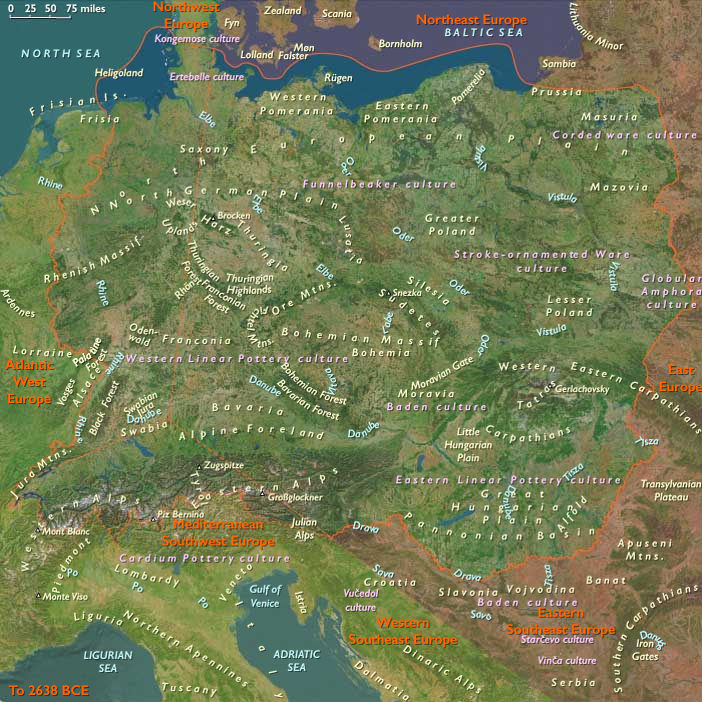
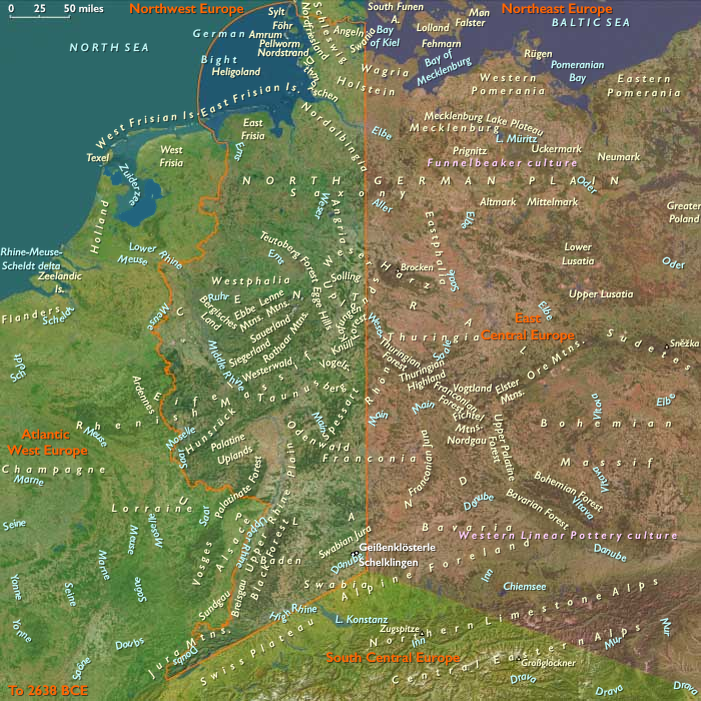
West Central Europe includes modern Germany west of 10°E and the Rhine-adjacent far northwest of Switzerland, including Basel and the eastern Jura Mountains.
-
After the Last Glacial Maximum, the Rhine corridor opened into more temperate environments.
-
Jura caves and river valleys served as stable habitation zones.
Climate and Environmental Shifts
-
The Late Glacial warming (c. 15,000 BCE) brought forest expansion.
-
The Younger Dryas (c. 12,900–11,700 BCE) reimposed cold, dry conditions.
-
The onset of the Holocene (after 11,700 BCE) ushered in forested landscapes and stable climates.
Societies and Political Developments
-
Magdalenian culture (c. 17,000–12,000 BCE) dominated, with rich art and hunter-gatherer societies.
-
Post-Magdalenian Mesolithic foragers adapted to forest ecologies, emphasizing fishing, small game, and nuts.
-
Social groups remained small and mobile, organized through kinship and ritual leaders.
Economy and Trade
-
Hunting: reindeer, red deer, aurochs, wild boar.
-
Fishing and shellfish expanded in Mesolithic riverine settings.
-
Trade networks moved flint, shells, and ornaments across hundreds of kilometers.
Subsistence and Technology
-
Magdalenian toolkits: blades, burins, microliths, harpoons.
-
Bone and antler harpoons specialized for fishing.
-
Artistic traditions: cave paintings, portable art, engraved antlers.
-
Mesolithic toolkits emphasized microlithic composites for arrows.
Movement and Interaction Corridors
-
Rhine–Moselle–Seine network facilitated mobility across northern and western Europe.
-
Jura highlands remained nodes of continuity for symbolic and settlement activity.
Belief and Symbolism
-
Rock art and decorated artifacts reflect hunting magic and cosmology.
-
Burials with grave goods demonstrate ancestor veneration and symbolic status.
Adaptation and Resilience
-
Broad-spectrum foraging buffered climate shifts.
-
Riverine adaptation ensured food stability.
-
Symbolic practices reinforced cohesion across scattered groups.
Long-Term Significance
By 7,822 BCE, West Central Europe had transitioned from Ice Age megafauna hunters toHolocene forest foragers, preserving symbolic and technological traditions while adapting to new ecologies.
Topics
Commodoties
Subjects
Regions
Subregions
Related Events
Showing 10 events out of 186 total
Years: 28577BCE - 7822BCE
Topics
Commodoties
Subjects
Regions
Subregions