
Event
East Central Europe (909 BCE – 819…
East Central Europe (909 BCE – 819 CE) Early Iron and Antiquity — Celts, Dacians, Sarmatians, Rome, and Early Slavs
Geographic and Environmental Context
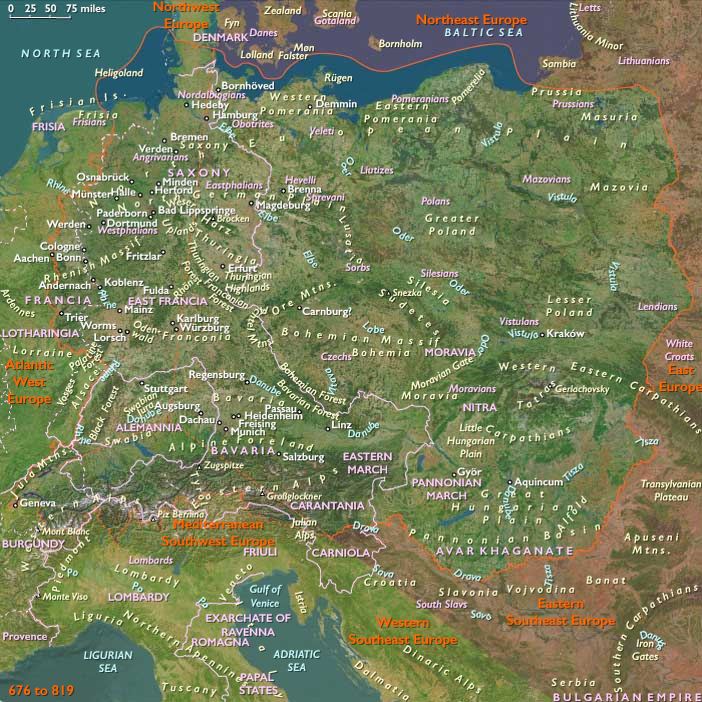
East Central Europe includes the greater part of Germany (including Berlin, Munich, Hamburg), Poland, Czechia (Bohemia and Moravia), Slovakia, Hungary, northeastern Austria, and the Danube basin through the Carpathian arc.
-
Anchors: La Tène Celtic towns (Bohemia, Danube), Dacian hillforts (Transylvania, Carpathians), Sarmatian steppe (Hungary Plain), Roman Pannonia/Noricum, Germanic Przeworsk–Wielbark in Poland, Slavic Prague–Korchak in later centuries.
Climate & Environmental Shifts
-
First-millennium variability; generally temperate, supporting dense agriculture.
Societies & Political Developments
-
Celts (La Tène) dominated 5th–1st c. BCE; established oppida and coinage.
-
Dacians built fortified towns in Transylvania; fought Rome.
-
Romans annexed Pannonia/Noricum (1st c. CE); towns, roads, villas flourished.
-
Sarmatian nomads entered Carpathian Basin (1st–4th c. CE).
-
Germanic tribes (Goths, Vandals, Lombards) moved through Poland–Danube (2nd–6th c. CE).
-
Slavic tribes expanded into Poland, Bohemia, Slovakia, Carpathian Basin (6th–9th c. CE).
-
Avars (6th–8th c.) created steppe empire in Carpathian Basin; Franks reached Bavaria; Byzantine influence extended to Danube frontier.
Economy & Trade
-
Agriculture intensified (plow, iron tools); vineyards, orchards.
-
Trade along Amber Route, Danube limes; Roman goods spread widely.
-
Slavic garden-farming with slash-and-burn in forests.
Technology & Material Culture
-
Iron weapons, tools; oppida walls; Roman villas, baths, roads.
-
Slavic handmade pottery; hillforts with timber ramparts.
Belief & Symbolism
-
Celtic polytheism, Dacian–Thracian cults; later Christianity spread via Rome and Byzantium.
-
Slavic animism persisted into 9th c.
Environmental Adaptation & Resilience
-
Agro-pastoral diversity buffered shocks; Roman infrastructure sustained exchange until collapse; Slavic subsistence flexibility supported expansion.
Legacy & Transition
By 819 CE, East Central Europe was a cultural crossroads: Celtic and Roman legacies, Dacian fortresses, Sarmatian horsemen, Avar steppe polities, and Slavic villages coexisted — laying foundations for the medieval polities of Moravia, Poland, and Hungary.
-
{# Image navigates to the detail page; the magnifying-glass chip is the only Fancybox lightbox trigger (kept a separate sibling — anchors can't nest). #}
 The Great Crossroads
World
-
{# Image navigates to the detail page; the magnifying-glass chip is the only Fancybox lightbox trigger (kept a separate sibling — anchors can't nest). #}
 Central Europe
Region
-
{# Image navigates to the detail page; the magnifying-glass chip is the only Fancybox lightbox trigger (kept a separate sibling — anchors can't nest). #}
 East Central Europe
Subregion
