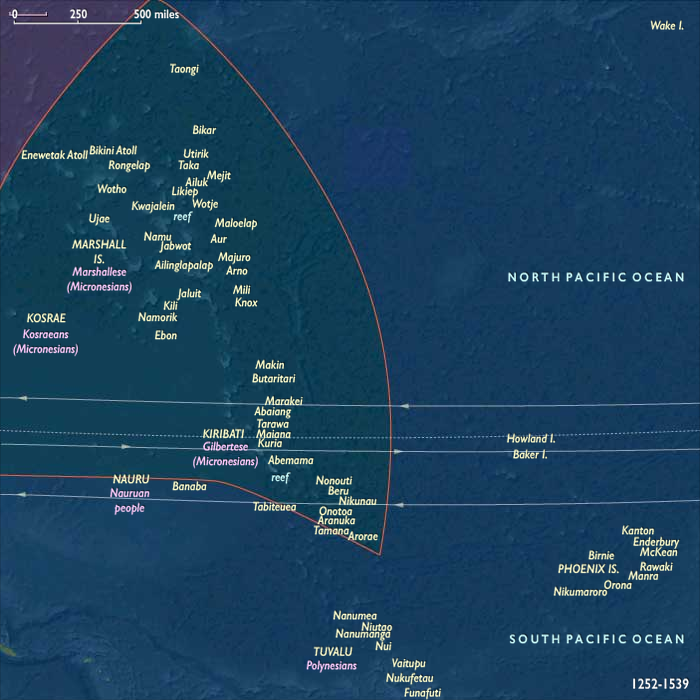
East Micronesia (1396–1539 CE): Oceanic Political Maturity…
1396 CE to 1539 CE
East Micronesia (1396–1539 CE): Oceanic Political Maturity and the Apex of Lelu
Geographic Parameters
East Micronesia remained a dispersed oceanic region whose communities occupied narrow atolls, lagoon shores, Nauru’s coastal belt, and Kosrae’s valleys and mangrove margins. Lelu formed a singular concentration of elite architecture within this overwhelmingly nonurban landscape.
Environmental Continuity
Increasing climatic variability may have subjected some atolls to repeated drought, shoreline change, and storm damage. Communities responded through deepened taro pits, stored breadfruit, protected groves, strict water management, reef tenure, and inter-island aid.
Kosrae’s rainfall and streams continued to support dense cultivation, although political concentration at Lelu required sustained tribute from productive districts elsewhere on the island.
Apex of Lelu
The major development of the age was the full maturity of Kosrae’s sacred political system.
Lelu flourished during approximately the fourteenth and fifteenth centuries as a center of royal residence, elite administration, ceremony, and burial. Its walled compounds and monumental tombs expressed the authority of Kosrae’s highest-ranking rulers and chiefs.
The city should nevertheless appear partially screened by vegetation, mangroves, waterways, and ordinary settlement. It was not a vast stone metropolis occupying the entire island.
Marshallese Navigational-Political Networks
Marshallese chiefs used established canoe routes to sustain alliances and tribute relationships across the Ralik and Ratak chains. Navigators, land stewards, and lineage leaders connected distant communities without erasing local autonomy.
Swell knowledge became an essential political resource. The ability to maintain contact after storms or during drought reinforced chiefly legitimacy and protected dispersed populations.
Kiribati Communal Polities
Kiribati communities developed mature systems of land tenure, communal deliberation, lineage precedence, and collective labor. The maneaba served increasingly as the visible institutional center of village life, but ordinary households, gardens, shoreline work areas, and canoe landings remained distributed through vegetation.
Political organization differed among northern, central, and southern islands and should not be flattened into one regional monarchy.
Nauruan Clan Society
Nauru maintained a compact, densely interconnected society organized through clans, land rights, fishing, and local alliances. Environmental limits restrained the growth of a large centralized court but encouraged detailed management of coastal land and reef resources.
Economy and Material Culture
Tree crops, taro, preserved foods, reef fishing, and pelagic voyaging remained foundational. Prestige exchange included fine mats, shell ornaments, sail materials, cordage, canoe parts, and ceremonial foods.
Kosraean stone construction reached its strongest expression, while atoll craftsmanship remained primarily vegetal, wooden, shell-based, and maritime.
Cultural Expression
Political authority was embedded in genealogy, sacred land, first-fruits rites, navigation traditions, oratory, dance, and communal feasting. Lelu represented the most architectural expression of these relationships, while the maneaba, canoe house, lineage grove, and reef passage remained equally important sacred institutions elsewhere.
Foreign Contact
European vessels had not yet imposed a durable presence. Any sightings or accidental encounters near the end of the age remained too rare to become a significant historical system or visual feature.
Adaptation and Resilience
Mature institutions redistributed food, organized voyages, and coordinated labor, but they remained dependent upon ecological restraint. Groves, reefs, freshwater lenses, and kin networks continued to govern the practical limits of power.
Legacy of the Age
By 1539 CE, East Micronesia had reached a period of oceanic political maturity. Lelu stood near its apex, Marshallese navigational chiefdoms linked multiple atolls, Kiribati communities maintained developed communal institutions, and Nauru preserved a resilient clan society.
The principal new system was the integration of mature political authority with established maritime networks. No outside power yet challenged indigenous control.
Images

East Micronesia in the Late Medieval (Upper) age
Topics
Subjects
Regions
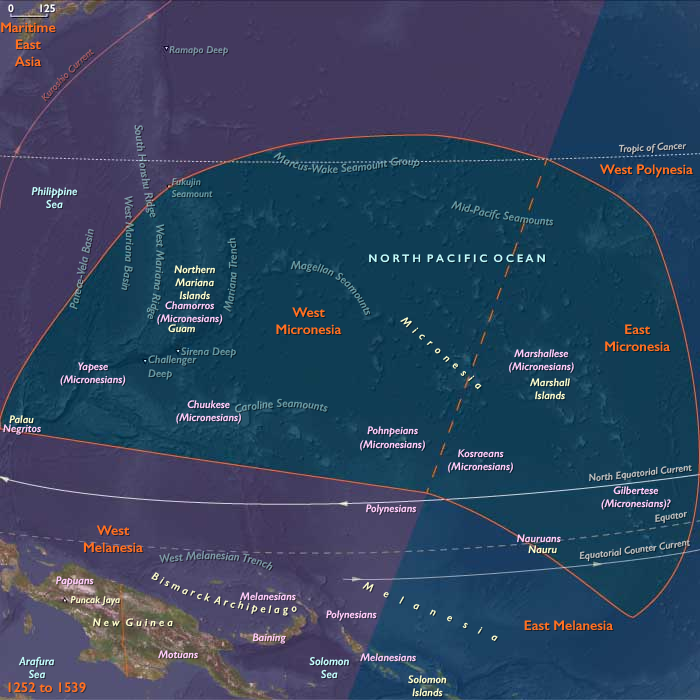
Micronesia
View →Subregions