East Micronesia (1828–1971 CE): Missions, Colonial Partition,…
1828 CE to 1971 CE
East Micronesia (1828–1971 CE): Missions, Colonial Partition, War, Extraction, and Decolonization
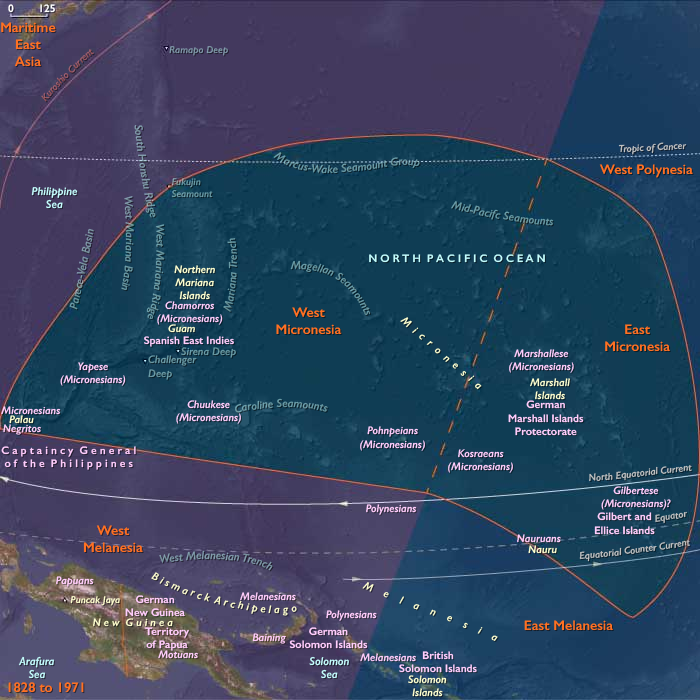
Geographic Parameters
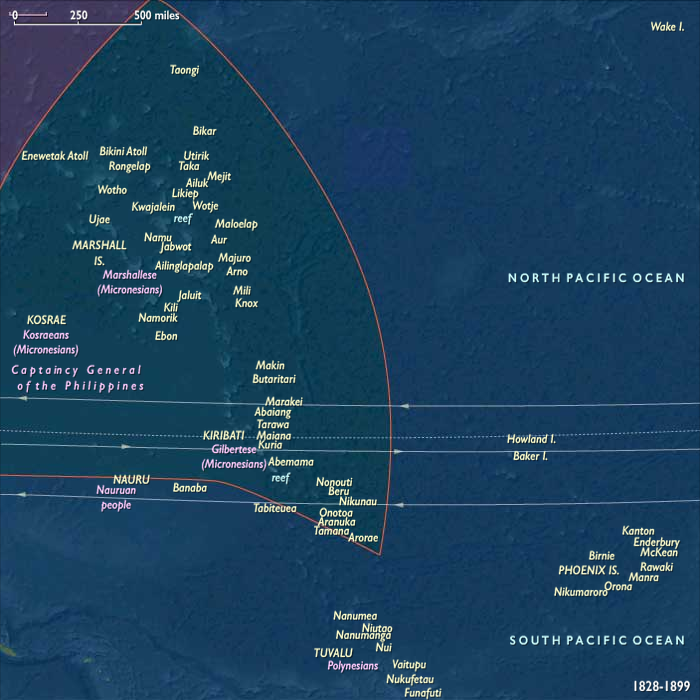
East Micronesia continued to comprise the Marshall Islands, the Kiribati groups assigned to the subregion, Nauru, and Kosrae. Their historical trajectories diverged sharply under different missions, commercial networks, colonial governments, military occupations, and postwar administrations.
The low atolls remained dependent upon reefs, lagoons, tree crops, and fragile freshwater lenses. Nauru’s uplifted plateau became the site of intensive phosphate extraction, while Kosrae retained its mountainous, stream-fed, forested environment despite demographic and political upheaval.
Missionization and Demographic Disruption
The first major transformation was the establishment of permanent foreign religious and commercial institutions.
Missionaries introduced churches, schools, literacy, translated scripture, hymnody, new marriage rules, and foreign moral codes. Indigenous teachers and converts became central to the spread of Christianity, making conversion more than a purely external imposition.
Kosrae underwent particularly severe nineteenth-century demographic decline from introduced diseases and disruption associated with foreign shipping. Christian institutions increasingly displaced the sacred royal order associated with Lelu, although Kosraean kinship, land tenure, language, and communal identity survived.
In the Marshalls, Kiribati, and Nauru, Protestant and Catholic missions developed alongside existing chiefly, clan, and communal systems. Churches became important local centers without wholly eliminating traditional authority.
Commercial Copra Production
Coconut groves acquired a new role as sources of copra for global markets. Traders established coastal stations, exchanged imported goods, offered credit, and encouraged households to redirect labor toward commercial production.
Copra did not immediately replace subsistence. Families continued fishing, tending breadfruit and pandanus, cultivating taro, and maintaining kinship obligations while producing export crops.
Imported tools, cloth, boats, firearms, kerosene, sewing equipment, and manufactured goods became increasingly common, but their distribution remained uneven.
Conflict and Colonial Intervention
Foreign weapons and commercial competition intensified some local disputes. Nauru experienced destructive internal conflict during the nineteenth century before German annexation in 1888 imposed external control.
Germany established authority in the Marshall Islands during the 1880s, annexed Nauru in 1888, and acquired Kosrae with Spain’s former Caroline claims in 1899. Britain declared a protectorate over the Gilbert Islands in 1892; the protectorate later became part of the Gilbert and Ellice Islands Colony. Kiribati itself would not become independent until 1979.
These colonial systems remained administratively separate. East Micronesia was never governed as one colonial territory.
Phosphate Extraction on Nauru
The discovery of commercially valuable phosphate produced the age’s most extensive extractive transformation.
Systematic mining began in the early twentieth century, removing phosphate-rich deposits from Nauru’s central plateau. The process stripped vegetation and soil, leaving limestone pinnacles and progressively confining ordinary settlement and agriculture to the coastal belt.
Mining linked Nauru to Australian and wider imperial agricultural economies while transferring much of the material benefit abroad. Phosphate extraction began in 1906 and continued through successive German, Australian, Japanese, and postwar administrations.
Colonial Succession after 1914
Japan seized Germany’s Micronesian possessions during the First World War and later administered the Marshall Islands and Kosrae under the South Seas Mandate. Japanese rule brought more intensive government supervision, schooling, communications, shipping, commercial regulation, and selected infrastructure.
Nauru was occupied by Australian forces and placed under an administrative arrangement involving Australia, Britain, and New Zealand. The Gilbert Islands remained under British colonial rule.
Colonial buildings, ports, radio towers, roads, and commercial facilities remained concentrated in limited districts. Most inhabited shorelines continued to contain indigenous houses, gardens, churches, fishing areas, and canoe landings.
Second World War
The principal political rupture of the middle twentieth century was militarization.
Japan fortified the Marshall Islands and Kosrae with airfields, bunkers, gun emplacements, roads, barracks, communications sites, and coastal defenses. Japanese forces also occupied the Gilbert Islands and Nauru.
Battles at Tarawa, Kwajalein, Enewetak, and other islands brought bombardment, mass casualties, displacement, and widespread destruction. Military infrastructure became locally dominant at selected sites but did not occupy the entire regional landscape.
Nauru was occupied by Japan from 1942 to 1945. Many Nauruans were deported to Chuuk and subjected to forced labor, hunger, disease, and high mortality.
Postwar Trusteeship
After the war, the Marshall Islands and Kosrae entered the American-administered Trust Territory of the Pacific Islands. Nauru became a United Nations trust territory administered principally by Australia on behalf of Australia, Britain, and New Zealand. The Gilbert Islands returned to British administration.
Schools, clinics, government offices, airfields, radios, motor launches, imported building materials, and wage employment expanded. Administrative centers became more densely built, but ordinary households continued fishing, gardening, gathering, attending churches, and maintaining communal land rights.
Imported food and government salaries gradually increased dependence upon external systems, particularly where war, displacement, mining, or military occupation had damaged older productive landscapes.
Nuclear Testing in the Marshall Islands
The age’s most severe military-environmental transformation occurred at Bikini and Enewetak.
Between 1946 and 1958, the United States conducted 67 nuclear tests in the Marshall Islands. Bikini and Enewetak communities were displaced, islands were physically transformed, and radioactive contamination affected additional populations and environments.
This nuclear system was geographically concentrated but historically overwhelming. It should not visually convert every Marshallese atoll into a military base; rather, selected test and administrative zones must appear embedded within a much larger surviving atoll world.
Displacement disrupted the relationship between lineage, land, reef, burial place, and identity. Marshallese petitions, testimony, songs, and political campaigns turned nuclear experience into a central issue of justice and self-determination.
Political Mobilization
Postwar education and representative institutions enabled new forms of political organization. Islanders increasingly challenged colonial control, demanded compensation, asserted customary land rights, and debated independence, autonomy, or association.
Nauru rejected proposals for permanent resettlement abroad, secured greater control over phosphate, and achieved independence in 1968. Kiribati remained a British colony until 1979, while the Marshall Islands and Kosrae continued within the American trust territory beyond 1971.
By the end of the age, independence and constitutional self-government had become practical political objectives rather than distant aspirations.
Indigenous Continuity
Despite profound disruption, indigenous institutions remained visible.
Marshallese matrilineal land rights, chiefly relationships, navigation knowledge, fishing, and communal obligations survived German, Japanese, and American rule.
Kiribati communities retained the maneaba, lineage landholding, fishing traditions, vernacular culture, and locally organized churches beneath British administration.
Kosrae preserved communal land relationships, food production, oral tradition, and the cultural memory of Lelu through missionization, depopulation, colonial succession, war, and trusteeship.
Nauru maintained clan identity and political cohesion despite the destruction of much of its interior landscape.
Legacy of the Age
Between 1828 and 1971, permanent missions and commerce were followed by colonial partition, phosphate extraction, Japanese administration, global war, American trusteeship, nuclear testing, and organized decolonization.
The principal new historical system was externally imposed territorial administration, but it accumulated in stages rather than appearing all at once. Commercial and religious institutions preceded formal rule; colonial rule preceded militarization; militarization preceded trusteeship and independence movements.
By 1971, Nauru had attained sovereignty. Kiribati, the Marshall Islands, and Kosrae had not yet reached their later constitutional settlements, but political power was increasingly contested by island leaders and communities.
The age ended not with completed regional independence but with Indigenous political reassertion emerging from landscapes profoundly altered—yet not wholly erased—by empire, extraction, war, and nuclear power.