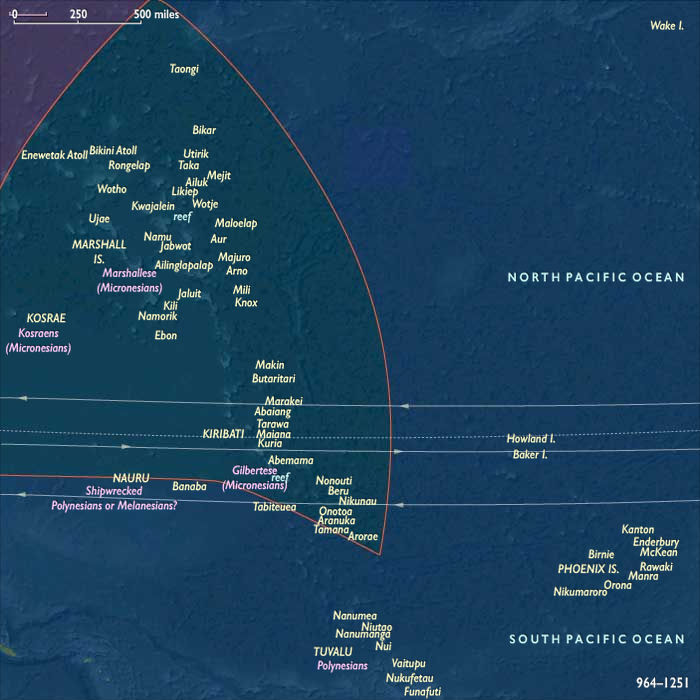
East Micronesia (964–1107 CE): Expanding Chiefly Coordination…
964 CE to 1107 CE
East Micronesia (964–1107 CE): Expanding Chiefly Coordination and Managed Atoll Landscapes
Geographic Parameters
The region retained its contrast between the Marshallese and Kiribati atoll chains, uplifted Nauru, and volcanic Kosrae. Lagoons and reef passages remained the primary corridors of communication, while productive land was concentrated in narrow coastal strips, managed groves, taro depressions, and Kosrae’s stream-fed valleys.
Environmental Continuity
Climatic variability continued to affect freshwater lenses and tree crops. Communities responded through more deliberate management of groves, taro pits, preserved foods, reef sectors, and labor.
Settlement remained distributed rather than urban. Houses, canoe shelters, work areas, gardens, and burial grounds were separated by palms, pandanus, scrub, mangroves, and undeveloped shoreline intervals.
Chiefly Coordination
The major development of the age was the expansion of political coordination beyond the individual household community.
In the Marshall Islands, chiefly lineages increasingly coordinated labor, tribute, voyages, fishing rights, and the allocation of productive land across more than one islet. Authority remained dependent upon lineage consent and the practical ability to redistribute resources.
Kiribati communities strengthened councils of elders and collective institutions concerned with land, water, conflict resolution, and communal labor. Political forms varied considerably from island to island and should not be rendered as a single uniform chiefdom system.
Nauru’s clans maintained localized authority. Leadership could become influential during disputes, exchange, ritual, or collective work, but no island-wide monarchy emerged.
Kosrae developed stronger distinctions among leading lineages, ritual specialists, and ordinary households. Coordinated feasting, tribute, and communal construction began to provide foundations for later sacred centralization, but large monumental compounds remained a future development.
Agriculture and Fisheries
Tree-crop landscapes became more carefully maintained. Coconut and pandanus supplied durable materials as well as food, while breadfruit yields supported larger seasonal gatherings. Taro pits were deepened, composted, and protected from salinity.
Fishing rights became more visibly associated with lineage and chiefly authority. Collective fish drives, tidal traps, and reef-sector restrictions allowed communities to coordinate harvesting and prevent immediate depletion.
Kosrae’s productive valleys supported surplus cultivation and increasingly formal systems of tribute and ceremonial redistribution. Nauru’s households combined reef fisheries with coconut, pandanus, and limited cultivation on suitable soils.
Canoe Technology and Navigation
Canoe specialists refined hull construction, lashings, sails, steering methods, and the balancing of outriggers. Long-distance voyages remained dangerous and specialized rather than routine for the entire population.
Navigational knowledge grew increasingly associated with trained experts and inherited teaching traditions. Star paths and swell sequences were memorized as ordered bodies of knowledge rather than learned only through casual experience.
Exchange and Redistribution
Voyaging connected neighboring Marshallese atolls and linked Kiribati island clusters through marriage, food exchange, canoe materials, mats, and ritual obligations. Redistribution after droughts and storms increased the political importance of chiefs, elders, and navigators.
Kosrae participated in maritime exchange but did not dominate or provision the entire subregion. Its importance remained strongest within its own island and nearby oceanic relationships.
Belief and Social Memory
Chiefly and lineage authority drew legitimacy from founding ancestors, migration histories, sacred land, and successful control of food production. Canoe builders and navigators held prestige because their knowledge protected communities from isolation and scarcity.
Feasting joined political authority to agricultural productivity. Breadfruit, taro, fish, mats, and valued objects were presented in ceremonies that reaffirmed obligations among households and ranked lineages.
Adaptation and Resilience
More coordinated labor allowed communities to restore storm-damaged groves, deepen taro pits, repair canoe fleets, and assist vulnerable households. Political development therefore emerged from productive cooperation before becoming an independent display of authority.
Legacy of the Age
By 1107 CE, chiefly and communal institutions had grown more capable of organizing resources across multiple settlements. The most important new historical system was coordinated redistribution through expanding local authority.
East Micronesia remained environmentally fragmented and politically plural. The landscape was still dominated by groves, lagoons, reefs, household districts, and canoe routes rather than ceremonial architecture.
Images
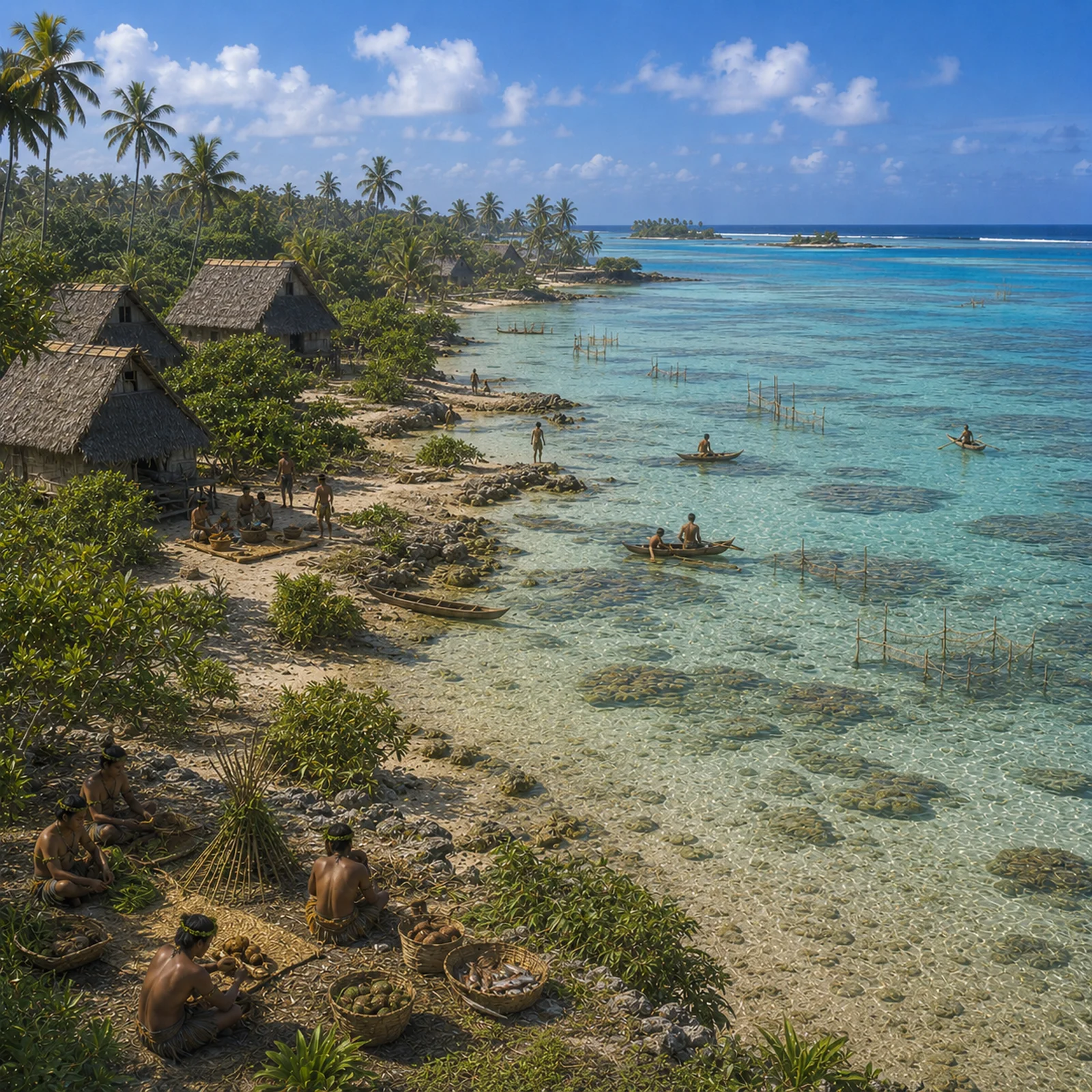
East Micronesia in the High Medieval (Lower ) age
Commodities
Subjects
Regions
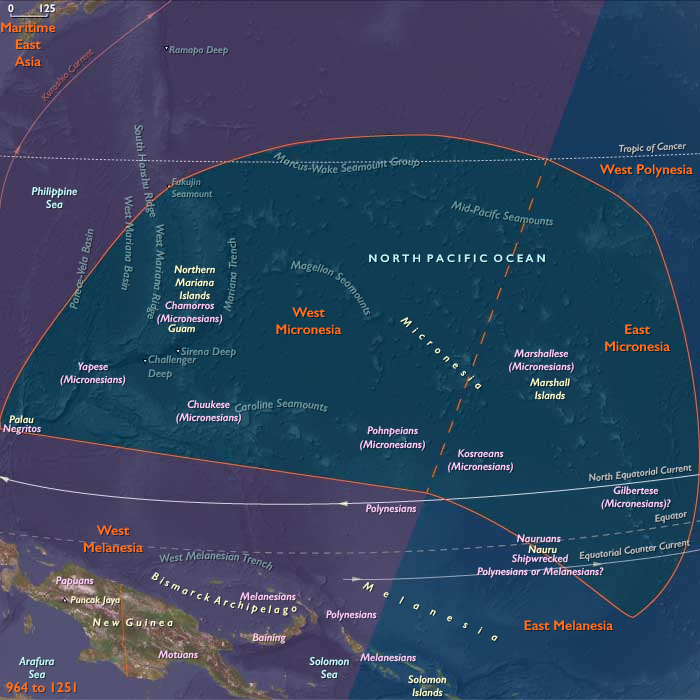
Micronesia
View →Subregions