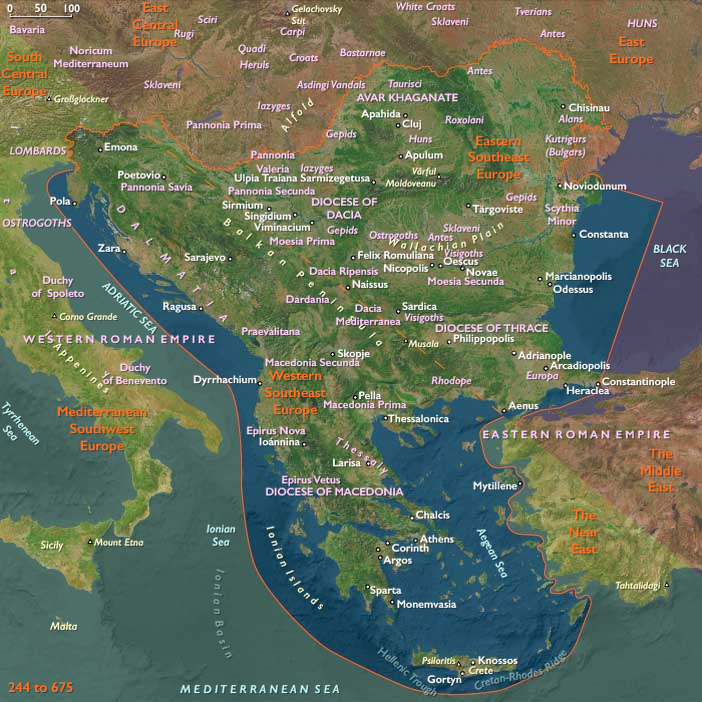
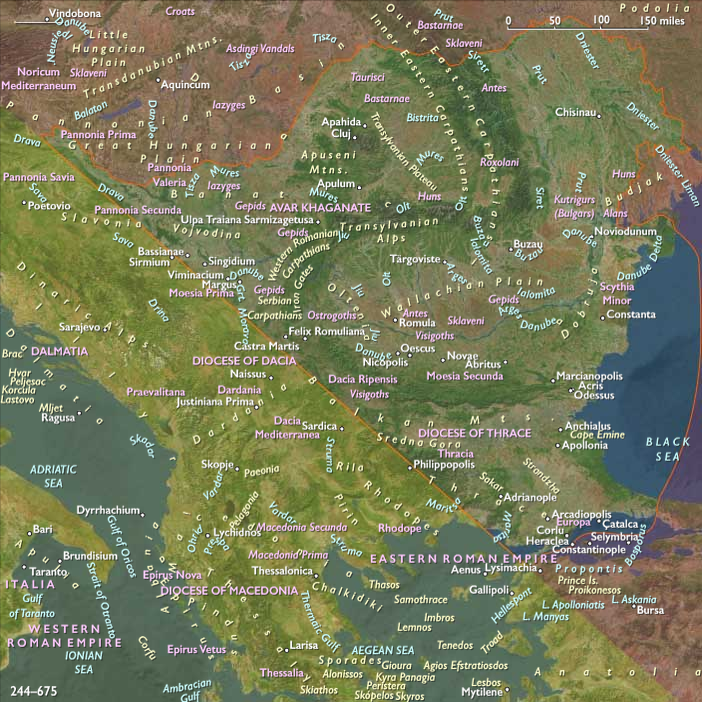
Eastern Emperor Leo I founds the Excubitors …
Years: 460 - 460
Eastern Emperor Leo I founds the Excubitors (Imperial Guard) at Constantinople; this elite tagmatic unit (three hundred men) is recruited from among the warlike Isaurians of southern Anatolia.
Locations
People
Groups
- Isaurians
- East, or Oriens, Praetorian prefecture of
- Roman Empire, Western (Ravenna)
- Roman Empire, Eastern: Leonid dynasty
Topics
Subjects
Regions
Subregions
Related Events
Filter results
Showing 10 events out of 118 total
The handsome, athletic young king stands in sharp contrast to his wary, miserly father.
Henry's lavish court quickly drains the treasury of the fortune he had inherited.
He married the widowed Catherine of Aragon, and they have several children, but none survive infancy except a daughter, Mary.
In 1512, the young king embarks on a war in France.
Although England is an ally of Spain, one of France's principal enemies, the war is mostly about Henry's desire for personal glory, regardless of the fact that his sister Mary is married to the French king Louis XII.
The war accomplishes little.
The English army suffers badly from disease, and Henry is not even present at the one notable victory, the Battle of the Spurs.
Meanwhile, James IV of Scotland (despite being Henry's other brother-in-law), activates his alliance with the French and declares war on England.
While Henry is dallying in France, Catherine, who is serving as regent in his absence, and his advisers are left to deal with this threat.
At the Battle of Flodden on September 9, 1513, the Scots are completely and totally defeated.
Most of the Scottish nobility are killed along with James himself.
When Henry returns from France, he is given credit for the victory even though he had had nothing to do with it.
Southern Italy comes under Spanish control in the opening years of the sixteenth century, but while France dominates the northern half of the peninsula, Venice seems to pose a new threat.
In response, France, the Holy Roman Empire, the papacy, and Spain form the League of Cambrai in 1508, reigniting the Italian Wars.
Northwest Europe (1504–1515 CE): Diplomacy, Renaissance Flourishing, and Religious Precursors
England: Diplomatic Maneuvering and Dynastic Ambitions
Under Henry VII, England continued its cautious yet effective foreign policy, ensuring internal stability and diplomatic alliances. Henry further secured his dynasty by arranging the marriage of his surviving son, Prince Henry, to Catherine of Aragon in 1509, after obtaining papal dispensation due to her previous marriage to Henry’s elder son Arthur. Following Henry VII’s death in the same year, Henry VIII ascended the throne, initiating a dynamic yet turbulent reign. The new king quickly demonstrated his ambition and martial aspirations, engaging in conflicts such as the Battle of the Spurs against France in 1513, securing English prestige on the European stage. Meanwhile, at home, the English Renaissance deepened, driven by increased patronage of arts and humanist scholarship. Notably, poet and satirist John Skelton flourished during this period, serving as "regius orator" and poet laureate to Henry VIII and writing influential works such as Phyllyp Sparrowe and The Bowge of Court, which fiercely satirized contemporary church and court life.
Scotland: Renaissance Peak and Flodden Disaster
Under James IV, Scotland experienced a cultural and intellectual renaissance marked by increased patronage of arts and learning, including the flourishing of poetry and the establishment of the first printing press in Edinburgh by Walter Chepman and Andrew Myllar in 1508. However, James’s political ambitions led him into the conflict with England known as the Battle of Flodden in 1513. The battle was catastrophic for Scotland, resulting in James IV’s death and significant losses among Scottish nobility, leading to political instability as his infant son, James V, ascended the throne under a regency.
Ireland: Gaelic Resilience Amid English Encroachment
Gaelic Ireland continued to sustain considerable autonomy, with powerful dynasties such as the Fitzgeralds of Kildare maintaining significant influence. The English crown’s attempts to assert greater control beyond The Pale remained limited, often relying on the support or cooperation of local Gaelic lords. Cultural and political structures under traditional Gaelic law (Brehon law) persisted robustly, reflecting the enduring Gaelic identity despite intermittent pressures from English authorities.
Scandinavia: Ongoing Strife Within the Kalmar Union
The Kalmar Union, now led by King Christian II, faced continued internal discord, notably in Sweden, where nationalist sentiments increasingly threatened union stability. Christian’s attempts at centralization and increased control sparked resistance and ongoing unrest, setting the stage for future conflicts. In Denmark and Norway, Christian II’s reign was marked by attempts to reform administration and reduce aristocratic power, foreshadowing turbulent political changes ahead.
Iceland: Literary Preservation and Economic Struggles
Iceland persisted in maintaining its rich literary tradition despite economic hardships and geographic isolation. Manuscript production remained central, preserving sagas, poetry, and essential historical documents. Icelandic identity and cultural integrity remained resilient, with local scholars meticulously safeguarding their heritage through continued literary production and scholarly endeavors.
Cultural and Intellectual Growth
Cultural flourishing continued across Northwest Europe, prominently in England and Scotland. The English court increasingly supported humanist scholarship, exemplified by figures such as John Colet and Thomas More, who championed educational and ecclesiastical reform, influencing future developments in English religious and intellectual life. Oxford’s Magdalen College, with its iconic Magdalen Tower completed in 1509, and other institutions continued to be centers of scholarly pursuit and architectural distinction. The Tudor architectural style increasingly reflected European influences, characterized by symmetrical plans and ornate detailing, marking a transition from Gothic forms.
Early Explorations and Emerging Global Ambitions
Maritime exploration efforts, initially led by John Cabot’s voyages in the late fifteenth century, laid groundwork for future English colonial aspirations. Interest in new routes and territories grew steadily, though direct English colonial establishments remained limited during this era. Nevertheless, these early voyages fostered increased curiosity and ambition for global exploration and trade expansion.
Prelude to Reformation
The era saw the early stirrings of religious dissent and critique of the established Church, anticipating broader reformist movements. Influential humanists and intellectuals began openly questioning ecclesiastical authority and practices, setting the intellectual stage for forthcoming religious upheavals.
Legacy of the Era
By 1515 CE, Northwest Europe had seen significant diplomatic, cultural, and intellectual progress, alongside deepening tensions and emerging ambitions that would define subsequent decades. The foundations laid during this era—marked by humanist learning, dynastic consolidation, and nascent global aspirations—significantly shaped the trajectory of future historical developments.

Julius, although unsatisfied with his gains, does not himself possess sufficient forces to fight the Republic; for the past two years he has instead occupied himself with the reconquest of Bologna and Perugia, which, located between Papal and Venetian territory, have in the meantime assumed a status of quasi-independence.
Julius returns in 1507 to the question of the cities in Venetian hands; once again rebuffed by the Senate, he encourages Emperor Maximilian I to attack the Republic.
The Navarrese Struggle for Stability and Ferdinand II’s Influence (1507–1508)
Since the mid-15th century, Navarre had been plagued by internal instability, with two major warring factions—the Beaumonts and the Agramonts—constantly vying for power. This instability made Navarre a target for external meddling, particularly from Castile and Aragon under Ferdinand II.
Navarre’s Political Factions and the Castilian Protectorate (1476–1507)
- The Beaumonts (aligned with Castile) and the Agramonts (aligned with France) had been locked in a power struggle.
- In 1476, Ferdinand II of Aragon effectively turned Navarre into a Castilian protectorate, using a mix of alliances and military influence.
- However, from 1482 to 1492, Ferdinand and Isabella were preoccupied with the conquest of Granada, temporarily shifting focus away from Navarre.
- After the fall of Granada (1492) and the death of Isabella I (1504), Ferdinand renewed his pressure on Navarre.
Ferdinand’s Marriage and Renewed Claims on Navarre (1506–1507)
- In 1506, Ferdinand married Germaine of Foix, daughter of John of Foix, Viscount of Narbonne, a claimant to the Navarrese throne.
- This move strengthened Ferdinand’s claim to Navarre through any potential heirs and was meant to undermine his son-in-law, Philip I of Castile.
- By 1507, Ferdinand had regained control of Castile as regent, allowing him to focus once again on Navarre.
The Rebellion of the Count of Lerín and Cesare Borgia’s Death (1507)
- In 1507, Louis de Beaumont, Count of Lerín, Ferdinand’s key ally in Navarre, revolted along with other Beaumont faction lords.
- The ruling monarchs of Navarre, Catherine I and John III of Albret, refused to negotiate with the rebels, declaring that no pardon would be granted to the Count of Lerín.
- During the Battle of Viana (1507), Cesare Borgia, the famous Italian condottiero, fighting for John III of Navarre, was killed by Beaumont knights.
The Defeat of the Beaumont Rebellion (1508)
- After a year-long standoff, in 1508, the Navarrese crown launched an offensive against the Count of Lerín.
- Lerín was occupied, and Louis de Beaumont suffered a severe defeat.
- This marked a temporary victory for the Navarrese monarchy against Ferdinand’s Castilian-backed allies.
Conclusion: The Path to Castilian Annexation
- Despite this victory, Navarre’s independence remained fragile, as Ferdinand continued to seek control over the kingdom.
- By 1512, Castile would invade Navarre outright, completing its annexation under Ferdinand II.
- The conflicts of 1507–1508 were a precursor to the final conquest, demonstrating Navarre’s vulnerability to both internal division and external pressures.
The Count of Lerín’s rebellion and Cesare Borgia’s death in 1507 were key moments in the larger struggle between Navarre and Castile, ultimately leading to Navarre’s downfall and absorption into the Spanish Crown.
Maximilian, using his journey to Rome for the Imperial coronation as a pretext, enters Venetian territory with a large army in February 1508 and advances on Vicenza, but is defeated by a Venetian army under Bartolomeo d'Alviano.
A second assault by a Tyrolean force several weeks later is an even greater failure; Alviano not only routs the Imperial army but also seizes Trieste and Fiume, forcing Maximilian to conclude a truce with Venice.
Julius, humiliated by the failure of the Imperial invasion, turns to Louis XII of France (who, having been left in possession of Milan after the Second Italian War, is interested in further expansion into Italy) with an offer of alliance.
In mid-March, the Republic provides a pretext for an attack on itself by appointing her own candidate to the vacant bishopric of Vicenza (an act in keeping with prevailing custom, though Julius considers it a personal provocation); the Pope calls for all Christian nations to join him in an expedition to subdue Venice.
Formation of the League of Cambrai Against Venice (1508)
On December 10, 1508, representatives of the Papacy, France, the Holy Roman Empire, and Ferdinand of Spainconcluded the League of Cambrai, a powerful coalition aimed explicitly against the territorial and economic dominance of the Republic of Venice. Negotiated at Cambrai, the alliance was designed to dismantle Venice’s extensive territorial holdings in Italy and redistribute them among the participating powers, significantly reshaping the political balance within Atlantic West Europe and the Italian Peninsula.
Terms and Objectives
The agreement stipulated the systematic partitioning of Venetian territories, with each signatory receiving strategically significant lands:
- Holy Roman Emperor Maximilian I would recover Istria and gain control of Verona, Vicenza, Padua, and Friuli, significantly expanding imperial influence in northern Italy.
- France, under King Louis XII, aimed to integrate wealthy Lombard cities such as Brescia, Crema, Bergamo, and Cremona into its existing possessions centered around Milan.
- Ferdinand of Spain planned the seizure of strategic port city Otranto, consolidating Spanish influence in southern Italy.
- The Papacy, under Pope Julius II, sought to add Rimini, Ravenna, and surrounding territories to the Papal States, thereby expanding papal sovereignty.
This coalition represented an unprecedented diplomatic alliance among Europe's leading powers, united by their shared hostility toward Venetian economic dominance, political influence, and territorial expansion.
Political and Strategic Significance
The League of Cambrai dramatically underscored Europe's emerging power dynamics, illustrating the fluidity of alliances and the extent to which territorial ambition and economic interests drove diplomatic engagements. Venice, previously viewed as economically indispensable and diplomatically astute, suddenly faced existential threats from a broad European coalition, revealing the fragility of its power despite centuries of commercial strength and political resilience.
Consequences and Legacy
The League of Cambrai initiated the War of the League of Cambrai (1508–1516), a conflict that drastically altered Italy’s geopolitical landscape. Though initially successful in significantly weakening Venice, the League quickly unraveled due to internal rivalries among its members, allowing Venice to regain some of its lost territories. Nevertheless, the episode vividly demonstrated the shifting power dynamics in early 16th-century Europe and foreshadowed the era’s prolonged struggles for dominance, influencing diplomatic strategies and alliances for decades to come.
Francesco Guicciardini, schooled in classics and law, in 1509 writes a history of the contemporary Italian wars, as well as of Florence, his native city, before embarking on his brilliant political career.
Years: 460 - 460
Locations
People
Groups
- Isaurians
- East, or Oriens, Praetorian prefecture of
- Roman Empire, Western (Ravenna)
- Roman Empire, Eastern: Leonid dynasty