
Eastern West Indies (1492–1503 CE): Encounter, Conquest, …
Years: 1492 - 1503
Eastern West Indies (1492–1503 CE): Encounter, Conquest, and Transformation
The Pre-Columbian Caribbean
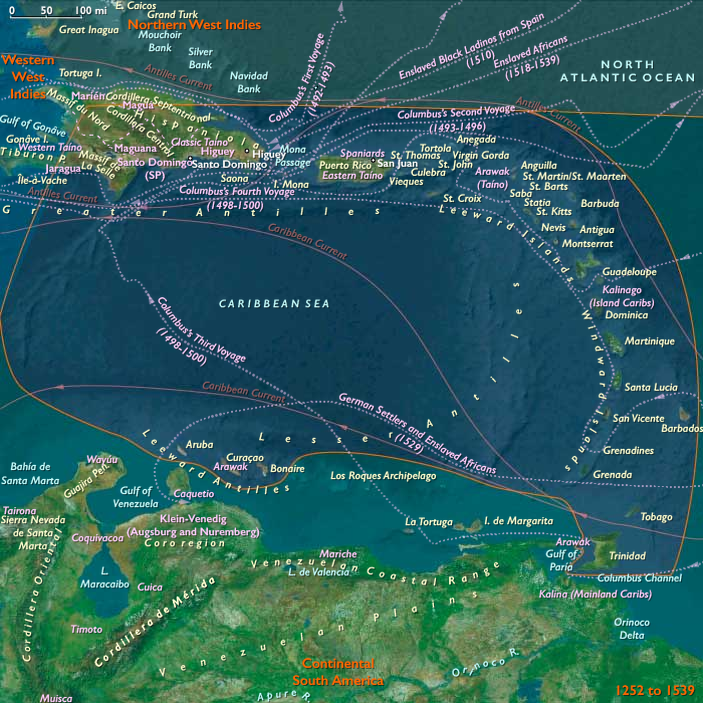
At the dawn of European arrival in 1492, the islands of the Eastern West Indies—encompassing present-day Haiti, the Dominican Republic, Puerto Rico, and the Lesser Antilles—were inhabited primarily by three indigenous groups: the Guanahatabey (formerly called Ciboney), the Taíno, and the Kalinago (Caribs). The Taíno, an Arawakan-speaking people, occupied most of the Greater Antilles, including Puerto Rico and Hispaniola (Haiti and the Dominican Republic). The Kalinago, renowned for their warrior traditions, predominantly inhabited the Lesser Antilles, and the Guanahatabey occupied parts of western Cuba and the Bahamas.
Estimates of the pre-Columbian Caribbean population vary widely. Early observers like Father Bartolomé de Las Casas suggested figures reaching several million for Hispaniola alone, although contemporary scholarship tends to favor lower numbers, typically under one million for the entire Caribbean.
European Arrival and the Treaty of Tordesillas (1492–1494)
Christopher Columbus, sailing under the Spanish crown, first reached the Bahamas in 1492, inaugurating European exploration and colonization of the Caribbean. Initially seeking a maritime route to East Asia, Columbus mistook the islands for lands near India, hence the enduring misnomer "West Indies" and "Indians."
In 1494, the Treaty of Tordesillas divided the non-Christian world between Spain and Portugal along an imaginary line in the Atlantic Ocean. Spain received claims west of the line, encompassing most of the Caribbean islands, while Portugal retained territories east, notably including Brazil. This division facilitated rapid Spanish colonization efforts in the Eastern West Indies.
Cultural and Economic Encounter
The wealth of the indigenous Caribbean people appeared modest to the Europeans, who sought gold, spices, and lucrative trade commodities. Native Antilleans, however, used gold ornamentally and exhibited little interest in trade beyond local exchanges. Their possessions were primarily functional—wooden stools, hammocks, clay bowls, and large dugout canoes. Notably, some canoes, such as those found in Jamaica, were capable of transporting dozens of individuals.
Subsistence among the Taíno and related groups relied heavily on hunting, fishing, and agriculture. They grew maize, beans, squash, and cassava, hunted terrestrial animals, and utilized sophisticated fishing methods including hooks, nets, and even trained remoras (small suckerfish) to catch larger marine animals.
Impact of European Conquest and Colonization
Columbus' arrival marked a devastating turning point. Native populations suffered catastrophic declines due to diseases like smallpox, measles, malaria, and dysentery, introduced by Europeans and enslaved Africans. Societies were forcibly reorganized, cultures suppressed in favor of Christianity, and economies subjugated to profit-driven European demands.
The Spanish swiftly imposed the encomienda system, granting colonizers rights to indigenous labor and tribute, further exacerbating population losses and societal disruption. Columbus' governance proved ineffective and increasingly oppressive, leading to his eventual loss of administrative control.
The Expansion of European Influence
Despite initial disappointment in finding little gold, European interest persisted, particularly after 1500 when Pedro Álvares Cabral officially claimed Brazil for Portugal. The expanding European presence irreversibly reshaped the region's demographic and cultural landscapes.
By the early sixteenth century, the Caribbean had become integrally connected to broader Atlantic commercial networks, dependent on forced labor and marked by European dominance.
Key Developments (1492–1503 CE)
-
1492: Columbus arrives in the Bahamas and Hispaniola, initiating European exploration of the Caribbean.
-
1494: Treaty of Tordesillas divides New World territories between Spain and Portugal.
-
1499: Limited gold deposits discovered on Hispaniola.
-
1500: Pedro Álvares Cabral claims Brazil for Portugal, solidifying Portuguese presence in the Americas.
-
1502: Columbus' final voyage; administrative and commercial authority increasingly stripped by Spanish monarchs.
Long-Term Consequences and Historical Significance
This era fundamentally transformed the Caribbean, laying the foundations for centuries of colonial exploitation, demographic upheaval, and cultural integration. The indigenous population’s precipitous decline drastically altered the region’s ethnic and cultural makeup, setting the stage for the extensive African slave trade, plantation economies, and the complex, multicultural societies that characterize the Caribbean today.
People
Groups
- Arawak peoples (Amerind tribe)
- Taíno
- Kalinago (Amerind tribe)
- Castillian people
- Aragon, Crown of
- Castile, Crown of
- Santo Domingo, Captaincy General of
- Brazil, Colonial
Topics
- Formative Stage (Americas)
- Colonization of the Americas, Portuguese
- Colonization of the Americas, Spanish
Commodoties
Subjects
- Commerce
- Sculpture
- Labor and Service
- Decorative arts
- Games and Sports
- Faith
- Government
- Custom and Law
Regions

Subregions
Years: 1492 - 1503
People
Groups
- Arawak peoples (Amerind tribe)
- Taíno
- Kalinago (Amerind tribe)
- Castillian people
- Aragon, Crown of
- Castile, Crown of
- Santo Domingo, Captaincy General of
- Brazil, Colonial
Topics
- Formative Stage (Americas)
- Colonization of the Americas, Portuguese
- Colonization of the Americas, Spanish
Commodoties
Subjects
- Commerce
- Sculpture
- Labor and Service
- Decorative arts
- Games and Sports
- Faith
- Government
- Custom and Law
Regions
Subregions