William Hogarth completes the earliest of the…
1731 CE
William Hogarth completes the earliest of the series of moral works that first give him his position as a great and original genius.
This is A Harlot's Progress, first as paintings (now lost), and then published as engravings in 1731.
The miserable fate of a country girl who began a prostitution career in town is traced out remorselessly in its six scenes from its starting point, the meeting of a bawd, to its shameful and degraded end, the whore's death of venereal disease and the following merciless funeral ceremonial.
The series is an immediate success.
The work of Hogarth, who has been credited as a pioneer in western sequential art, ranges from excellent realistic portraiture to comic strip-like series of pictures called “modern moral subjects.”
Much of his work, though at times vicious, pokes fun at contemporary politics and customs.
Early satirical works included an Emblematical Print on the South Sea Scheme about the disastrous stock market crash of 1720.
In the bottom left corner, he shows Protestant, Catholic, and Jewish figures gambling, while in the middle there is a huge machine, like a merry-go-round, which people are boarding.
At the top is a goat, written below which is "Who'l Ride" and this shows the stupidity of people in following the crowd in buying stock in The South Sea Company.
The people are scattered around the picture with a real sense of disorder, which represents the confusion.
The progress of the well dressed people towards the ride in the middle shows how foolish some people could be, which is not entirely their own fault.
An early print entitled A Just View of the British Stage from 1724 depicts Robert Wilks, Colley Cibber, and Barton Booth rehearsing a pantomime play with puppets enacting a prison break down a privy.
The "play" is comprised of nothing but special effects, and the scripts for Hamlet, inter al., are toilet paper.
Other early works include The Lottery (1724); The Mystery of Masonry brought to Light by the Gormogons (1724); A Just View of the British Stage (1724); some book illustrations; and the small print, Masquerades and Operas (1724).
The latter is a satire on contemporary follies, such as the masquerades of the Swiss impresario John James Heidegger, the popular Italian opera singers, John Rich's pantomimes at Lincoln's Inn Fields, and last but not least, the exaggerated popularity of Lord Burlington's protégé, the architect and painter William Kent.
He had continued that theme in 1727, with the Large Masquerade Ticket.
Hogarth in 1726 had prepared twelve large engravings for Samuel Butler's Hudibras.
These he himself valued highly, and are among his best book illustrations.
In the following years he has turned his attention to the production of small "conversation pieces" (i.e., groups in oil of full-length portraits from twelve to fifteen inches high).
Among his efforts in oil between 1728 and 1732 had been The Fountaine Family (circa 1730), The Assembly at Wanstead House, The House of Commons examining Bambridge, and several pictures of the chief actors in John Gay's popular The Beggar's Opera.
Images

William Hogarth's A Harlot's Progress, plate 1, showing Molly's arrival in London, with Colonel Francis Charteris and "Handy Jack" leering in the background, while a syphilitic madame in the foreground procures her first.
Locations
People
Commodities
Regions
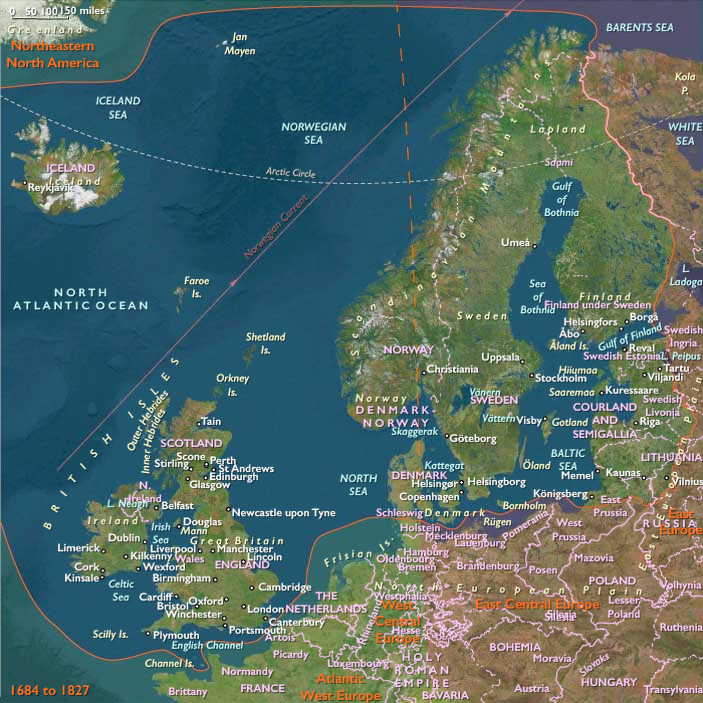
North Europe
View →Subregions