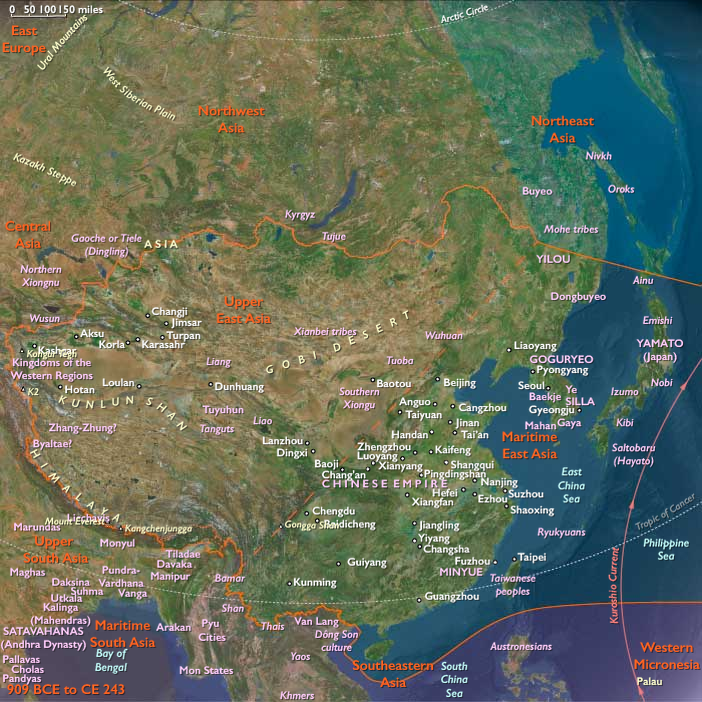
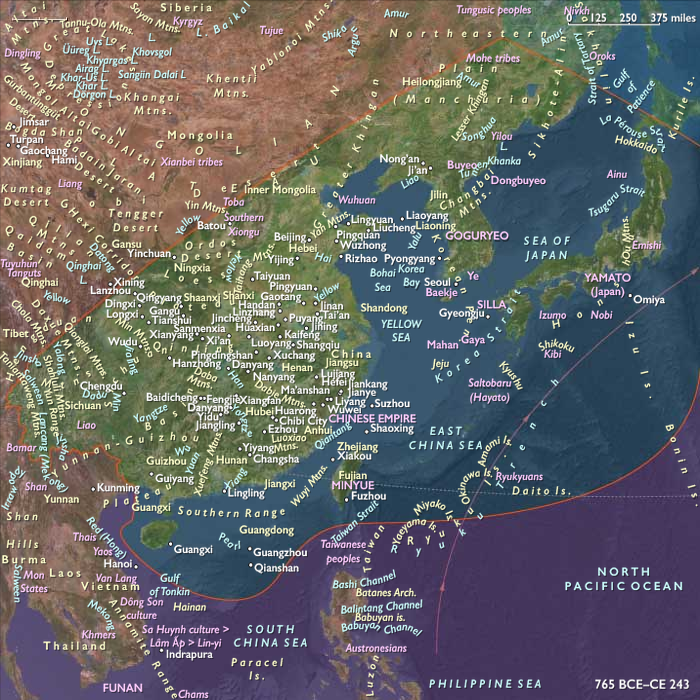
A number of Emperor Gengshi's generals, feeling trapped, conspire to kidnap him and flee back to their home region of Nanyang (in modern Henan).
They are discovered, and many are executed, but one, Zhang Ang occupies most of Chang'an, forcing Emperor Gengshi to flee, just as Chimei forces are approaching.
The Chimei leaders, deciding that they also need their own emperor, find three descendants of Liu Zhang, Prince of Chengyang, who was very popular with the people of his principality (from which many Chimei soldiers come) and who was worshiped as a god after his death.
After drawing lots, the youngest, the fifteen-year-old Liu Penzi, is chosen and declared emperor.
However, the young "emperor" is not given any power, but is effectively a puppet who continues to serve as a cattle herder within the army.
Generals still loyal to Emperor Gengshi are eventually able to evict Zhang from the capital, but by this time the situation is desperate.
Zhang and his allies surrender to Chimei and, working with them, attack Chang'an, which falls quickly, and Emperor Gengshi flees, followed only by several loyal followers, including Liu Zhi, the Prince of Dingtao and Liu Gong, the Marquess of Shi—who, incidentally, is Liu Penzi's older brother.
They are eventually taken in by one of Emperor Gengshi's generals, Yan Ben, who, however, is in actuality holding them as bargaining chips.
When Liu Xiu hears about the fall of Chang'an, he creates Emperor Gengshi the Prince of Huaiyang, in absentia, and decrees that anyone who harms the Prince of Huaiyang will be severely punished and that anyone who protects and delivers him to the Eastern Han dynasty will be rewarded.
(This appears to be basically political propaganda on Liu Xiu's part.)
When news of Chang'an's fall arrives in Luoyang, Luoyang surrenders to Liu Xiu, who enters the city and makes it his capital.
In winter 25, after being held by Yan a few months, Emperor Gengshi sees the futility of his situation and requests Liu Gong to negotiate surrender terms.
A promise is made that he will be created the Prince of Changsha.
Emperor Penzi's general Xie Lu arrives at Yan's camp and escorts Emperor Gengshi back to Chang'an to offer his seal (seized from Wang Mang) to Emperor Penzi.
Chimei generals, notwithstanding the earlier promise, want o execute him.
It is only Liu Gong's final intercession (in which he threatens to commit suicide at the execution site) that allows Emperor Gengshi to be spared at this point, and he is created the Prince of Changsha.
He, however, is forced to stay in Xie's headquarters, and Liu Gong protects him on a number of occasions.
Meanwhile, Emperor Penzi is installed on the Han throne in Chang'an.
Initially, the people of the Guanzhong (modern central Shaanxi) region submit and offered tributes—and are surprised when the Chimei soldiers continuously rob them on the way to Chang'an.
The locals soon resume maintaining and defending their outposts.
They also start to look forward to the rule of Liu Xiu, who by now has declared himself as an emperor as well (establishing the Eastern Han Dynasty), and his general Deng Yu, whose forces are stationed nearby but not confronting the Chimei forces, content to consolidate his control over the prefectures of Shang, Beidi, and Anding (modern northern Shaanxi and eastern Gansu) and waiting for the Chimei to collapse by themselves.
Chimei generals are even less able to govern the capital than Emperor Gengshi, as they are unable to control their soldiers from pillaging the residents, who begin to yearn for the return of Emperor Gengshi.
Zhang Ang and his allies, afraid of what might happen if Emperor Gengshi returns to power, persuade Xie to strangle Emperor Gengshi.
Liu Gong hides his body in a secure location.
Years later, after the Eastern Han dynasty has securely captured the Chang'an region, Liu Xiu has Emperor Gengshi's body buried with princely honors at Baling, near the tomb of Emperor Wen.