
Emperor Shizong of Jin, early in his…
January 1189 CE
Emperor Shizong of Jin, early in his reign, had chosen three thousand Jurchen men to study the Jurchen language.
In 1173, the state had begun offering jinshi degrees in Jurchen as well, opened the Jurchen Imperial Academy in the capital and local schools in all the circuits (lu) of the empire.
It is thought by modern scholars that the purpose of offering the jinshi examinations in Jurchen was more to promote Jurchen scholarship than to recruit more Jurchen for the state service, as most of the Jurchen jinshi degree holders ended up working as teachers of the Jurchen language and of the Chinese classics in Jurchen translation.
Shizong had required that when dealing with Jurchen speakers, government officials responded in Jurchen.
In 1174, even the imperial guards were told to learn Jurchen, and not to speak in Chinese; in 1183, one thousand copies of the Jurchen edition of the Canon of Filial Piety had been distributed to them for their edification.
As one of the ways of restoring Jurchen traditions, Shizong has prohibited servants and enslaved people from wearing silk, and in 1188 he had prohibited Jurchens in general from wearing Chinese clothes.
Shizong (as well as his successor Zhangzong) has been described as a believer in both Buddhism and Taoism.
He hadin 1187 invited Wang Chuyi (a disciple of the founder of the Quanzhen school of Taoism, Wang Chongyang) to preach at his inner palace.
(According to some sources, another one of Wang Chongyang's disciple, Qiu Chuji, had been invited as well).
The emperor requeststhe presence of Wang Chuyi himself at his deathbed Modern scholars of the Jin Empire feel that Shizong's efforts to maintain and revive Jurchen language and culture were not particularly efficacious.
The language lacked native literature, and his translations of Chinese works into Jurchen were helping to bring Chinese ideas and values into Jurchens' minds.
In fact, the emperor himself once said that the Jurchen language was "inferior to Chinese", and could not even match Khitan.
Outside of the old Jurchen lands in far Manchuria, people did not see the utility of speaking the "dying" and "inferior" language, and Shizong himself was wondering if the posterity would criticize him for his attempts to force people use it.
Groups
Commodities
Subjects
Regions
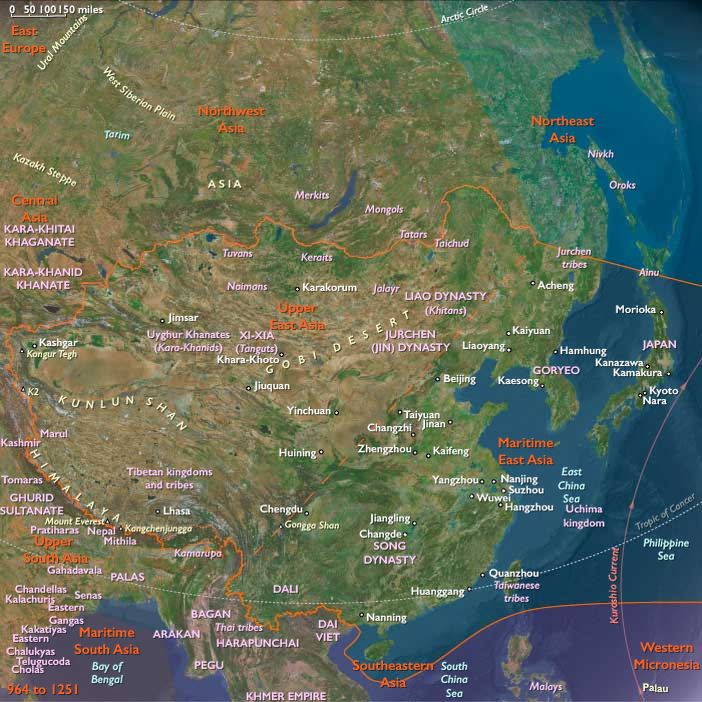
East Asia
View →Subregions
