Barthélemy Prosper Enfantin had resigned his office…
1832 CE
Barthélemy Prosper Enfantin had resigned his office of cashier after the July Revolution of 1830 and devoted all his energy to the promotion Saint-Simon's version of utopian socialism.
Besides contributing to Le Globe, he has made appeals to the people by systematic preaching, and organized centers of action in some of the main cities of France.
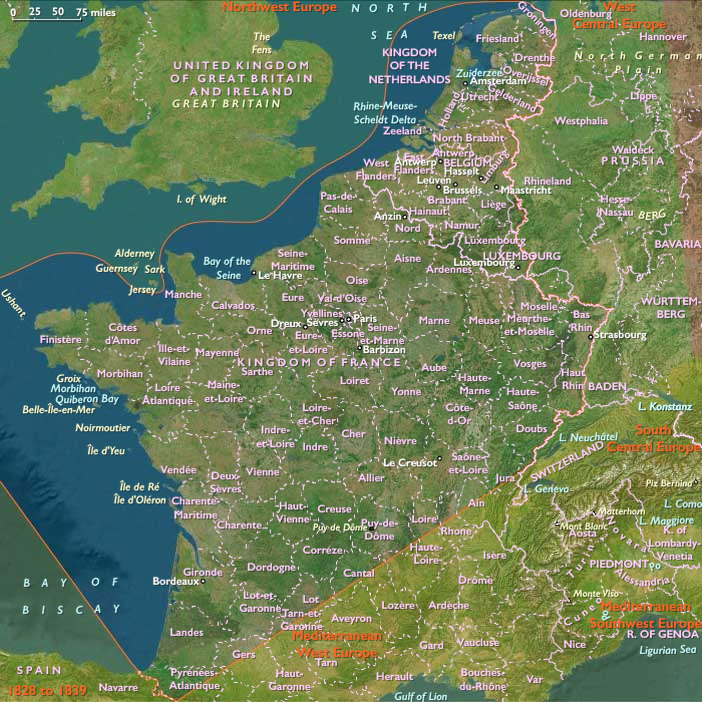
The headquarters in Paris had been moved from the modest rooms in the Rue Taranne to the large halls near the Boulevard des Italiens.
Enfantin and Amand Bazard had been proclaimed Pères Suprêmes ("Supreme Fathers")—a union that is, however, only nominal, as a divergence is already manifest.
Bazard, who has concentrated on organizing the group, has devoted himself to political reform, while Enfantin, who favors teaching and preaching, has dedicated his time to social and moral change.
The antagonism has been widened by Enfantin's announcement of his theory of the relation of man and woman, which would substitute a system of "free love" for the "tyranny of marriage.” Bazard and his disciples had broken with Enfantin's group.
The latter has become sole "father", leading a movement chiefly oriented to religion, joined by new converts (according to Enfantin's estimate, the total number of followers would have reached forty thousand).
He wears on his breast a badge with his title of Père, is referred to by his preachers as "the living law", declares himself to be the chosen of God, and sends out emissaries in a quest of a woman predestined to be the "female Messiah," and the mother of a new Savior (the latter quest has been very costly and altogether fruitless).
Meanwhile, the new religion has gathered believers in all parts of Europe.
His extravagances and success at length bring him to the attention of authorities, who argue that he is endangering public morality.
In May 1832, the government closes the halls of the new sect, and the Père, with some of his followers, appears before the tribunals.
Enfantin retires to his estate at Menilmontant, near Paris, where with forty disciples, all of them men, he continues to carry out his socialist views.
In August of the same year, he is again arrested, and on his appearance in court he desires his defense to be undertaken by two women who are with him, alleging that the matter is of special concern to women; the request is promptly refused.
The trial occupies two days and results in a verdict of guilty, and a sentence of imprisonment for a year with a small fine.
Enfantin is released in a few months, but this prosecution has discredited the new society.
Locations
Subjects
Regions

West Europe
View →Subregions