Edgar Crookshank declares “the credit given to…
1889 CE
Edgar Crookshank declares “the credit given to vaccination belongs to sanitation” in his two-volume treatise entitled A History and Pathology of Vaccination, published in 1889.
A professor of pathology and bacteriology at Kings College, Crookshank had been requested by the British government to investigate a cowpox outbreak in Lechlade, Wiltshire.
His investigations had led him to reconsider the use of cowpox-derived vaccines to immunize against smallpox, a treatment developed by Edward Jenner nearly a hundred years earlier.
His conclusion is that such vaccines are ineffective in preventing smallpox because the two diseases (cowpox and smallpox) are "totally distinct".
Vaccination policies are a divisive topic at this time and in the ensuing controversy that results from his publication, Crookshank will quit his chair at King's College London in 1891.
He will continue to speak out on health matters but will never work in a laboratory again.
He subsequently, however, will focus on the encouragement of agricultural and veterinary science, serving as a governor of the Royal Veterinary College until his death.
In 1894, Crookshank will be appointed Justice of the Peace for Sussex, and in 1906 stand unsuccessfully as East Grinstead's parliamentary candidate as a Unionist and Tariff Reformer.
In later life, he will travel extensively in the Dominions, becoming a skilled big-game hunter and deputy chairman of two Scottish-Australian corporations.
Crookshank had studied at King's College London and qualified for medicine in 1881.
He served briefly as an assistant to Joseph Lister, a physician noted for his work promoting antiseptics and sterile surgery.
In 1882, Crookshank served as a doctor with the British armed forces sent to Egypt as a result of the Urabi Revolt; he was decorated for his service at the Battle of Tel el-Kebir.
On return from Egypt, Crookshank toured Europe in 1884 for further medical training.
In Berlin, he visited the laboratory of Robert Koch and learned methods of isolating bacterial strains to investigate infectious diseases.
When he returned to London, Crookshank wrote a textbook, An Introduction to Practical Bacteriology Based on the Methods of Koch, which was published in 1886.
Subsequent editions were published under differing titles in 1887, 1890 and 1896, and a French translation by H. Bergeaud was published in Paris as soon as 1886.
In 1885, Crookshank had founded one of the world's first bacteriological laboratories for human and veterinary pathology in London.
Crookshank is also interested in the use of photography to study bacteria and had published Photography of Bacteria in 1887, the first text in English devoted solely to the photography of bacteria.
In the introduction to this book he wrote that the photographs were "intended to convince scoffers of the essential truth of the new Science, that specific, often morphologically distinct, microorganisms were the cause of particular infectious diseases".
During this time he became interested in the study of infectious diseases in animals and in 1886 had been awarded the chair of Comparative Pathology and Bacteriology at King's College London.
Locations
Regions
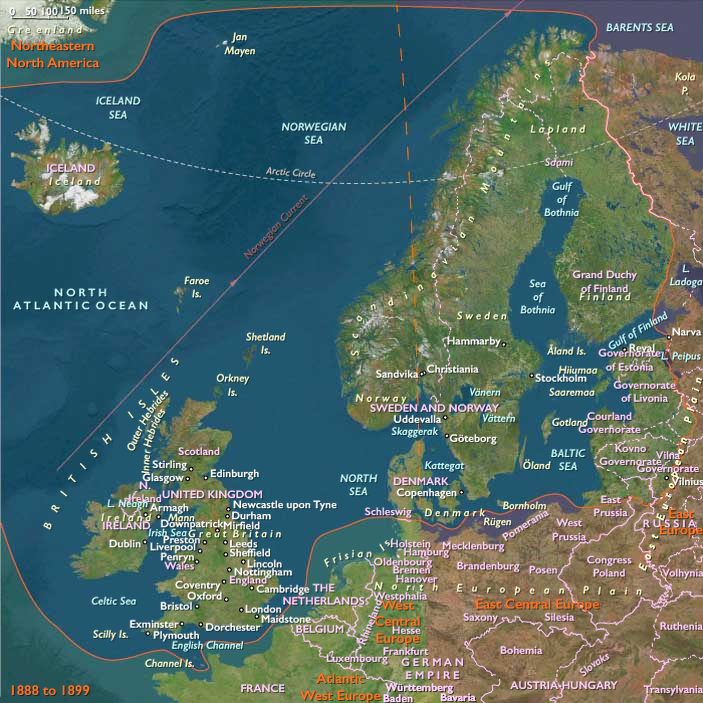
North Europe
View →Subregions