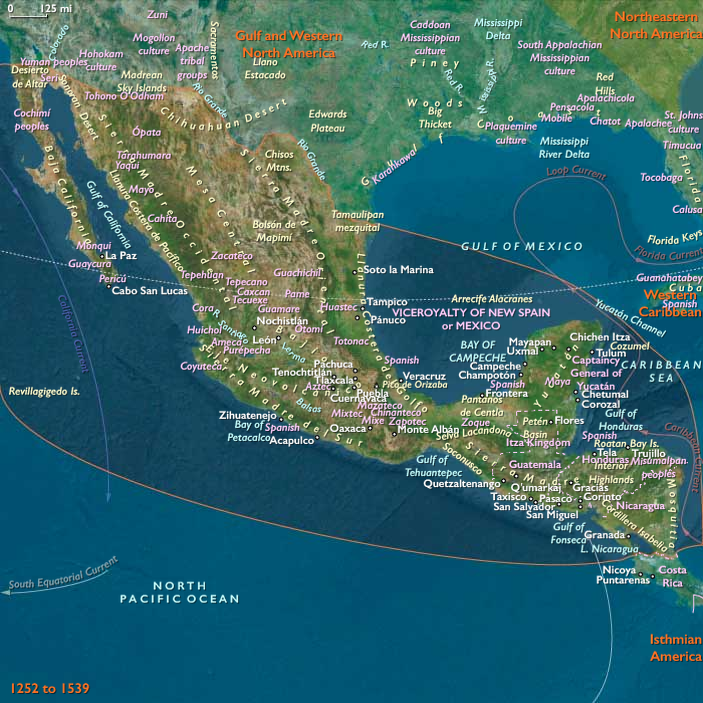
Evidence of early human habitation in the…
1534 CE
Evidence of early human habitation in the present Mexican state of Hidalgo, located in eastern Mexico and bordered by San Luis Potosí and Veracruz on the north, Puebla on the east, Tlaxcala and México on the south and Querétaro on the west, is found in Cerro de las Navajas and Zacualtián, in the Sierra de Pachuca.
Here primitive mines to extract green obsidian, arrow heads, scraping tools and mammoth remains can be traced back as far as 12,000 BCE.
An ancient pre-Hispanic obsidian tool-making center has also been found in the small town of San Bartolo near the present city of Pachuco.
Around 2000 BCE, nomadic groups here began to be replaced by sedentary peoples who formed farming villages in an area then known as Itzcuincuitlapilco, of which the municipality of Pachuca is a part.
Later artifacts from between 200 CE and 850 CE show Teotihuacan influence with platforms and figurines found in San Bartolo and in Tlapacoya.
Development of this area as a city, however, had lagged behind other places in the region such as Tulancingo, Tula and Atotonilco El Grande, but the archaeological sites here are on the trade routes among these larger cities.
After the Teotihuacan era, the area was dominated by the Chichimecas with their capital in Xaltocan, who called the area around Pachuca Njunthé.
Later, the Chichimecas had founded the dominion of Cuauhtitlán, pushing the native Otomis to the Mezquital Valley.
These conquests had coalesced into a zone called Cuautlalpan, of which Pachuca was a part.
Fortifications in the area of Pachuca city and other areas were built between 1174 and 1181.
This dominion had eventually been overrun by the Aztec Triple Alliance between 1427 and 1430, with rule in Pachuca then coming from the city of Tenochtitlan.
According to tradition, it was after this conquest that mineral exploitation began here and in neighboring Real del Monte, at a site known as Jacal or San Nicolás.
The Aztec governing center was where Plaza Juárez in Pachuca city is now.
The Spanish had arrived in these silver-bearing western foothills of the Sierra Madre Oriental in 1528, killing the local Aztec governor, Ixcóatl, and begin a settlement here on 1534.
Locations
Groups
Commodities
Subjects
Regions
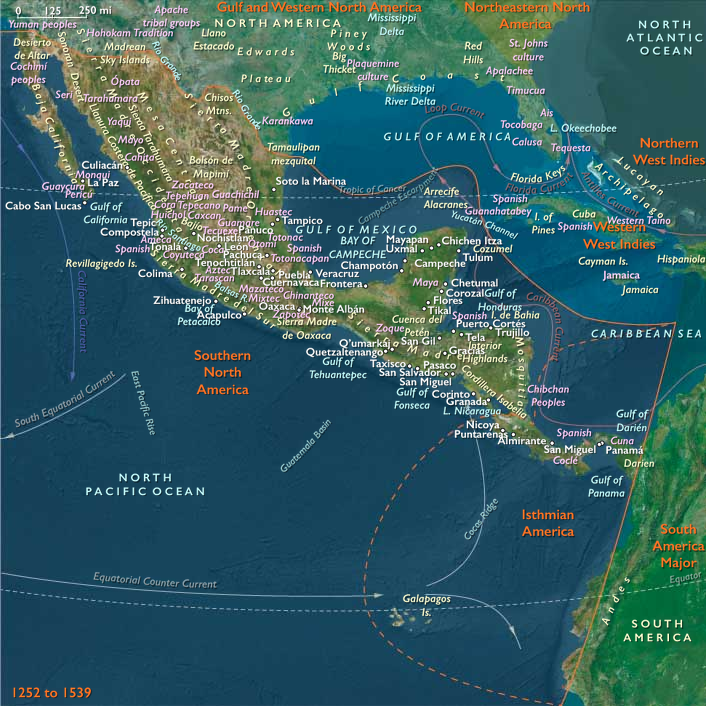
Middle America
View →Subregions