
Floris V, Count of Holland and Zeeland:…
1272 CE
Floris V, Count of Holland and Zeeland: Early Rule and the Struggle for Independence (1266–1272)
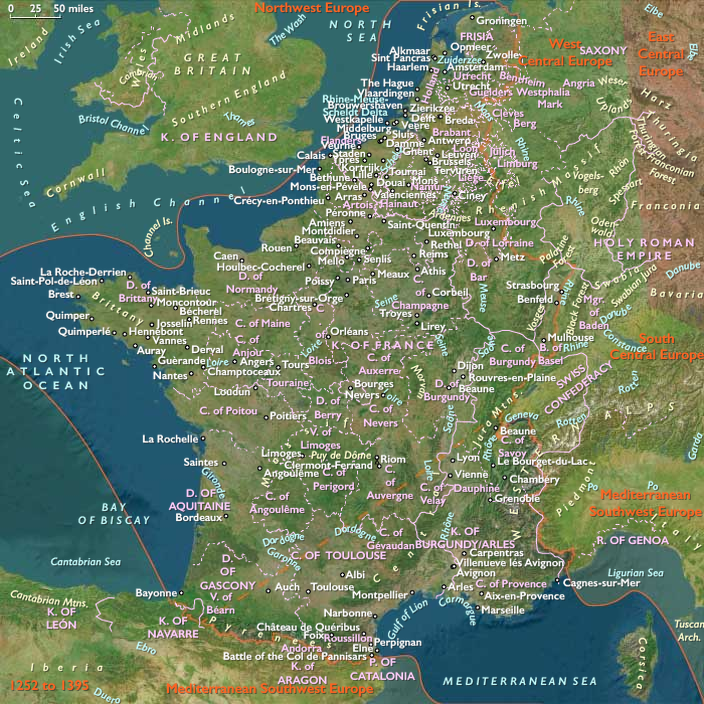
Floris V, Count of Holland and Zeeland (r. 1266–1296), was the son of Count William II, who had been elected King of the Romans in 1248 but was slain by the Frisians in 1256. Floris inherited the county at the age of two, leading to a struggle over his guardianship until he reached adulthood in 1266.
Floris V’s Early Life and the Struggle for Regency
- Following William II’s death, Floris was first placed under the regency of his uncle, Floris de Voogd (1256–1258), and later under his aunt, Adelaide of Holland (1258–1263).
- Count Otto II of Guelders, after defeating Adelaide’s forces at the Battle of Reimerswaal (1263), was chosen as regent by nobles opposing her rule.
- Otto II remained Floris’s guardian until 1266, when the young count was declared capable of ruling independently at the age of twelve, on July 10, 1266.
- That same year, his mother, Elisabeth of Brunswick-Lüneburg, died on May 27, 1266, and was buried in Middelburg Abbey Church.
Political Alignments and Marriage to Beatrix of Dampierre (1269)
- Floris V sought political backing from John I, Count of Hainaut, of the House of Avesnes, an archenemy of the House of Dampierre, which ruled Flanders.
- Despite this alliance, Floris married Beatrix of Dampierre in 1269, daughter of Guy of Dampierre, Count of Flanders. This match, though politically significant, did not ease tensions between Holland and Flanders.
First War Against the Frisians (1272)
- In 1272, Floris launched his first military campaign against the Frisians, attempting to avenge his father’s death and retrieve his remains.
- The expedition, however, ended in failure, demonstrating the continued resilience of the Frisians and Floris’s inexperience in warfare.
- His quest to recover his father’s body would remain an ongoing ambition throughout his rule.
Floris V’s Early Challenges and Future Ambitions
- By 1272, Floris had secured his authority over Holland but still faced internal and external threats, particularly from Flanders and the Frisians.
- His failed invasion of Frisia was an early setback, but he would later emerge as a powerful ruler, expanding his territory and influence in the years to come.
Floris V's early reign set the stage for his later successes and conflicts, which would define Holland’s growing power in the late 13th century.
Locations
Groups
Commodities
Subjects
Regions
West Europe
View →Subregions
