
John Rudyard, who is neither an architect…
1709 CE
John Rudyard, who is neither an architect nor professional engineer, but a silk merchant and a property developer, had been contracted to build the second lighthouse on the site of first Eddystone Lighthouse following its utter destruction in the Great Storm (in which the first architect was lost, together with five other men who had been working on the structure).
A Captain Lovett had acquired the lease of the rock, and by Act of Parliament had been allowed to charge passing ships a toll of one penny per ton.
He had commissioned Rudyard (or Rudyerd) to design the new lighthouse as a conical wooden structure around a core of brick and concrete.
A temporary light had first been shown from it in 1708 and the work is completed in 1709.
This proves more durable than the original, surviving nearly fifty years.
Regions
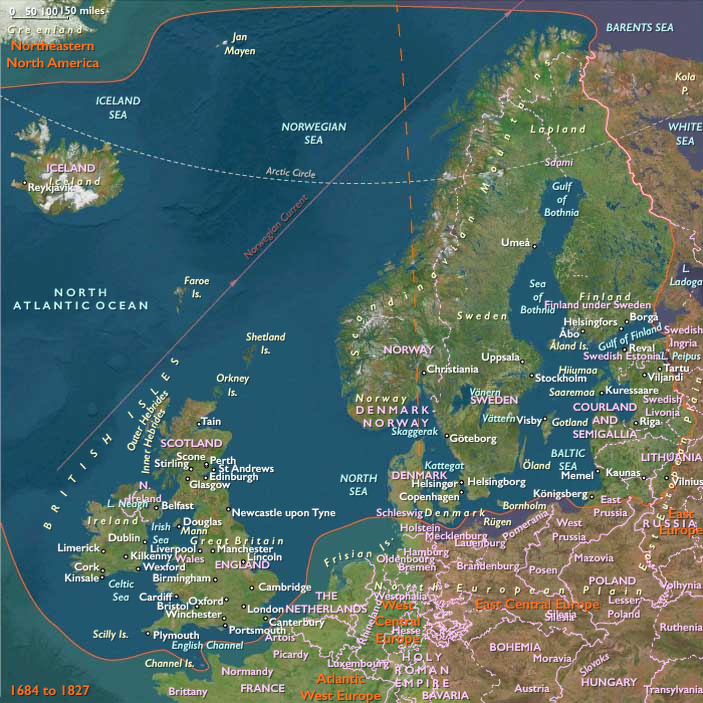
North Europe
View →Subregions

Northwest Europe
View →Related Events
No active filters.
Showing 10 events out of 28596 total
Tōdai-ji (Eastern Great Temple) is a Buddhist temple complex located in the city of Nara, Japan, initially constructed in the 750s.
Its Great Buddha Hall, the largest wooden building in the world, houses the world's largest bronze statue of the Buddha Vairocana, known in Japanese simply as Daibutsu.
The Great Buddha Hall (Daibutsuden) has been rebuilt twice after fire.
The current building is finished in 1709, and although immense—fifty-seven meters long and fifty meters wide—it is actually thirty percent smaller than its predecessor.
About one hundred and twenty-eight thousand people die in the ämter (rural districts) of Insterburg, ...
In preparation for the plague, a Collegium Sanitatis (health commission) is set up, including physicians from the university and leading civilian and military officials of the town.
The plague arrives in August 1709, most probably carried by a Danzig sailor.
The provincial government is exiled to Wehlau while the chancellor, von Kreytzen, remains in Königsberg and continues to work as the chairman of the Collegium Sanitatis, which meets daily.
The city walls are manned by the military, the burghers are conscripted into neighborhood watches, medical and other personnel are hired, dressed in black waxed clothes and housed in separate buildings.
While at first the city authorities downplay the plague, which reaches a peak in early October and then declines, this approach is abandoned when the death toll again starts to rise significantly in November.
Without prior public announcement, a cordon sanitaire is implemented around the city, sealing it off completely from the surrounding countryside from November 14/15 until December 21, 1709.
While it has so far avoided participation in the war, the conflict has affected it indirectly by a reduction of its trade volume, rising taxes and food shortages.
The city council adopts a dual strategy of actively downplaying the plague to the outside world, especially Danzig's trading partners, thus keeping the city open and allowing international and local trade to continue with few restrictions, while at the same time the restrictions on burials are eased due to a coffin shortage and the deaths of many grave diggers, plague (pest) houses and new graveyards are designated, and a "health commission" to organize the anti-plague measures is implemented to, for example, collect weekly reports from the physicians and provide the plague victims with food.
Until the end of May, it seems that the plague will not be as severe, and the health commission's reports are openly accessible.
However, the plague is not contained and spreads from the plague houses to the poorer suburbs and surrounding countryside, and starting in early June the death toll rises significantly.
The health commission's reports are now declared secret.
When the plague fades out by December 1709, never to return to Danzig, the town has lost about half of its inhabitants.
According to Zapnik (2006), the returning soldiers' wives who had contact with the plague-stricken areas around Poznań were most likely the transmitters of the plague to Pomerania.
After the outbreak in Damm, the mail route connecting Stettin with Stargard in the adjacent Prussian province of Pomerania via Damm is relocated to Podejuch.
Despite the precautions, the plague breaks out in Warsow, just north of Stettin, and by the end of September also inside Stettin's walls, transmitted by a local woman who had provided food to her son in Damm.
As in Danzig, the city council downplays the plague cases to not impair Stettin's trade, but also sets up a health commission and pest houses and hires personnel to deal with the infected.
Stettin (now Szczecin), the capital city of Swedish Pomerania located on the opposite bank of the river, reacts by isolating the town with a guarded cordon sanitaire.