
Increasingly restrictive laws to keep alcohol out…
1834 CE
American Fur is the company most affected by these laws, and they have lobbied heavily against them.
Alcohol is inexpensive, easy to transport, and something natives will always trade for.
The company's primary means of transporting furs from and trade goods to their trading posts is by steamboat, and these boats can be inspected at Fort Osage.
In order to avoid losing out to foreign traders, McKenzie had had the parts shipped to him in 1833 to build a distillery at Fort Union.
Since it is illegal to sell alcohol to natives, they give away watered-down whiskey, doctored with tobacco, pepper, molasses, and anything else that will give it a kick, one day, and the next, when they are to commence trading, they give them a non-alcoholic version.
In August, 1833, a proud McKenzie had showed off his still to M. S. Cerré and Nathaniel J. Wyeth.
They were outraged at the prices McKenzie was charging for his goods—and the fact that he wouldn't sell them any liquor for their own trade.
When the two reached Fort Leavenworth, they reported the still.
On June 30, 1834, Congress prohibits distilleries in Indian territory—a law that is still on the books today, although most laws against selling liquor to Indians will be repealed in 1948.
The distillery at Fort Union effectively ended the career of McKenzie, the American Fur Company's best field trader; he is fired.
John Jacob Astor retires in 1834 and sells the western division of American Fur to Pierre Chouteau, Jr., who had been Astor's St. Louis agent since 1827. (The northern portion of Astor's company goes to Ramsay Crooks, who retains the "American Fur Company" title for his company.)
It will be reorganized in 1838 as Pierre Chouteau, Jr. and Company and will continue until it dissolves in 1864.
Groups
Regions
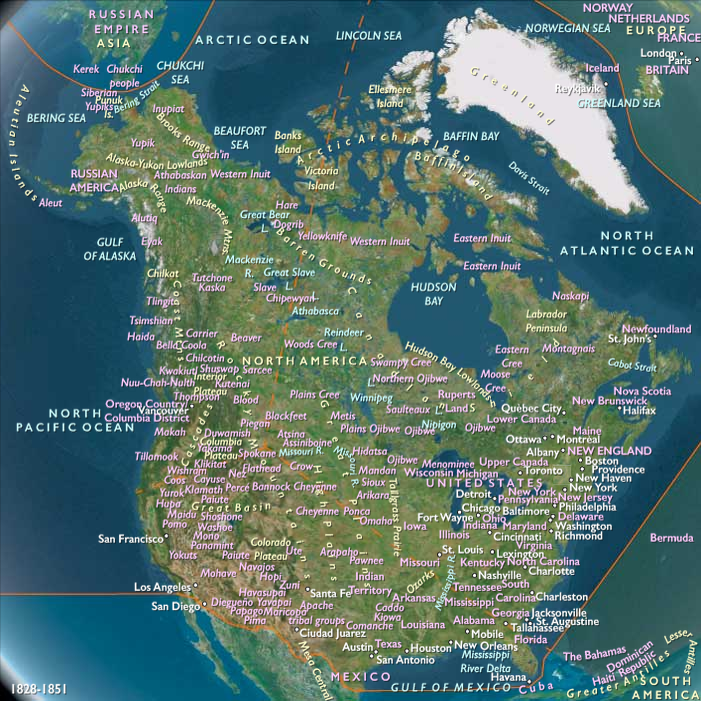
Northern North America
View →Subregions
