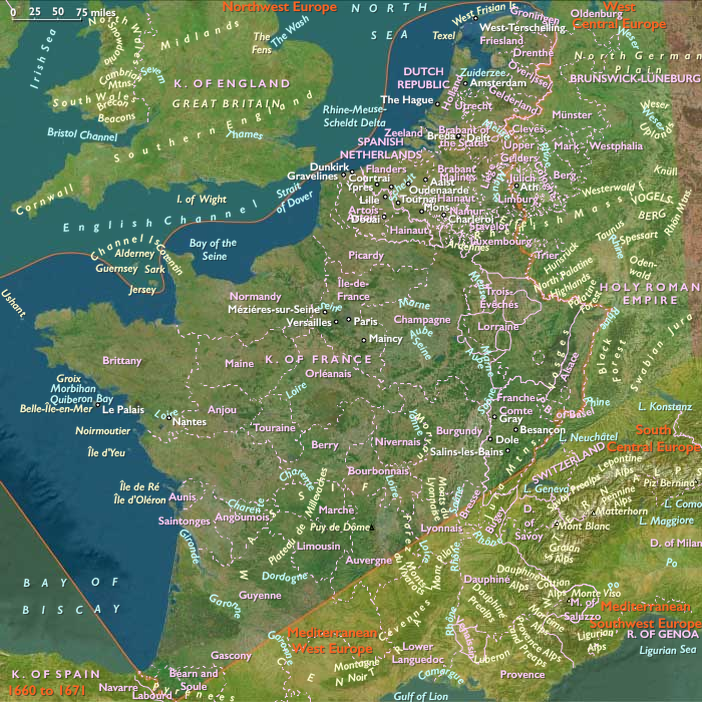
France and Spain had in 1659 concluded…
February 1667 CE
France and Spain had in 1659 concluded the Treaty of the Pyrenees, which had ended twenty-four years of war between the two states.
With the Treaty, King Philip IV of Spain had had to cede certain territories, and also had to consent to the marriage of his daughter Maria Theresa of Spain to the young Louis XIV of France.
Furthermore, it had been agreed that with this marriage, Maria Theresa explicitly renounced all rights to her father's inheritance.
As compensation, a dowry of five hundred thousand gold écus had been promised to the Bourbon Louis XIV, but this has not been paid.
At the death of Philip IV on September 17, 1665, the French king had immediately laid claim to parts of the Spanish Netherlands: the Duchies of Brabant and Limburg, Cambrai, the marquessate of Antwerpen, the Lordship of Mechelen, Guelders, the counties of Namur, Artois and Hainaut, a third of the County of Burgundy and a quarter of the Duchy of Luxembourg.
Louis XIV justifies this with the fact that the promised dowry had not been paid and that the Queen's renunciation of her inheritance is therefore invalid.
Although Louis's claims to the Spanish Netherlands are tenuous, French legal scholars conclude from this and the clause of 'devolution' that the Spanish Netherlands should not go to the still underage heir to the Spanish throne Charles II of Spain, since he had been born as a result of the second marriage of Philip IV.
Maria Theresa on the other hand is a result of his first marriage and is therefore entitled to the inheritance in Brabant, and, through her, Louis XIV.
The Queen cannot renounce this natural right for her children as well.
Maria Theresa's stepmother, Queen Mariana of Spain, who is taking care of government business for her underage son along with her confessor Cardinal Johann Eberhard Neidhardt, rejects these claims, referring to the renunciation by Maria Theresa of all inheritance rights.
At this, the French king had begun preparations for a new campaign against Spain.
His able financial minister Colbert has reorganized the army and expanded it from fifty thousand to eighty thousand men.
Spain, on the other hand, is a fragmented nation struggling to cope with major inflation.
Locations
Groups
Topics
Commodities
Subjects
Regions
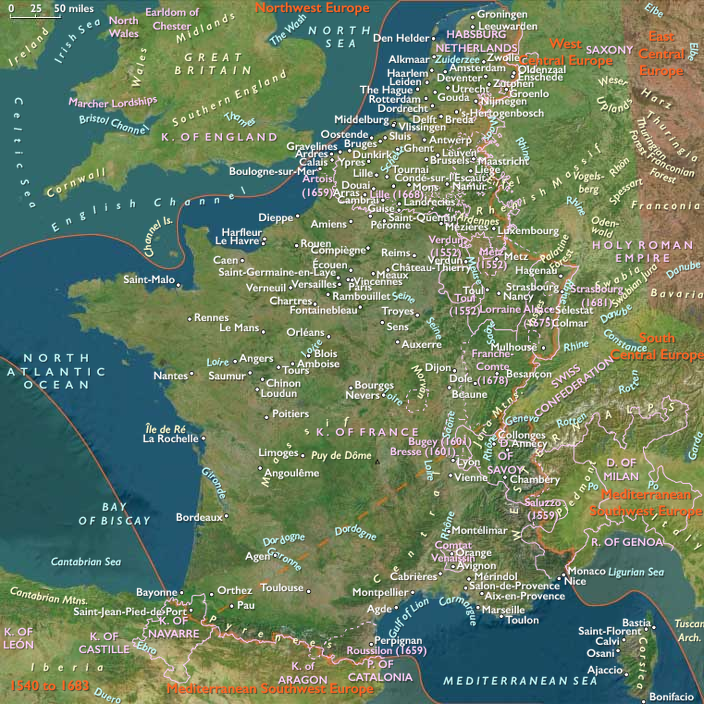
West Europe
View →Subregions