The Ethnic and Cultural Foundations of Emerging…
1000 CE to 1011 CE
The Ethnic and Cultural Foundations of Emerging France
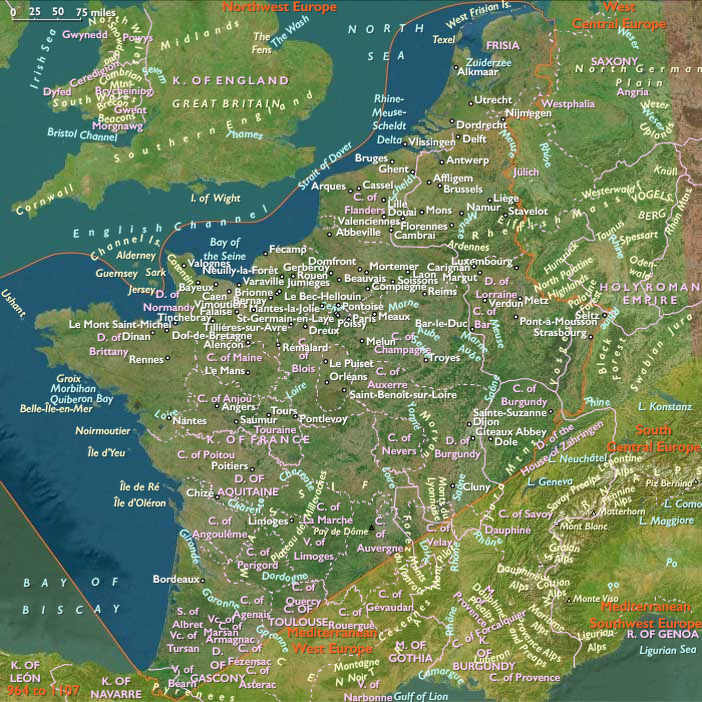
By the turn of the millennium, France was beginning to take shape as a distinct nation, formed through a syncretic blend of Celts, Romans, and various Germanic and Norse groups. This cultural and ethnic fusion created the foundations of the French identity, blending languages, legal traditions, and social structures from its diverse inhabitants.
The Three Major Ethnic Strands
-
The Gauls (Celts)
- The original inhabitants of much of France, the Gauls had a rich warrior culture and a long history of settlement across the region.
- Though conquered by Julius Caesar in the 1st century BCE, their influence remained in place names, rural customs, and aspects of folklore.
-
The Romans
- Following Roman conquest, Gaul was deeply Romanized, adopting Latin language, infrastructure, law, and urban planning.
- The Romans established cities such as Lyon (Lugdunum) and integrated Christianity into the region, laying the groundwork for medieval French governance and religious identity.
-
The Germanic and Norse Invaders
- Franks: The dominant group that would give France its name, the Franks took control under Clovis I (r. 481–511), establishing the Merovingian dynasty and later the Carolingian Empire under Charlemagne.
- Visigoths: Originally settled in southern France, particularly in Aquitaine, before being driven into Spain.
- Burgundians: Established a powerful kingdom in eastern France, which later merged into the medieval French realm.
- Vandals: Briefly settled in Gaul before moving into Hispania and North Africa.
- Vikings (Normans): Raiders and settlers who established Normandy under Rollo (911 CE), bringing Scandinavian elements into French culture and military traditions.
France as a Fusion of Civilizations
- The Frankish military aristocracy fused with the Romanized Gallo-Celtic population, creating a feudal society blending Frankish law, Latin-based language, and Christian institutions.
- By 1000 CE, the Capetian dynasty was consolidating power, overseeing a realm that was linguistically diverse, culturally rich, and politically fragmented.
Legacy
This unique ethnic and cultural synthesis shaped France’s medieval identity, influencing its language (Old French), laws, and feudal hierarchy. The Capetian monarchs would later unify these diverse regions into a centralized kingdom, giving rise to the France we recognize today.
Locations
Groups
Subjects
Regions
West Europe
View →Subregions