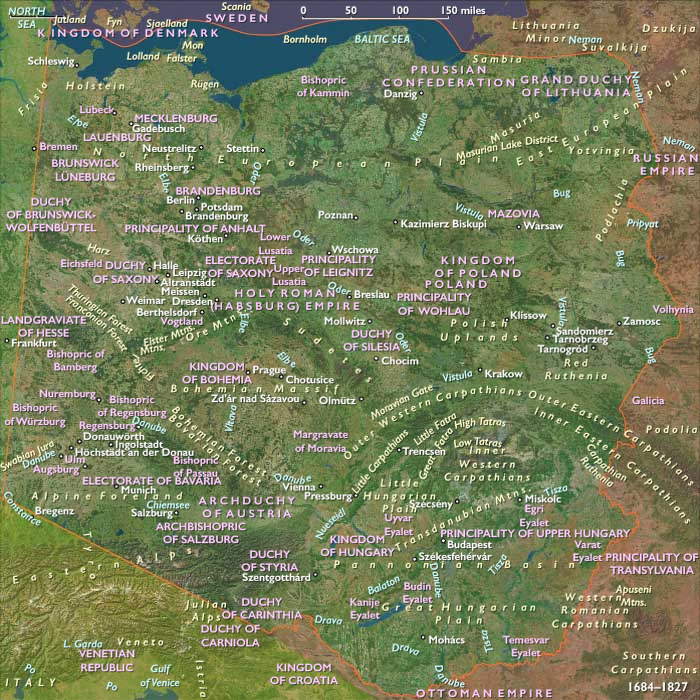
The secret treaty between Emperor Charles VI…
May 1736 CE
The secret treaty between Emperor Charles VI and Francis Stephen of Lorraine, signed on May 4, 1736, exchanging the Duchy of Lorraine for the Grand Duchy of Tuscany, as France had demanded that Maria Theresa's fiancé surrender his ancestral duchy to accommodate the deposed King of Poland.
The Emperor had considered other possibilities (such as marrying his daughter to the future Charles III of Spain) before announcing the engagement of the couple.
If something were to go wrong, Francis will become governor of the Austrian Netherlands.
Francis, who was born in Nancy, Lorraine (now in France), the oldest surviving son of Leopold Joseph, duke of Lorraine, and his wife Élisabeth Charlotte d'Orléans, daughter of Philippe, duc d'Orléans, is connected with the Habsburgs through his grandmother Eleonor, daughter of Emperor Ferdinand III, and wife of Charles Leopold of Lorraine, his grandfather.
He was very close to his brother and sister Anne Charlotte.
The Emperor favors the family, who, besides being his cousins, have served the house of Austria with distinction.
He has designed to marry his daughter Maria Theresa to Francis' older brother Leopold Clement.
On Leopold Clement's death, Charles had adopted the younger brother as his future son-in-law.
Francis had been brought up in Vienna with Maria Theresa with the understanding that they were to be married, and a real affection has arisen between them.
Brought to Vienna at fifteen, he had been established in the Silesian Duchy of Teschen, which had been mediatized and granted to his father by the emperor in 1722.
Francis had succeeded his father as Duke of Lorraine in 1729, and in 1731 had been initiated into freemasonry (Grand Lodge of England) at a specially convened lodge in The Hague at the house of the British Ambassador, Philip Stanhope, 4th Earl of Chesterfield.
During a subsequent visit to England, Lorraine had been made a Master Mason at another specially convened lodge at Houghton Hall, the Norfolk estate of British Prime Minister Robert Walpole.
Maria Theresa had arranged for Francis to become "Lord Lieutenant" (locumtenens) of Hungary in 1732.
He was not excited about this position, but Maria had wanted him closer to her, so had agreed to go to Pressburg in June 1732.
When the War of the Polish Succession broke out in 1733, France had used it as an opportunity to seize Lorraine, since France's prime minister, Cardinal Fleury, was concerned that, as a Habsburg possession, it would bring Austrian power too close to France.
A preliminary peace had been concluded in October 1735.
Francis had agreed on January 31, 1736, to marry Maria Theresa after hesitating three times (and laying down the feather before signing).
Especially his mother Élisabeth Charlotte d'Orléans and his brother Prince Charles Alexander of Lorraine are against the loss of Lorraine.
Maria Theresa sends Francis a letter on February 1: she will withdraw from her future reign, when a male successor for her father appears.
They married on February 12 in the Augustinian Church, Vienna; the wedding celebration was held two days later.
In March, the Emperor had persuaded Francis to secretly sign away Lorraine.
Locations
People
Groups
Regions
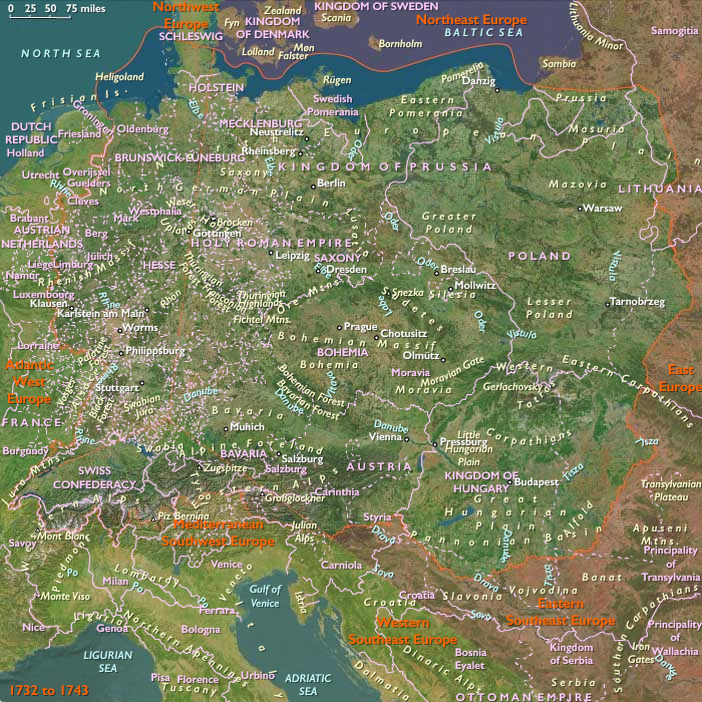
Central Europe
View →Subregions