
Frederick and his augmented army of about…
December 1757 CE
Prince Charles, aware of Frederick's approach, positions his army facing west on an eight kilometer (five mile) front in country of rolling hills near the village of Leuthen, which serves as the Austrian center, deploying his troops in two lines, the right wing at its northern most point, anchored at Nippern, and establishing his command post at Leuthen proper.
The foggy weather makes it difficult to see positions from either side, but Frederick and his commanders know the terrain well, as it had been the site of earlier Prussian military maneuvers, and they use this knowledge to their advantage.
At four AM on this Sunday morning, Frederick moves toward the Austrian right wing in four columns: the inner two consisting of infantry and the outer two, of cavalry.
Using the knolls to block his movements, he shifts the two columns of infantry and one of cavalry obliquely to his right.
The leftmost column of cavalry remains behind, to convince the Austrians that they are still approaching directly.
Their visible approach serves as a screen for Frederick's intent to execute an oblique maneuver.
The Prussian infantry marches southward, remaining out of Austrian sight, behind a line of low hills.
Prince Charles, watching from his vantage point in one of the Leuthen towers, moves his reserve to his right flank, thus weakening his left flank.
The Prussian army has seemed to simply vanish, appearing to the Austrians as if in retreat.
The Prussians continue undetected, behind these hills, across the Austrian front, and overreach the Austrian left wing.
When the heads of the two superbly drilled Prussian columns—the distances between the marching platoons remaining exactly the width of each platoon's front—have passed the Austrian left flank, the columns veer left toward the enemy and continue their march until they had passed beyond the left Austrian flank.
Now, on command, the platoons of the columns face left at Lobetinz, and the whole Prussian army lies in line of battle, two to three men deep, at nearly a right angle to the Austrian's left, its weakest position.
Zieten's cavalry has traversed the entire Austrian front, and positioned itself at a forty-five-degree angle to the Austria flank, the Prussian horse artillery consisting of several twelve-pound guns.
The bulk of the newly repositioned Prussian army now faces the smallest component of the Austrian force.
The one column of cavalry left at the Austrian right continues to demonstrate in front of the Austrians, as if this is where the attack will occur.
The Prussian infantry, now arrayed in the conventional two lines of battle, advances on the weakest part of the Austrian line, and rolls up the flank.
The Austrian infantry on their left are beset with murderous fire from the mobile Prussian horse artillery's twelve-pounders.
Prussian fire increases as each successive battalion attacks.
Prince Charles rushes troops from his right to his left, forming a hastily made line along the village of Leuthen (formerly the Austrian center).
The Austrians desperately attempt to realign themselves, but the line of battle is so long, it takes soldiers from the right flank an hour and a half to get into place.
The determined Prussians, in forty minutes, storm he village while both armies' artillery pound away at each other.
Prussian Grenadiers now storm the church and many of the defenders are killed.
The Austrian cavalry, seeing the exposed Prussian line, now hurries to take them in the flank and win the battle.
Unfortunately for the Austrians, Zieten's Prussian cavalry intercepts them with a devastating charge.
The cavalry mêlée soon swirls into the Austrian line behind Leuthen, causing confusion and havoc.
The Austrian line breaks: the battle has lasted a little more than three hours.
The Austrians retreat toward Breslau across the Wesistritz, at this time called the Schweidnitz water.
This is Frederick's greatest victory—an assessment shared by many contemporaries, as the Austrian Army is considered to be a highly professional force—and again shows the world of the superiority of Prussian infantry.
However, Frederick has missed an opportunity to completely destroy the Austrian army at Leuthen and it escapes back into Bohemia, once again leaving Silesia to the rising Prussian Kingdom.
People
Groups
Subjects
Regions
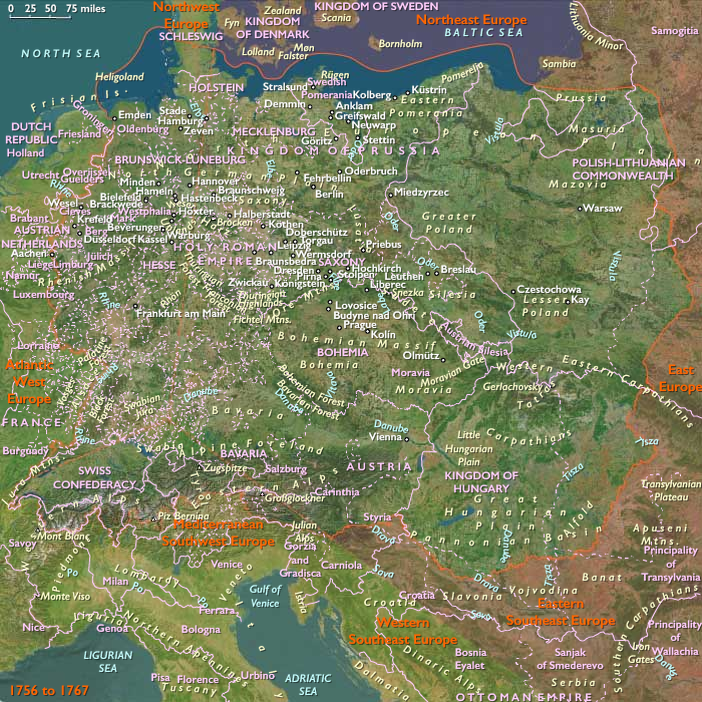
Central Europe
View →Subregions
