
The Duke of Brunswick-Bevern has been charged…
November 1757 CE
This soon turns out to be a difficult task, as he has to face the superior Austrian forces, whose main army of fifty-four thousand troops is led by Prince Charles Alexander of Lorraine and Count Leopold Joseph von Daun.
The corps of twenty-eight thousand troops under Franz Leopold von Nádasdy is also able to advance to the front.
Despite their overwhelming superiority, the Austrians want to initially avoid a battle.
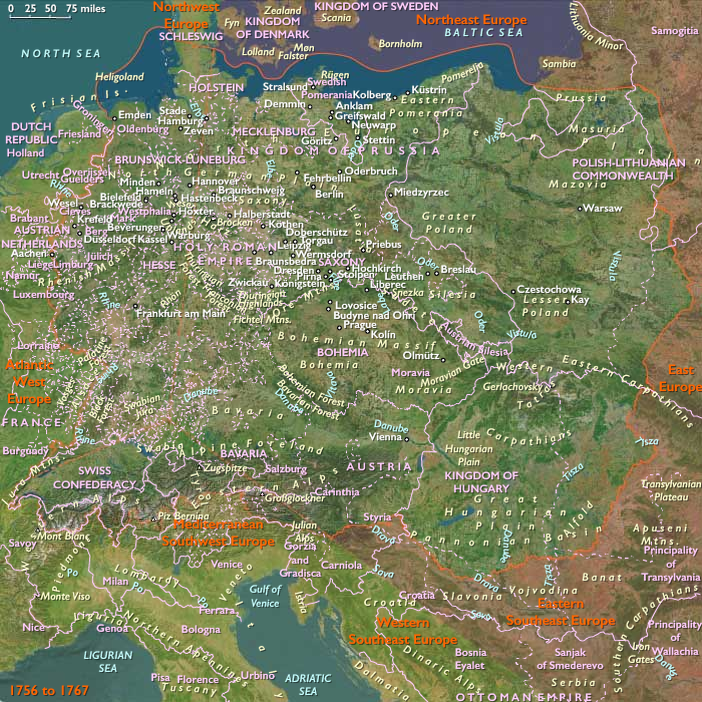
The main army's role is supposed to be to tie up the Prussians, thereby allowing Nádasdy’s forces to take the fortress of Schweidnitz, which is a key position ensuring the flow of supplies Bohemia to Silesia.
After Nádasdy’s corps had been reinforced, bringing its strength up to forty-thee thousand troops, the Austrians had surrounded Schweidnitz on October 14.
The handover had then occurred place on November 13.
Until that time, Bevern had managed to keep the main Austrian army engaged in battle, but it had been considerably strengthened after joining Nádasdy’s corps.
As a direct result of the additional reinforcements, the Austrian army command gives up their position and decides to launch an immediate attack on the Prussians; their intention is to take Breslau before the arrival of the main Prussian forces so that they will be unable to winter in Silesia.
The Prussians have over forty battalions and one hundred and two squadrons at their disposal (totaling twenty-eight thousand four hundred troops).
The Austrian army, however, consists of ninety-six battalions, ninety-three grenadier companies, one hundred and forty-one squadrons and two hundred and twenty-eight artillery pieces (totaling eighty-three thousand six hundred and six troops).
Prince Charles Alexander of Lorraine attacks the Prussian forces on November 22 outside the gates of Breslau, between the villages of Kosel und Gräbschen, launching the battle with a cannonade.
The Prussians, who had taken up fortified positions in the surrounding villages, are now attacked at three separate points.
After the Austrians are able to conquer the first few villages, they man them with howitzers and intensify their cannonade, after which the duke of Brunswick-Bevern gathers ten regiments together and begins a counter-attack.
A tough, bloody struggle for the villages begins, in which the Prussians are able to score several decisive successes against the superior Austrian forces.
It has never been established whether Bevern wanted to lead another counter-attack the next day or whether the retreat.
Nevertheless, the Prussians do retreat, which seems to have begun suddenly as if on cue, whether it had been ordered or not.
The battlefield is consequently abandoned to Prince Charles and the Prussians return to Glogau via Breslau.
The battle, which has lasted almost the entire day, has cost the Austrians five thousand seven hundred and twenty-three men and the Prussians six thousand three hundred and fifty men.
Locations
People
Groups
Subjects
Regions
Central Europe
View →Subregions
