
Louis Pasteur, newly made administrator and director…
1856 CE
Louis Pasteur, newly made administrator and director of scientific studies of the École Normale Supérieure in Paris, discovers in 1856 that fermentation is caused by microorganisms, and that the growth of microorganisms in nutrient broths is not due to spontaneous generation.
Locations
People
Subjects
Regions
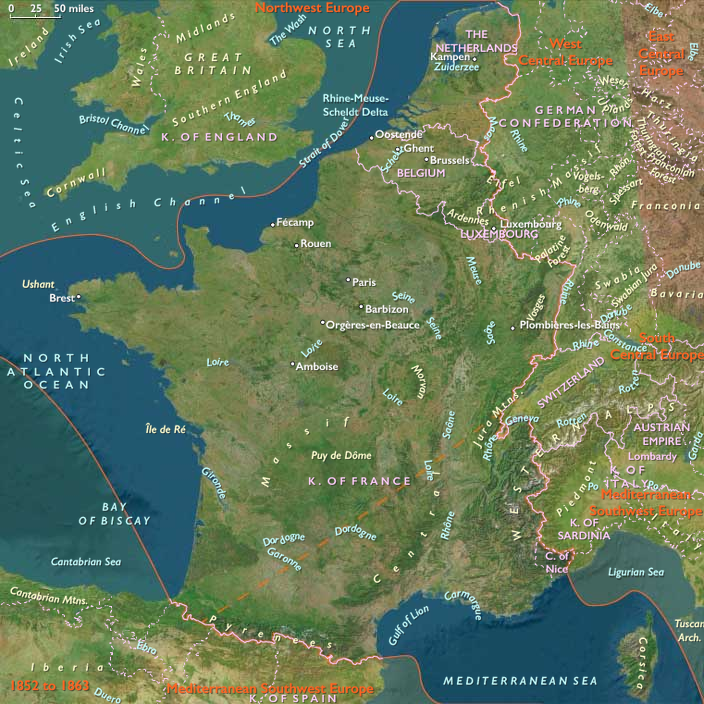
West Europe
View →Subregions
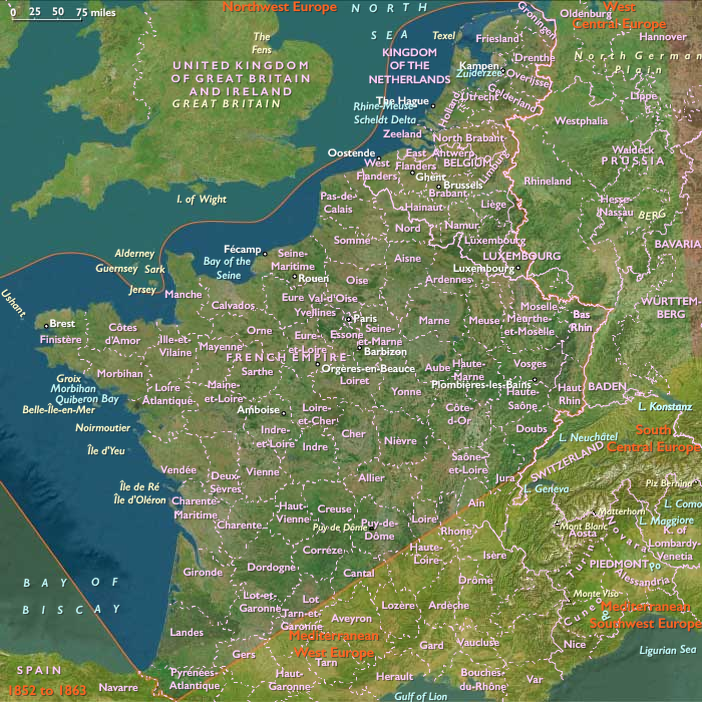
Atlantic West Europe
View →Related Events
No active filters.
Showing 10 events out of 15433 total
Mongkut concludes trade and friendship agreements with France and the US in 1856;
Chang Lo-hsing receives the title of “lord of the alliance” of the Nien in 1856, but he is far too weak to form a center.
Yang, as eastern king, has attempted to usurp much of the T'ien-wang's power prerogatives as Heavenly King, and in 1856 the resentful Hong orders Yang's execution.
Shi Dakai plots with the northern king Wei Changhui to kill Yang.
Not only is Yang put to death on September 2, 1856, but also his entire family and thousands of his adherents are destroyed.
When Shi objects to the slaughter, the northern king plots to kill him, but Shi discovers the plot and escapes, taking with him a large personal following and some of the most able Taiping commanders.
The Muslim-Chinese clash in central Yunnan develops into a slaughter of a great many Muslims in and around the provincial capital, K'un-ming, the following April.
This causes a general uprising of Yunnan Muslims, led by Tu Wen-hsiu, alias Sultan Sulayman.
Obtaining arms from the British authorities in Burma, Tu stages the Panthay Rebellion, a separatist movement of the Hui people and Chinese Muslims.
The British, seeking to extend their trading rights in China, find an excuse to renew hostilities in 1856 when some Chinese officials board the ship Arrow (a Chinese-owned ship registered in Hong Kong under British nationality and engaged in the opium trade) and lower the British flag.
The French join the British in this Second Opium War or Arrow War, using as their excuse the murder of a French missionary in the interior of China.
China’s Anglo-French War, or second Opium War, which begins in 1856, sees the foreign occupation and looting of Beijing.
Russia expands at Chinese expense.
The element aluminum is first isolated by Friedrich Wöhler, due to the isolation of the elements yttrium, beryllium, and titanium, the observation that "silicium" (silicon) can be obtained in crystals, and that some meteoric stones contain organic matter.
Wöhler analyzes meteorites, and for many years has written the digest on the literature of meteorites in the Jahresberichte über die Fortschritte der Chemie; he possesses the best private collection of meteoric stones and irons existing.
He and Henri Étienne Sainte Claire Deville had discovered the crystalline form of boron, and Wöhler and Heinrich Buff discover silane in 1856.
Wöhler also prepared urea, a constituent of urine, from ammonium cyanate in the laboratory without the help of a living cell.
The strict and repressive regime that had been imposed on Poland after the November Insurrection (1830-31) is substantially relaxed after Alexander II becomes emperor of Russia and king of Poland in 1855.
Conspiratorial societies that oppose any form of Russian rule in Poland remain active nevertheless, and gain support, particularly among students and other groups of urban youth.
Hermann von Helmholtz publishes the first of his seminal Handbook of Physiological Optics trilogy in 1856, providing empirical theories on spatial vision, color vision, and motion perception.
Russia's defeat in the Crimea forces the tsar to seek peace, affirmed in 1856 by the Treaty of Paris.
De jure Ottoman suzerainty over the principalities continues after the treaty, which abolishes the Russian protectorate and replaces it with a joint European guarantee.
The treaty also frees navigation on the Danube and forces Russia to cede part of southern Bessarabia, which includes control of the river's mouth, to Moldavia.