Alois Senefelder starts a publishing firm using…
1792 CE to 1803 CE
The value of the new cheap and exact reproduction process is recognized early by land surveying offices across Europe.
Senefelder was born Aloys Johann Nepomuk Franz Senefelder in Prague, at that time an Imperial city (Reichsstadt) of the Holy Roman Empire of the German Nation, where his actor father was appearing on stage.
Educated in Munich, he had won a scholarship to study law at Ingolstadt, but the death of his father in 1791 had forced him to leave his studies to support his mother and eight siblings, and he became an actor and wrote a successful play, Connoisseur of Girls.
Problems with the printing of his play Mathilde von Altenstein had caused him to fall into debt, and unable to afford to publish a new play he had written, Senefelder experimented with a novel etching technique using a greasy, acid resistant ink as a resist on a smooth fine-grained stone of Solnhofen limestone.
He then discovered that this could be extended to allow printing from the flat surface of the stone alone, the first planographic process in printing.
He joins with the André family of music publishers and gradually brings his technique into a workable form, perfecting both the chemical processes and the special form of printing press required for using the stones.
He calls it "stone printing" or "chemical printing", but the French name "lithography" becomes more widely adopted.
Locations
People
Commodities
Regions
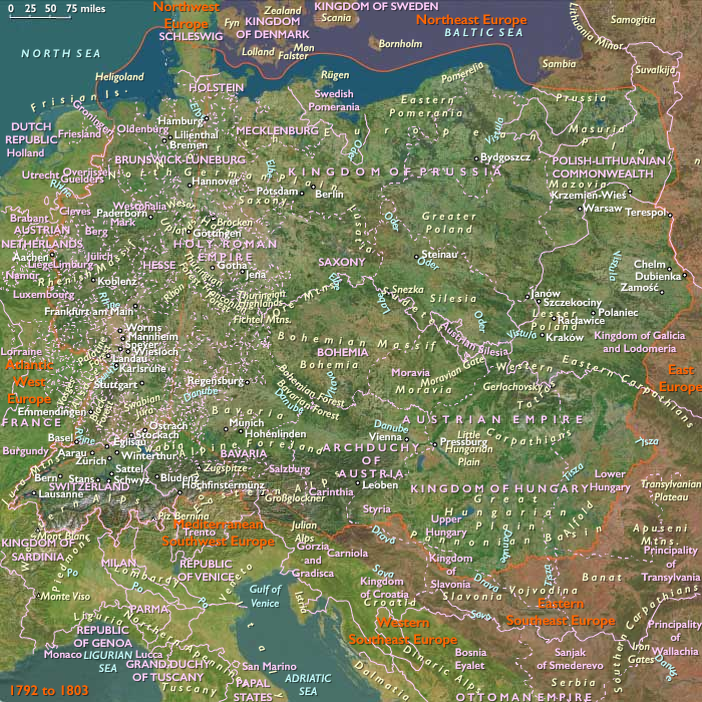
Central Europe
View →Subregions