The first complete identified remains of Archaeopteryx…
September 1861 CE
Over the ensuing years, twelve body fossil specimens of Archaeopteryx will be found.
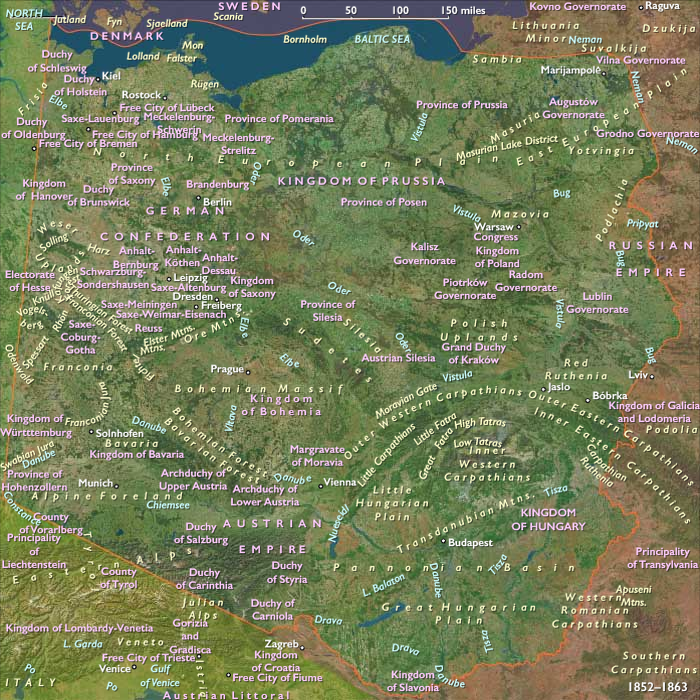
All of the fossils come from the limestone deposits, quarried for centuries, near Solnhofen in Bavaria.
The initial discovery, a single feather, had been unearthed in 1860 or 1861 and described in 1861 by Hermann von Meyer.
It is currently located at the Natural History Museum of Berlin.
Though it is the initial holotype, there are indications that it might not have been from the same animal as the body fossils.
In 2019 it will be reported that laser imaging had revealed the structure of the quill (which had not been visible since some time after the feather was described), and that the feather was non-avian.
The first skeleton, known as the London Specimen (BMNH 37001), is unearthed in 1861 near Langenaltheim, Germany, and perhaps given to local physician Karl Häberlein in return for medical services.
He then sells it for £700 to the Natural History Museum in London, where it remains.
Missing most of its head and neck, it will be described in 1863 by Richard Owen as Archaeopteryx macrura, allowing for the possibility it did not belong to the same species as the feather.
Charles Darwin, in the subsequent fourth edition of his On the Origin of Species, will describe how some authors had maintained "that the whole class of birds came suddenly into existence during the eocene period; but now we know, on the authority of professor Owen, that a bird certainly lived during the deposition of the upper greensand; and still more recently, that strange bird, the Archaeopteryx, with a long lizard-like tail, bearing a pair of feathers on each joint, and with its wings furnished with two free claws, has been discovered in the oolitic slates of Solnhofen. Hardly any recent discovery shows more forcibly than this how little we as yet know of the former inhabitants of the world."
Locations
People
Groups
Subjects
Regions
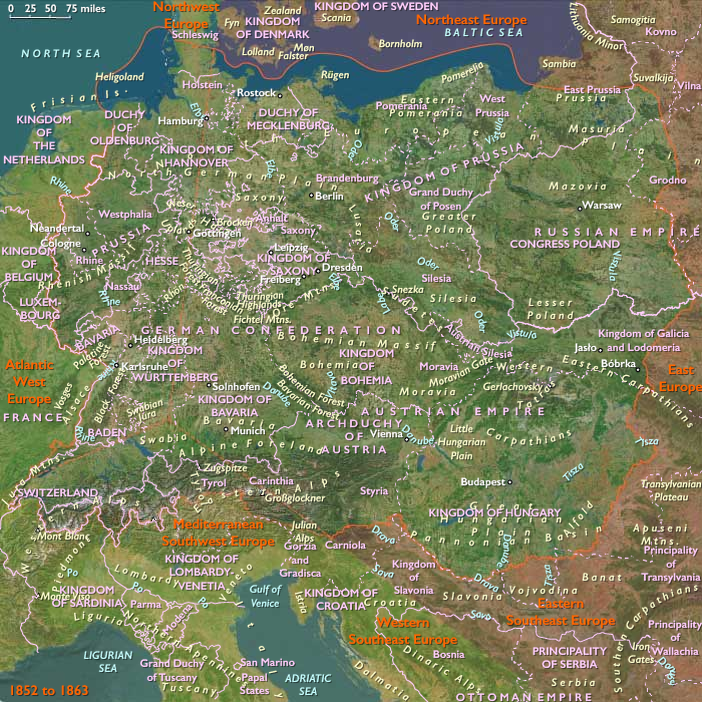
Central Europe
View →Subregions