
The Good Friday fire in New Orleans…
March 1788 CE
Because the fire starts on Good Friday, priests refuse to allow church bells to be rung as a fire alarm.
Within five hours it has consumed almost the entire city as it is fed by a strong wind from the southeast.
The fire destroys virtually all major buildings in the city (now French Quarter), including the church, municipal building, army barracks, armory, and jail.
Colonial Governor Esteban Rodríguez Miró sets up tents for the homeless.
The fire area stretches between Dauphine Street and the Mississippi River and between Conti Street in the south and St. Philip Street in the north.
It spares the riverfront buildings including the Customs House, the tobacco warehouses, the Governor's Building, the Royal Hospital, and the Ursuline Convent.
Colonial officials are to replace the wooden buildings with masonry structures, which have courtyards, thick brick walls, arcades, and wrought iron balconies.
Among the new buildings will be the central New Orleans (now Jackson Square) fixtures of St. Louis Cathedral, the Cabildo, and the Presbytere.
The funds and supervision for the Cathedral and the Cabildo will be provided by Don Andres Almonaster y Rojas.
The Cabildo will burn in the 1794 fire and have to be reconstructed.
The Presbytere will be built on a somewhat later basis, and Almonaster will die before it can be completed.
Groups
Subjects
Regions
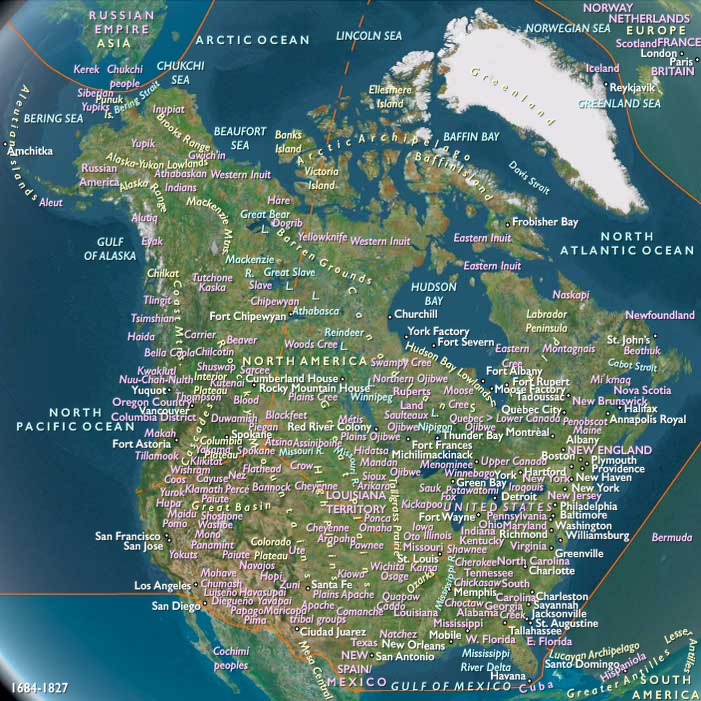
Northern North America
View →Subregions
