
García Íñiguez, the son of Íñigo Arista, …
Years: 851 - 851
March
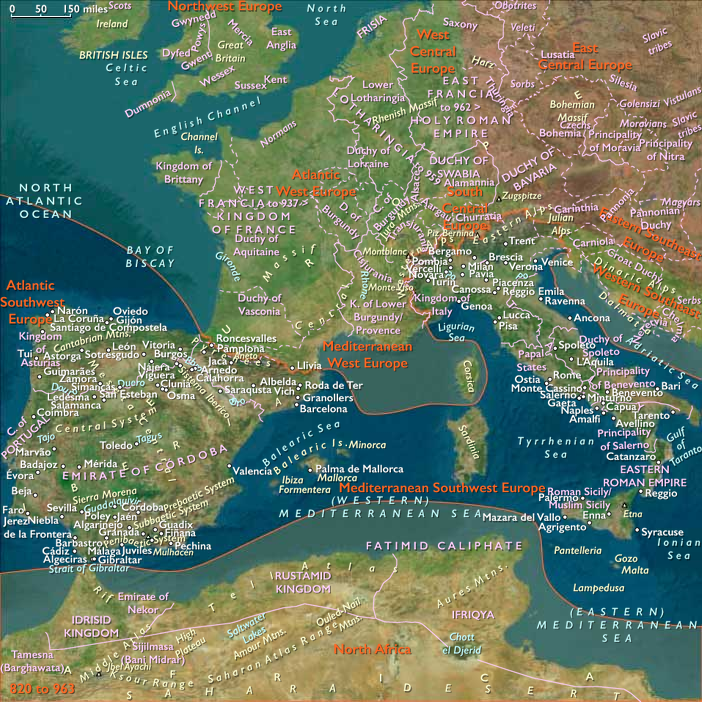
García Íñiguez, the son of Íñigo Arista, the first king of a Basque dynasty ruling in Pamplona, had been educated in Córdoba, as a guest at the court of the Emir of Córdoba.
When his father was stricken by paralysis in 842, García had become regent of the kingdom (or perhaps co-regent with his uncle Fortún Íñiguez).
He and his kinsman Mūsā ibn Mūsā ibn Fortún of the Banu Qasi had rebelled against the Cordoban emir in 843.
This rebellion had been put down by Emir Abd ar-Rahman II, who had attacked the Kingdom of Pamplona, defeating García badly and killing Fortún.
At his father's death in 851/2 (237 A.H.), he succeeds to the crown.
Locations
People
Groups
- Moors
- Galicia, Kingdom of
- Banu Qasi
- Córdoba, Umayyad Emirate of
- Navarre, Kingdom of
- Asturias, Kingdom of
Topics
Commodoties
Subjects
Regions
Subregions
Related Events
Filter results
Showing 10 events out of 54139 total
Paulicianism, revived in the early ninth century, had expanded into Cilicia and Asia Minor under Sergius (Tychicus), who had made it strong enough to survive the persecution and massacre instigated by Emperor Michael III and his mother, the empress Theodora, in 843-844.
Ordoño I: The First Hereditary King of Asturias
On January 1, 850, Ordoño I succeeds his father, Ramiro I, as King of Asturias. Unlike his predecessors, who were elected by the Asturian nobility, Ordoño ascends the throne as his father’s heir, making him the first Asturian king to inherit the crown without election.
Early Challenges: The Basque Rebellion and the Banu Qasi
Ordoño’s reign begins with immediate military challenges. His first confrontation is with the Basques, who rebel with the support of the Banu Qasi of Zaragoza, a powerful Muslim dynasty of Muladi origin that frequently shifted alliances between Christians and the Emirate of Córdoba.
Ordoño marches against the rebels and successfully defeats them, restoring control over the region.
Victory Against the Moors at the Ebro
While returning to Oviedo after his victory, Ordoño receives urgent news of an impending Moorish attack on Vardulia (part of modern Castile). Rather than waiting for the enemy to strike, Ordoño intercepts the Muslim forces near the Ebro River and decisively defeats them, securing his realm’s northern frontier.
These early military successes solidify Ordoño’s rule and mark the continuation of Asturian resistance against both Muslim incursions and internal uprisings.
Canterbury has suffered great loss of life during Danish raids in 842 and 851.
Danish Vikings, having wintered on Thanet Island in the Thames, had routed the Mercians.
Æthelwulf of Wessex defeats them, through this victory gaining primacy among the Anglo-Saxon heptarchy.
The Final Campaign of Nominoe and His Death (851): The Founding of Breton Sovereignty
By 851, Nominoe, having successfully expelled Frankish forces from Brittany, embarks on a campaign of territorial expansion into Neustria, striking deep into Frankish heartlands. His rule marks the first true assertion of Breton autonomy, setting the precedent for an independent Brittany.
The Fall of Frankish Garrisons and the Ravaging of Le Mans
- The Frankish garrisons in Rennes and Nantes, installed by Charles the Bald in 850, capitulate to Nominoe in 851.
- With Brittany free of Frankish military presence, Nominoe turns eastward, launching raids into Neustria, particularly targeting Le Mans, which he ravages.
- His campaign demonstrates Breton military strength, taking the fight beyond Brittany’s borders into the heart of West Francia.
Nominoe’s Final Ambition and Sudden Death
- Encouraged by his previous victories, Nominoe plans to advance even further, setting his sights on Chartres, a major Frankish stronghold.
- However, while continuing his campaign in Nantais and Anjou, he dies unexpectedly near Vendôme on March 7, 851.
- He is buried at Redon Abbey, an important monastic center that had benefited from his patronage.
The Succession of Erispoe and the Breton Legacy
- Nominoe is succeeded by his son, Erispoe, who continues his father’s policies of military expansion and resistance to Frankish control.
- Though Nominoe’s own administration did not mimic Carolingian court structures, his successors will adopt Carolingian-style charters, using their language and symbols of legitimacy to solidify Breton rule.
Nominoe’s Legacy: The Founder of Breton Independence
- Nominoe establishes a political tradition of Breton sovereignty, creating a unified Brittany for the first time.
- His military campaigns prove that Brittany is no longer a vassal state of West Francia, but an independent power capable of rivaling the Carolingians.
- His rule lays the foundation for the later Duchy of Brittany, ensuring that the region will resist full Frankish integration for centuries to come.
Though Nominoe dies before achieving his full ambitions, his reign marks the birth of an independent Breton state, altering the political landscape of medieval Western Europe.
The Battle of Jengland (851): Erispoe's Victory and the Recognition of Breton Independence
Following the death of Nominoe in March 851, his son Erispoe is proclaimed leader of Brittany. However, his claim to power is immediately challenged by Charles the Bald, the King of West Francia, who still considers Brittany a Frankish vassal state.
Determined to continue his father’s campaign for Breton autonomy, Erispoe allies with Lambert II of Nantes, a Frankish noble who had been dispossessed by Charles. Their forces continue the Breton offensive, prompting Charles to launch a counter-campaign to reassert his authority over the region.
Charles the Bald Prepares for War
- Faced with the Breton threat, Charles seeks support from his brother, Louis the German, who provides a contingent of Saxons to bolster the Frankish army.
- In August 851, Charles leads his forces from Maine, advancing into Brittany along the Roman road from Nantes to Corseul.
- The Frankish army is estimated at around 4,000 troops, while Erispoe commands a much smaller force of approximately 1,000 men.
The Battle of Jengland: Breton Tactics Prevail
-
Charles arranges his troops in two lines:
- Saxon mercenaries at the front, tasked with absorbing the initial Breton cavalry assault.
- Frankish heavy infantry and cavalry at the rear, prepared for close combat.
-
The battle begins with a javelin assault by the Bretons, forcing the Saxons to retreat behind the Frankish line.
-
The Franks are taken by surprise, expecting a direct engagement, but instead, the Bretons employ a highly mobile strategy reminiscent of Parthian tactics:
- Hit-and-run attacks, avoiding prolonged melee.
- Feigned retreats, drawing the Frankish forces out and isolating groups.
- Encirclement maneuvers, overwhelming overextended Frankish troops.
-
The battle lasts two days, during which the Franks suffer catastrophic losses in men and horses, while the Bretons remain relatively unscathed.
-
Unable to counter Erispoe’s superior mobility, Charles withdraws under cover of night.
-
When his disappearance is discovered the next morning, panic spreads among the remaining Frankish soldiers, leading to a disorganized rout.
-
The Bretons raid the Frankish camp, seizing weapons, armor, and supplies, and slaughtering fleeing soldiers.
Aftermath: The Treaty of Angers and Recognition of Brittany (851)
- Following his humiliating defeat, Charles is forced to recognize Erispoe as King of Brittany at the Treaty of Angers (851).
- Brittany is now fully independent from West Francia, marking the first formal recognition of Breton sovereignty.
- In addition to recognizing Erispoe’s rule, Charles cedes the counties of Rennes, Nantes, and Retz to Brittany, further expanding its territory.
Legacy of the Battle of Jengland
- Erispoe secures Brittany’s autonomy, continuing his father Nominoe’s legacy.
- Frankish military dominance is shattered, proving that Brittany is no longer just a rebellious province but a fully independent power.
- Charles the Bald, already struggling with Viking incursions and internal noble revolts, is forced to abandon further attempts to conquer Brittany.
- The battle cements the reputation of the Breton cavalry, whose mobile tactics prove effective against heavily armored Frankish forces, shaping Breton military doctrine for centuries.
The Battle of Jengland (851) is a turning point in the history of Brittany, securing Breton independence from Carolingian rule and reshaping the balance of power in Western Francia.
The Treaty of Angers (851): The Recognition of the Kingdom of Brittany
Following Erispoe’s decisive victory over Charles the Bald at the Battle of Jengland (851), the relationship between the Franks and the Bretons is permanently redefined. Recognizing his inability to subjugate Brittany by force, Charles meets Erispoe at Angers in September 851 to formalize a peace settlement.
The Terms of the Treaty of Angers (851)
-
Recognition of Erispoe as "King of Brittany"
- Erispoe formally submits to Charles as Emperor, acknowledging nominal Carolingian overlordship.
- In return, Charles grants him the title of "rex" (king), elevating Erispoe’s status beyond that of a mere duke or regional leader.
- This allows Erispoe to rule Brittany as a recognized sovereign, even though he remains, in principle, a vassal of the Carolingians.
-
Expansion of Brittany’s Borders
- Charles cedes the former Breton March to Erispoe, including:
- Rennes
- Nantes
- Pays de Retz
- These territories, previously controlled by the Franks as a buffer zone, are now fully integrated into Brittany.
- For the first time, Brittany incorporates a significant non-Breton population, composed of Gallo-Roman and Romano-Frankish peoples, marking a shift in its political and cultural composition.
- Charles cedes the former Breton March to Erispoe, including:
-
The Stabilization of Franco-Breton Relations
- The treaty sets the limits of historic Brittany, essentially defining the borders of the medieval Duchy of Brittany and the later French province of Brittany.
- While later Breton rulers will attempt further expansion, their ability to hold additional lands proves difficult, as the treaty establishes a stable equilibrium between the two realms.
- By securing political recognition, Erispoe ensures that Brittany is no longer viewed as a rebellious province, but rather as a legitimate kingdom within the Frankish sphere.
The Long-Term Impact of the Treaty of Angers
- Breton Sovereignty is Secured → Though technically a vassal state, Brittany now operates as an independent kingdom, setting a precedent for later Breton rulers.
- Franco-Breton Peace Enables Defense Against the Vikings → With Franco-Breton relations stabilized, the Bretons can now focus on defending their land from Norse incursions, which will become a major threat in the coming decades.
- Defines the Borders of Brittany for Centuries → The treaty essentially establishes Brittany's medieval borders, ensuring that its territorial core remains distinct even as its rulers occasionally expand or lose lands.
The Treaty of Angers (851) marks a turning point in Franco-Breton relations, as it not only ends decades of conflict but also formally establishes Brittany as a political entity, separate from direct Carolingian control. While future Breton rulers will face internal and external challenges, this agreement cements Brittany’s place in medieval Europe as a kingdom in its own right.
Godfrid Haraldsson's Raids in Frisia and Flanders (851): The Devastation of Ghent and Drongen
In 851, the Danish Viking leader Godfrid Haraldsson, having previously raided Frisia alongside his cousin Rorik, returns to launch a new wave of attacks against Frankish territories. His campaign targets key settlements along the Rhine, the Scheldt, and Flanders, demonstrating the continued vulnerability of the Carolingian Empire to Viking incursions.
Godfrid’s Raids in Frisia and the Rhine Region
- Frisia is once again ravaged, as Viking forces plunder coastal settlements and trading centers.
- Moving inland, Godfrid’s fleet sails up the Rhine, attacking Frankish river towns and disrupting trade routes.
The Attack on Ghent and the Destruction of Drongen Abbey
- After raiding along the Rhine, Godfrid sails up the Scheldt River, targeting the rich Flemish region.
- He attacks and plunders Ghent, one of the most important towns in Flanders.
- His forces then turn to the Abbey of Drongen, an influential monastic center, which they destroy, looting its wealth and likely slaughtering its inhabitants.
Impact of the 851 Raids
- Continued Frankish Weakness → The inability of Charles the Bald to prevent Viking incursions underscores the empire’s vulnerability, especially as it remains politically divided.
- Destruction of Religious and Economic Centers → The destruction of Drongen Abbey is part of a wider pattern of Viking attacks on monasteries, which serve as both rich plunder sites and symbols of Christian authority.
- Strategic Viking Expansion → By controlling key waterways like the Scheldt and the Rhine, the Vikings consolidate their ability to conduct deeper raids into the Frankish heartland.
A Prelude to More Viking Incursions
- The raid of 851 foreshadows further Norse expansion, as Viking leaders increasingly establish permanent bases in Frisia and along major rivers.
- Frankish efforts to resist the Vikings will lead to further tributes (Danegeld) and, eventually, territorial concessions—mirroring the later settlement of Normandy in 911.
Godfrid’s ruthless campaign in 851 signals that Viking raiding is no longer seasonal but part of a sustained strategy of conquest and occupation, further weakening Carolingian control in the Low Countries.
Years: 851 - 851
March
Locations
People
Groups
- Moors
- Galicia, Kingdom of
- Banu Qasi
- Córdoba, Umayyad Emirate of
- Navarre, Kingdom of
- Asturias, Kingdom of
