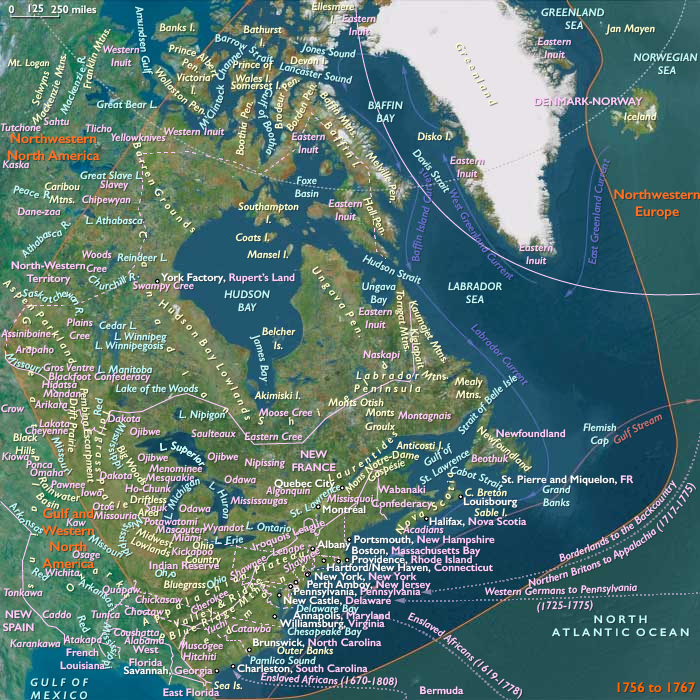
Moses Hazen, who had purchased a commission…
1763 CE
General James Murray wrote approvingly of Hazen in 1761, "He discovered so much still bravery and good conduct as would justly entitle him to every military reward he could ask or demand".
Hazen was born in Haverhill, a frontier town in the Province of Massachusetts Bay, to an old New England Puritan family whose family name was Hassen in England.
Some histories that mention Hazen sometimes indicated that he was Jewish: his contemporaries seem to have thought he was Jewish; for example, Sergeant James Thompson, in his diary The Fraser’s Highlanders, describes meeting him during the retreat from the Battle of Sainte-Foy: "On the way, I fell in with a Captain Moses Hazen, a jew".
Apprenticed to a tanner when the French and Indian War broke out in 1756, he had enlisted with the local militia, which included a number of family members.
He first served at Fort William Henry near Lake George, where he probably first met, and may have served under, Robert Rogers of Rogers' Rangers.
Rogers had eventually recommended him for an officer's commission in a new company of the Rangers; after having worked for his brother providing supplies for the British Siege of Louisbourg, he had been commissioned as a first lieutenant in John McCurdy's company of the Rangers at Fort Edward in 1758.
In McCurdy's company, he had seen action at Louisbourg, including the initial landings, when the action was quite fierce.
After Louisbourg, the company was stationed first at Fort Frederick (Saint John, New Brunswick), and then at Fort St. Anne, where the company was part of a campaign against natives and Acadians that had taken refuge there from the ongoing expulsion of the Acadians.
These raids were sometimes quite brutal; the company was known to scalp Acadian settlers.
In one particularly brutal incident, Hazen was responsible for the scalping of six men, and the burning of four others, along with two women and three children, in a house he set on fire.
Joseph Bellefontaine, a leader of the local militia and the father of one of the women, claimed that he was forced to witness this event in an attempt to coerce his cooperation with the rangers. (Bellefontaine escaped into the woods with two of his grandchildren.)
General Jeffrey Amherst, who had not heard of the incident until after he had promoted Hazen to captain, noted, "I am sorry that to say what I have since heard of that affair has sullied his merit with me as I shall always disapprove of killing women and helpless children."
When Captain McCurdy was killed in January 1759, by a tree felled by one of his men, Hazen had been given command of the company.
Later in that year his company was at the siege of Quebec, where the company was primarily engaged in scouting and raiding in the countryside; he was away on one of those raids during the Battle of the Plains of Abraham.
In another notable atrocity that may have involved Hazen's company, a priest and thirty parishioners in a parish near Quebec were killed and scalped.
Hazen also fought at the 1760 Battle of Sainte-Foy, where he was severely wounded in the thigh.
People
Groups
Topics
Regions
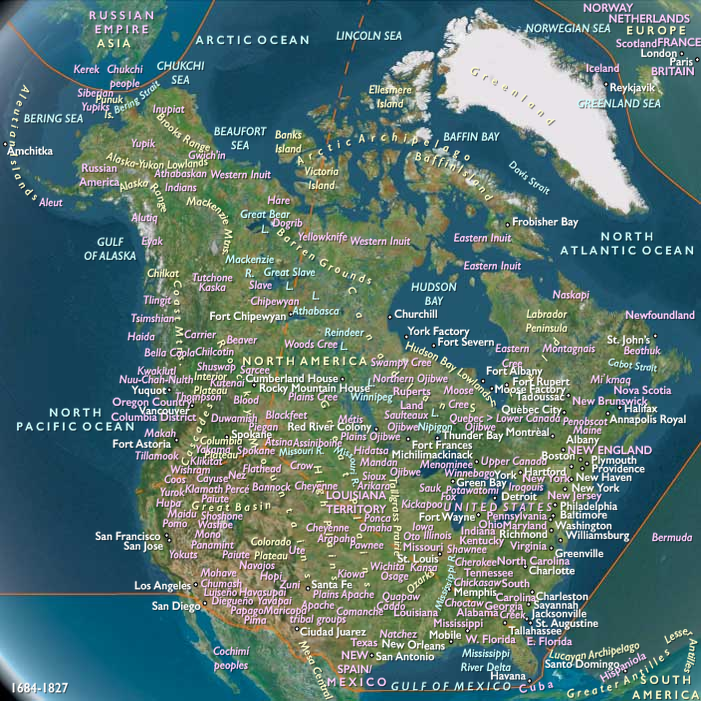
Northern North America
View →Subregions