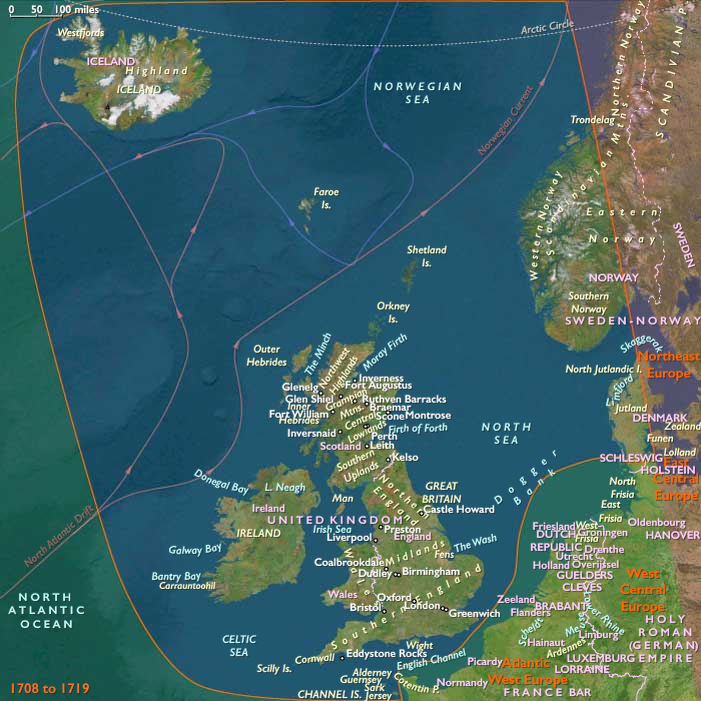
George Frideric Handel, who had in 1710…
1712 CE
George Frideric Handel, who had in 1710 become Kapellmeister to George, Elector of Hanover, who will soon become King George I of Great Britain, had visited London in 1710 and settles here permanently in 1712, receiving from Queen Anne a yearly income of two hundred pounds.
Born at Saxony-Anhalt to Georg and Dorothea (née Dorothea Taust) Händel in 1685, the birth year of both Johann Sebastian Bach and Domenico Scarlatti, had displayed considerable musical talent at an early age; by the age of seven he was a skillful performer on the harpsichord and organ, and at nine he had begun to compose music.
His father, an eminent barber-surgeon who served as valet and barber to the Courts of Saxony and Brandenburg, as well as a distinguished citizen of Halle, had been opposed to George Friederich pursuing a musical career, preferring him to study law, whereas his mother, Dorothea, encouraged him in his music.
The young Handel had nevertheless been permitted to take lessons in musical composition and keyboard techniques from Friedrich Wilhelm Zachau, the organist of the Liebfrauenkirche, Halle.
His aunt, Anna, had given him a spinet (early harpsichord with a single keyboard and only one string for each note) for his seventh birthday, which they moved into the attic and he went there to play it whenever he could.
In obedience to his father's wishes, he had begun the study of law at the University of Halle in 1702, but after his father's death the following year, he had abandoned law for music, becoming the organist at the Protestant Cathedral.
He moved the following year to Hamburg, accepting a position as violinist and harpsichordist in the orchestra of the opera-house.
Here, early in 1705, his first two operas, Almira and Nero, had been produced.
Two other early operas, Daphne and Florindo, had been produced in 1708 at Hamburg.
Handel from 1707 to 1709 had traveled and studied in Italy.
After local authorities banned opera, Handel had found work as a composer of sacred music and had written some pieces in operatic style.
The famous Dixit Dominus (1707) is from this era.
His Rodrigo had been produced in Florence in 1707, and his Agrippina at Venice in 1708.
Two oratorios, La Resurrezione and Il Trionfo del Tempo, had been produced at Rome in 1709 and 1710, respectively.
Locations
People
Groups
Topics
Subjects
Regions
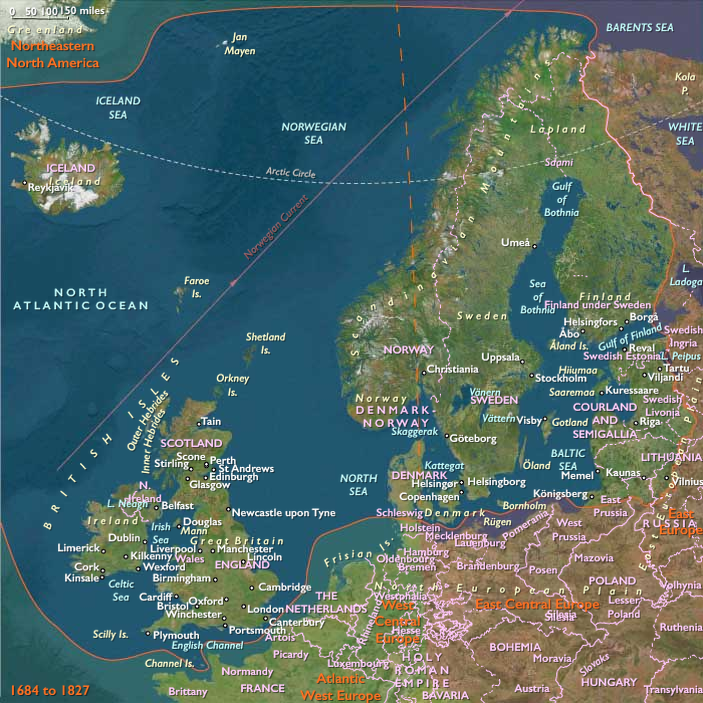
North Europe
View →Subregions