Donald Smith famously hammers home the last…
November 1885 CE
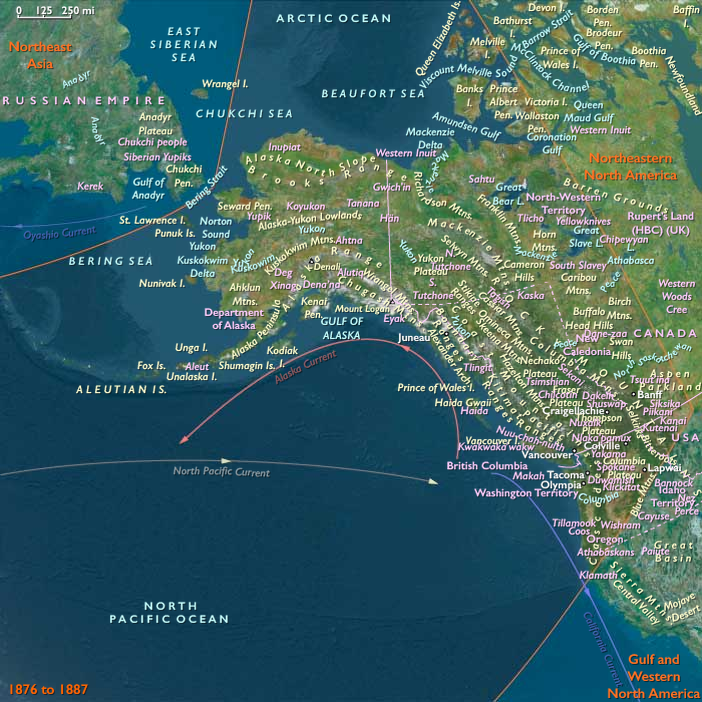
Donald Smith famously hammers home the last spike in the Canadian Pacific Railway on November 7, 1885, at Craigellachie, British Columbia, .
Smith, George Stephen, and Richard Angus are the sole members of the original syndicate to have kept their nerve.
Their gamble pays off and the success of the first leg of what will soon become the "world's greatest transportation system" almost immediately makes them enormously rich.
Stephen, as the first president of the Canadian Pacific Railway, has overseen the monumental task of not just negotiating a route across two thousand miles of forests, swamps, rivers, and mountains; but also raising the necessary funds estimated at one hundred million dollars, of which at least half had to be secured.
At James Hill's suggestion, he had hired William Cornelius Van Horne to construct three major sections of the track, and his partnership with James Ross had proved invaluable to the engineering success of the railway.
However, by the end of 1881, Stephen admitted that the project was "assuming dimensions far beyond my calculations".
He had ceased all other activities, and bringing R. B. Angus to Montreal with him, they had devoted all their energies to the world's first transcontinental railroad.
As Stephen purposefully did not want a long list of investors, the risks were high to all those involved and the CPR had found few takers in London and New York.
By 1883, the syndicate was straining under the huge financial obligations being called of them.
Stephen was risking almost all of his fortune on the venture and even used his mansion in Montreal as collateral.
Hill had resigned in 1883, when he realized that his own railroad would be in direct competition with the CPR for eastbound traffic.
However, through loyalty to his partners, he had held on to half of his shares.
Next, Johsn Stewart Kennedy resigned, depressing the CPR stock even further and making Stephen's increasingly frantic attempts to find capital even more difficult.
In the face of this crisis, fellow Montrealer Duncan McIntyre had resigned in 1884, forcing the other directors to buy his shares and in the process earning himself Stephen's lifelong enmity.
Using every ounce of his experience in banking, natural flair for persuasion and business acumen, Stephen had proved capable of putting together the complicated financing needed to complete the project, despite cost overruns from numerous unanticipated engineering, business and political problems.
The final piece in the financial puzzle had been secured when, in 1885, he traveled to London for a personal appeal that convinced Lord Revelstoke and Barings Bank to underwrite the sale of £3 million in company stock.
Images

Donald Alexander Smith driving the last spike of the Canadian Pacific Railway, 885
People
Subjects
Regions
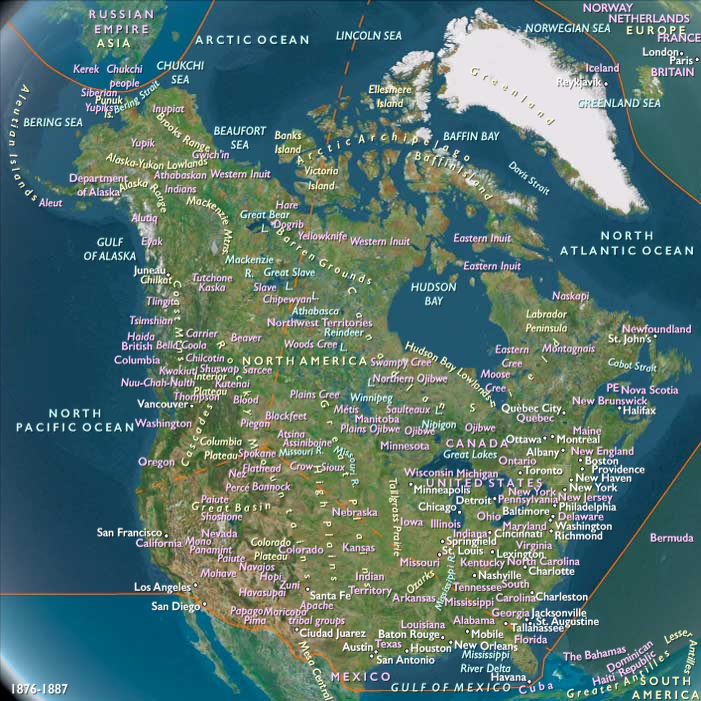
Northern North America
View →Subregions