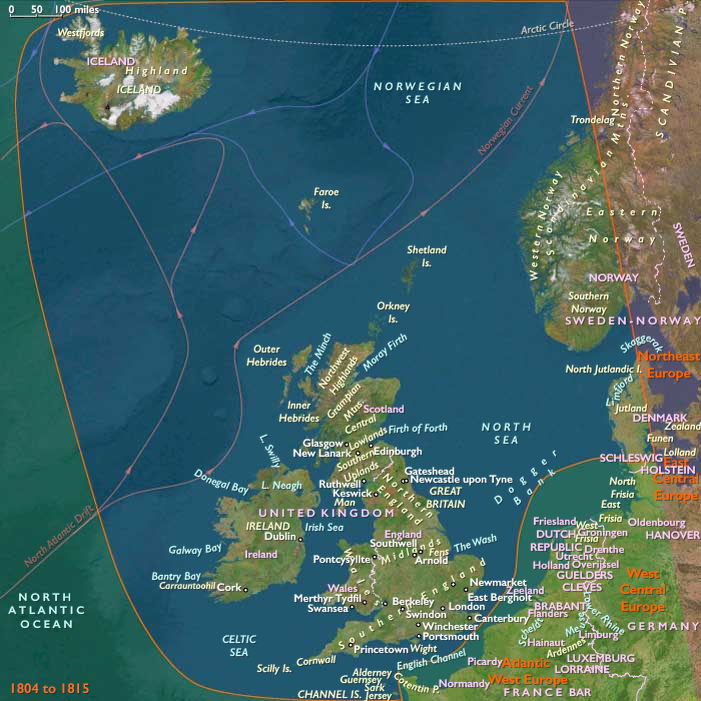
George Stephenson has designed his first locomotive…
July 1814 CE
George Stephenson has designed his first locomotive Blücher, a traveling engine designed for hauling coal on the Killingworth wagonway, and named Blücher after the Prussian general Gebhard Leberecht von Blücher.
His test run of July 25, 1814 is a success.
Constructed in the colliery workshop behind Stephenson's home, Dial Cottage, on Great Lime Road, this locomotive can haul thirty tons of coal up a hill at four miles per hour (six point four kilometers per hours), and is the first successful flanged-wheel adhesion locomotive: its traction depends only on the contact between its flanged wheels and the rail.
Stephenson, the second child of Robert and Mabel, neither of whom could read or write, was born in Wylam, Northumberland, nine point three miles (fifteen kilometers) west of Newcastle upon Tyne.
Robert was the fireman for Wylam Colliery pumping engine, earning a very low wage, so that there was no money for schooling.
At seventeen, George had become an engineman at Water Row Pit, Newburn.
Realizing the value of education, he paid to study at night school to learn reading, writing and arithmetic—he was illiterate till the age of eighteen.
In 1801 he began work at Black Callerton colliery as a 'brakesman', controlling the winding gear of the pit.
The following year, he married Frances (Fanny) Henderson and moved to Willington Quay, east of Newcastle, where he worked as a brakesman while they lived in one room of a cottage.
George made shoes and mended clocks to supplement his income.
In 1803 their son Robert was born, and in 1804 they moved to West Moor, near Killingworth, while George worked as a brakesman at Killingworth pit.
His wife gave birth to a daughter, who died after a few weeks, and in 1806 Fanny died of consumption (tuberculosis).
George then decided to find work in Scotland, leaving Robert with a local woman while he went to work in Montrose.
After a few months he returned, probably because his father was blinded in a mining accident.
George moved back into his cottage at West Moor and his unmarried sister Eleanor moved in to look after Robert.
In 1811 the pumping engine at High Pit, Killingworth was not working properly and Stephenson offered to fix it, doing so with such success that he was soon promoted to enginewright for the neighboring collieries at Killingworth, responsible for maintaining and repairing all of the colliery engines.
He had soon become an expert in steam-driven machinery.
Cornishman Richard Trevithick is credited with the first realistic design of the steam locomotive in 1802.
He later visited Tyneside and had built an engine there for a mine-owner.
Several local men, inspired by this, had designed engines of their own.
Altogether, Stephenson will be said to have produced sixteen locomotives at Killingworth, although it has never proved possible to produce a convincing list of all sixteen.
Of those that have been identified, most were built for use at Killingworth itself or for the Hetton colliery railway.
Subjects
Regions
North Europe
View →Subregions