One of the creators of German idealism…
November 1831 CE
One of the creators of German idealism is the philosopher Georg Wilhelm Friedrich Hegel, with Johann Gottlieb Fichte and Friedrich Wilhelm Joseph Schelling.
Hegel has developed a comprehensive philosophical framework, or "system”, to account in an integrated and developmental way for the relation of mind and nature, the subject and object of knowledge, and psychology, the state, history, art, religion, and philosophy.
In particular, he has developed a concept of mind or spirit that manifests itself in a set of contradictions and oppositions that it ultimately integrates and unites, such as those between nature and freedom, and immanence and transcendence, without eliminating either pole or reducing it to the other.
His influential conceptions are of speculative logic or "dialectic," "absolute idealism," "Spirit," negativity, sublation (Aufhebung in German), the "Master/Slave" dialectic, "ethical life," and the importance of history.
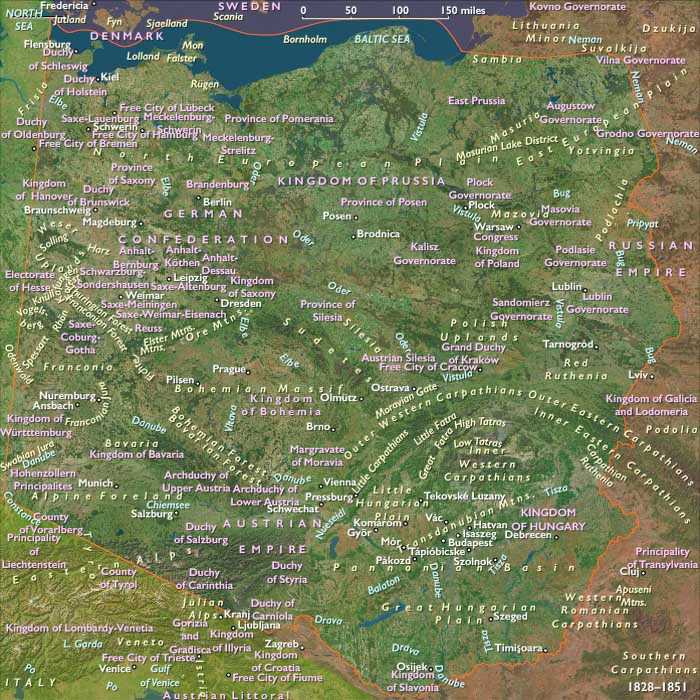
In 1818, Hegel had accepted the renewed offer of the chair of philosophy at the University of Berlin, which had remained vacant since Fichte's death in 1814.
Here, in 1821, he had published his Elements of the Philosophy of Right, his fourth and final book.
Hegel's efforts are primarily directed at delivering his lectures; his fame has spread and his lectures attract students from all over Germany and beyond.
Appointed Rector of the University in 1830, he had been deeply disturbed by the riots for reform in Berlin in that year.
In 1831, Frederick William III decorates him for his service to the Prussian state.
In August of this year, a cholera epidemic originating in Russia reaches Berlin and Hegel leaves the city, taking up lodgings in Kreuzberg.
Now in a weak state of health, Hegel goes out little.
As the new semester begins in October, Hegel had returned to Berlin, under the mistaken impression that the epidemic has largely subsided.
By November 14, Hegel is dead.
The physicians pronounce the cause of death as cholera, but it is more likely he has died from a gastrointestinal disease.
His lecture courses on aesthetics, the philosophy of religion, the philosophy of history, and the history of philosophy will be published posthumously from lecture notes taken by his students.
His development of the Hegelian dialectic triad, in which one thesis is followed by its opposite, the antithesis, and the ensuing conflict between the two is brought together at a higher level as a new concept, or synthesis, which becomes the thesis of yet another triad.
This will serve as the basis of future globalist control paradigms, in which a power elite maintains political control by funding, overtly or covertly, “opposing” social forces to create predetermined outcomes.
The agents provocateur employed by intelligence organizations are classic examples of this application.
Locations
People
Groups
Regions
Central Europe
View →Subregions