
Gottfried von Strassburg and His Tristan (c.…
1210 CE
Gottfried von Strassburg and His Tristan (c. 1210 CE)
Around 1210, Gottfried von Strassburg composed his incomplete yet highly influential romance Tristan, a German version of the legendary love story of Tristan and Isolde. This work departed from the traditional courtly love conventions of the troubadours, instead presenting a mystical, exalted concept of love that transcended marriage and social duty.
Alongside Wolfram von Eschenbach’s Parzival and the anonymous Nibelungenlied, Tristan is regarded as one of the great narrative masterpieces of medieval German literature.
Gottfried’s Unique Approach to the Tristan Legend
-
Mystical Love Over Courtly Convention
- Unlike earlier versions, Gottfried presents Tristan and Isolde’s love as a force of destiny, independent of courtly obligations and wedlock.
- Their love is pure, eternal, and spiritually transformative, rather than a mere adulterous romance.
- This concept elevates passion above feudal and religious constraints, making Tristan both a tragic and philosophical work.
-
Refinement and Psychological Depth
- Gottfried’s sophisticated poetic style and psychological insight enhance character development, especially in Tristan’s inner conflicts.
- His writing blends courtly refinement with deep introspection, making Tristan one of the most nuanced portrayals of love in medieval literature.
-
Incomplete Yet Influential
- Tristan was left unfinished, possibly due to Gottfried’s death.
- It was later completed by other poets, including Ulrich von Türheim and Heinrich von Freiberg, though their additions differ in tone from Gottfried’s original vision.
Gottfried’s Influence and Legacy
-
Inspiration for Richard Wagner
- Gottfried’s version of Tristan directly influenced Wagner’s opera Tristan und Isolde (1865).
- Wagner adopted its themes of transcendent love, fate, and tragedy, shaping one of the most revolutionary works in musical history.
-
A Major Work of German Medieval Literature
- Tristan ranks alongside Parzival and the Nibelungenlied as one of the greatest Middle High German literary achievements.
- Its philosophical exploration of love and destiny set it apart from more conventional Arthurian romances.
-
Possibly a Lyric Poet
- Some scholars believe Gottfried also composed a small number of courtly lyrics, though few have survived.
Conclusion
Gottfried von Strassburg’s Tristan is a masterpiece of medieval German poetry, distinguished by its philosophical depth, poetic brilliance, and radical vision of love. Though unfinished, its legacy endures through later adaptations and its profound influence on Romantic and modern literature, making it a landmark of European storytelling.
Locations
Groups
Subjects
Regions
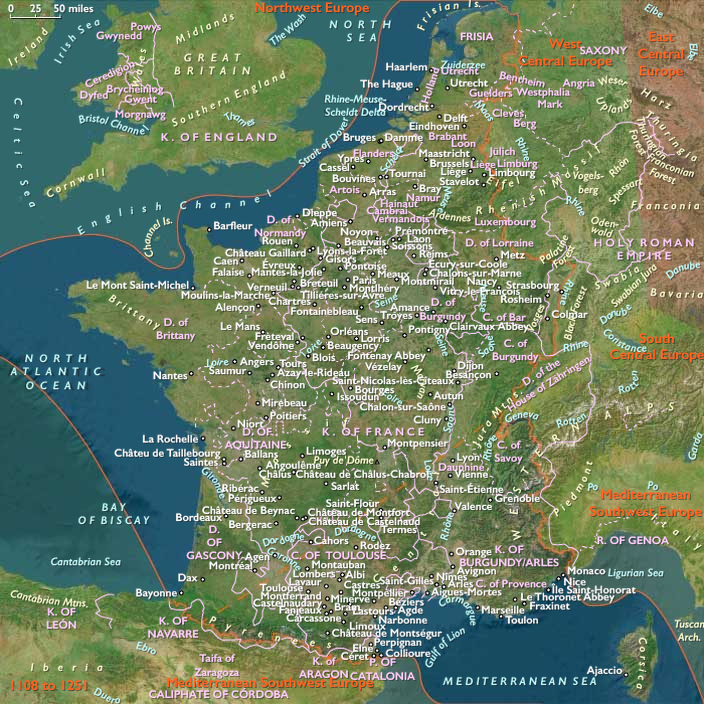
West Europe
View →Subregions
