
Ghatotkacha, who rules the Gupta family holdings …
Years: 316 - 327
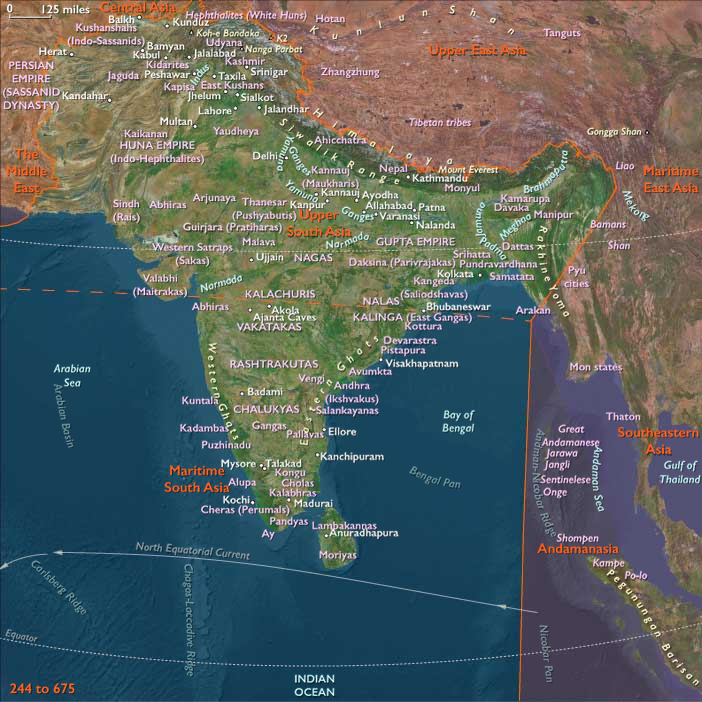
Ghatotkacha, who rules the Gupta family holdings around Bihar from about 280 to 319, is succeeded by his son Chandragupta (not to be confused with Chandragupta Maurya, the fourth century BCE founder of the Mauryan Empire).
In a breakthrough deal, Chandragupta is married to Kumaradevi, a Licchavi princess—the main power in Magadha.
With a dowry of the kingdom of Magadha and an alliance with the Licchavi, Chandragupta sets about expanding his power, conquering much of Magadha, Prayaga and Saketa, to establish by 321 a realm stretching from the Ganges River to Prayaga (modern-day Allahabad).
He assumes the imperial title of Maharajadhiraja, and expands his empire through marriage alliances.
People
Groups
Topics
Commodoties
Subjects
Regions
Subregions

Related Events
Filter results
Showing 10 events out of 161 total
West Europe (1396–1539 CE)
Dynastic Struggles, Maritime Republics, and Reformation Currents
Geography & Environmental Context
West Europe in this age bridged the Mediterranean and the Atlantic through two intertwined spheres.
Mediterranean West Europe encompassed southern France (Languedoc, Provence, the Rhône valley, the French Pyrenees), Monaco, and Corsica—a frontier of mountain uplands, terraced coasts, and river plains tied to Italian and Iberian seas.
Atlantic West Europe ran along the Atlantic and Channel coasts of France, the Loire Valley Burgundy, northern France (including Paris), and the Low Countries (Belgium, the Netherlands, Luxembourg)—fertile basins and estuaries linked to Europe’s commercial cores.
From Marseille and Nice to Antwerp, Rouen, and Bordeaux, ports, riverways, and passes bound inland grainlands to sealanes and mercantile emporia.
Climate & Environmental Shifts
The Little Ice Age brought cooler winters, late frosts, and erratic rains.
-
Languedoc–Provence & Corsica: Vine and olive belts suffered frost damage in severe winters; storms battered harbors.
-
Rhône & Loire valleys; Paris Basin; Burgundy: Alternating floods, droughts, and cold snaps reshaped grain and grape yields.
-
Low Countries & Channel coasts: North Sea surges and wetter fields demanded relentless dike upkeep; fisheries endured rougher seas yet remained staples.
Subsistence & Settlement
-
Mediterranean sphere: Mixed farming of wheat, barley, rye, and legumes in valleys; vines and olives on coastal terraces; chestnuts in Corsican uplands. Sheep–goat transhumance linked Pyrenean and island pastures to town markets. Marseille, Avignon, Montpellier, Nice, and Ajaccio thrived as fortified, trade-facing towns.
-
Atlantic sphere: Wheat, rye, oats, and barley dominated; Burgundy’s vineyards and the Loire’s orchards supported regional exchange; flax and hemp in Flanders; dairy and cattle in the Low Countries. Paris, Rouen, Dieppe, Bordeaux, Bruges, Antwerp, Ghent, and Brussels anchored urban craft and export economies. Fisheries for herring and cod—salted and barreled—fed towns and long-distance trade.
Technology & Material Culture
-
Agriculture: Three-field rotations; water- and windmills; hillside terracing across Provence and Corsica.
-
Shipbuilding & seamanship: Mediterranean galleys and Atlantic cogs evolved toward caravels and larger ocean-going hulls; coastal shipyards provisioned fleets from Marseille to Rouen and Antwerp.
-
Architecture: Flamboyant Gothic cathedrals in Narbonne and Montpellier; papal complexes at Avignon; Genoese towers on Corsica; Burgundian ducal palaces; Flemish belfries and town halls; early Renaissance idioms appeared in Loire châteaux.
-
Print & craft: Lyon, Paris, and Antwerp emerged as printing hubs; Flemish woolens and tapestries, Burgundian wines, and Parisian luxury metalwork set European tastes.
Movement & Interaction Corridors
-
Mediterranean sealanes: Marseille and Monaco linked to Genoa, Naples, and Barcelona; Corsica sat astride Italy–Iberia–Maghreb routes.
-
Rhône corridor: Carried salt, wine, and grain north to Lyon and beyond.
-
Atlantic & Channel arteries: Bruges (declining by 1500), Antwerp (rising), and Rouen tied northern Europe to Iberia and the Mediterranean; Bordeaux connected the Loire–Garonne basins to the ocean.
-
Overland networks: Burgundian roads knit Dijon and Brussels to the Empire and France; pilgrimage roads joined Roussillon, Provence, and the Loire to Santiago de Compostela and Rome.
Cultural & Symbolic Expressions
-
Catholic orthodoxy & humanism: Monastic houses and cathedrals structured devotion; Avignon’s papal legacy lingered. Lyon and Avignon sustained humanist circles; Montpellier’s medical school gained renown.
-
Burgundian court culture: Under the Valois dukes (Philip the Good, Charles the Bold), Dijon and Brussels patronized Jan van Eyck, Rogier van der Weyden, and civic pageantry.
-
French monarchy & Renaissance: Post–Hundred Years’ War recovery culminated in Francis I’s embrace of Italianate forms and royal patronage along the Loire.
-
Netherlandish art: Early Netherlandish painters pioneered oil technique; civic commissions in Ghent, Bruges, and Antwerp flourished. Troubadour legacies survived in lyric verse across Provence; confraternities staged processions and charity in town parishes.
Environmental Adaptation & Resilience
-
Diversified ecologies: Mixed cereals, vines, olives, flax, and livestock spread climatic risk.
-
Water & earth works: Terraces and dikes stabilized fragile slopes and polders; flood embankments guarded the Rhône, Loire, and Low Country coasts.
-
Storage & exchange: Communal barns, urban granaries, and salt trade mitigated shortfalls; guild aid, hospitals, and beguinages provided social buffers.
Technology & Power Shifts (Conflict Dynamics)
-
Hundred Years’ War (to 1453): Though major battles lay north, raids and instability touched Languedoc and Provence. French resurgence culminated in Joan of Arc’s campaigns (1429) and Castillon (1453).
-
Aragon–French rivalry: Roussillon oscillated between crowns; Pyrenean frontiers remained militarized.
-
Burgundian Wars (1474–1477): Charles the Bold fell at Nancy; his inheritance split—parts to France, the rest to the Habsburgs—reshaping Low Country sovereignty.
-
Italian Wars (1494–1559): Drew Provence and Corsica into Valois–Habsburg struggles; Fornovo (1495) and Pavia (1525, capture of Francis I) reverberated through Provençal ports.
-
Corsica: Fought over by Genoa and Aragon; Genoa reasserted control, fortifying coasts against Barbary corsairs.
-
Naval theaters: Mediterranean galley wars and Adriatic–Aegean rivalries impacted Marseille and Monaco; the Low Countries pivoted toward Habsburg naval finance and Atlantic networks.
Transition (to 1539 CE)
By 1539, West Europe stood as a frontier of empires and a laboratory of recovery and renaissance.
In the Mediterranean, France had consolidated Provence and Roussillon yet suffered reverses in Italy; Genoa controlled Corsica, bracing against French and Ottoman pressure; Marseille and Monaco thrived as naval–mercantile hubs under the shadow of corsair raids.
Across the Atlantic sphere, Burgundy was partitioned between Valois and Habsburg realms; the Low Countries emerged as Europe’s commercial heart, with Antwerp surpassing Bruges as entrepôt to Iberian spice and silver trades.
Humanism animated Lyon and Avignon; Gothic and early Renaissance forms stood side by side; confessional tensions gathered on the horizon.
Poised between the Mediterranean and the Atlantic, West Europe entered the mid-16th century as both battlefield and marketplace—its rivers and ports set to channel the coming storms of Reformation and Habsburg–Valois rivalry.
Atlantic West Europe (1396–1539 CE): Burgundian Prestige, French Recovery, and Netherlandish Flourishing
Geographic & Environmental Context
The subregion of Atlantic West Europe includes the Atlantic and Channel coasts of France, the Loire Valley, Burgundy, northern France (including Paris), and the Low Countries (Belgium, the Netherlands, Luxembourg). Anchors included the Channel ports (Calais, Rouen, Dieppe, Antwerp, Bruges, Amsterdam), the Loire valley (Orléans, Tours, Nantes), the Burgundian heartlands (Dijon, Beaune), and the Paris Basin. This zone blended coastal trade hubs, fertile river valleys, and political cores, linking France, England, and the Holy Roman Empire.
Climate & Environmental Shifts
The Little Ice Age imposed cooler winters and erratic harvests:
-
Paris Basin & Burgundy: Periodic frosts reduced wheat and grape harvests.
-
Loire valley: Vineyards and orchards remained productive in most decades but saw occasional setbacks from floods and cold snaps.
-
Low Countries: Waterlogged fields required dike maintenance; storm surges (notably 15th-century North Sea floods) devastated coastal settlements.
-
Atlantic coasts: Rough seas complicated fishing and shipping; herring and cod fisheries persisted, anchoring diets.
Subsistence & Settlement
-
Agriculture: Wheat, rye, oats, and barley; vineyards in Burgundy and the Loire; flax and hemp in Flanders; dairy and cattle in the Low Countries.
-
Fishing: Channel and North Sea fisheries for herring, cod, and flatfish; salted and barrelled for trade.
-
Urban centers: Paris as royal capital; Bruges, Antwerp, Ghent, and Brussels as mercantile and craft hubs; Rouen, Dieppe, and Bordeaux on the Atlantic coast.
-
Craft production: Flemish cloth, Burgundian wines, and Parisian luxury goods (illuminated manuscripts, metalwork).
Technology & Material Culture
-
Agrarian systems: Three-field rotation, water- and windmills, improved plows in northern France and the Low Countries.
-
Textiles: Flemish woolens, later outpaced by English cloth but still dominant; silk and luxury fabrics in Lyon by early 16th century.
-
Architecture: Gothic cathedrals (Rouen, Chartres), Burgundian ducal palaces, Flemish town halls, and belfries; early Renaissance style appeared in royal châteaux along the Loire.
-
Print: Presses in Paris, Lyon, Antwerp; humanist works circulated widely.
Movement & Interaction Corridors
-
Channel & Atlantic ports: Bruges (declining), Antwerp (rising after c.1500), and Rouen tied northern Europe to Iberia and the Mediterranean.
-
Loire River corridor: Linked Atlantic ports to Paris and Burgundy.
-
Burgundian roads: Connected Dijon and Brussels to the Empire and France.
-
Pilgrimage routes: To Chartres, Mont-Saint-Michel, and Santiago via Atlantic ports.
Cultural & Symbolic Expressions
-
Burgundian court culture: Centered at Dijon and Brussels under the Valois dukes (Philip the Good, Charles the Bold); patronized Jan van Eyck, Rogier van der Weyden, and courtly pageantry.
-
French monarchy: Reasserted authority after the Hundred Years’ War; patronage of the arts flourished under Francis I, who embraced the Renaissance.
-
Netherlandish art: Early Netherlandish painters pioneered oil painting; civic patronage in Ghent, Bruges, and Antwerp thrived.
-
Religious life: Catholic piety remained dominant; confraternities, processions, and urban guild altars structured devotion. Reformist murmurs appeared by early 16th century.
Environmental Adaptation & Resilience
-
Dike building & poldering: Secured farmland in the Low Countries; towns rebuilt after floods.
-
Diversification: Farmers planted grains, vines, flax, and maintained cattle to spread risk.
-
Grain storage & trade: Surpluses from fertile regions like Artois and Flanders mitigated poor harvests elsewhere.
-
Urban resilience: Guild charities, hospitals, and beguinages provided relief in lean years.
Technology & Power Shifts (Conflict Dynamics)
-
Hundred Years’ War (1337–1453): Culminated in Joan of Arc’s campaigns (1429) and the Battle of Castillon (1453), restoring French control of most territory.
-
Burgundian Wars (1474–1477): Charles the Bold fell at the Battle of Nancy (1477); his lands were split between France and the Habsburgs.
-
French monarchy: Consolidated Loire valley as a royal heartland; launched the Italian Wars (1494–1559)under Charles VIII, Louis XII, and Francis I, drawing Burgundy and French Atlantic ports into continental conflict.
-
Low Countries: Fell under Habsburg rule after the Burgundian inheritance (1477–1482); Antwerp rose as a Habsburg entrepôt, drawing Iberian spice and silver trades by 1500.
-
Franco-Imperial rivalry: Battle of Pavia (1525) saw Francis I captured by Charles V, marking Habsburg predominance; northern France became a frontier of war finance and recruitment.
Transition
By 1539 CE, Atlantic West Europe had shifted from Hundred Years’ War devastation to Renaissance resurgence and early global entanglement. France’s Loire valley glittered with Renaissance châteaux; Burgundy had been absorbed into Valois and Habsburg spheres; the Low Countries emerged as Europe’s commercial heart, with Antwerp surpassing Bruges. Coastal fisheries and Channel ports endured climatic strain, but shipping and finance tied the region ever more tightly to Iberian Atlantic empires. Rivalries between Valois France and Habsburg Spain–Netherlands shaped a region poised at the forefront of European conflict and global expansion.
The handsome, athletic young king stands in sharp contrast to his wary, miserly father.
Henry's lavish court quickly drains the treasury of the fortune he had inherited.
He married the widowed Catherine of Aragon, and they have several children, but none survive infancy except a daughter, Mary.
In 1512, the young king embarks on a war in France.
Although England is an ally of Spain, one of France's principal enemies, the war is mostly about Henry's desire for personal glory, regardless of the fact that his sister Mary is married to the French king Louis XII.
The war accomplishes little.
The English army suffers badly from disease, and Henry is not even present at the one notable victory, the Battle of the Spurs.
Meanwhile, James IV of Scotland (despite being Henry's other brother-in-law), activates his alliance with the French and declares war on England.
While Henry is dallying in France, Catherine, who is serving as regent in his absence, and his advisers are left to deal with this threat.
At the Battle of Flodden on September 9, 1513, the Scots are completely and totally defeated.
Most of the Scottish nobility are killed along with James himself.
When Henry returns from France, he is given credit for the victory even though he had had nothing to do with it.
Louis XI and the Forced Marriage of Louis of Orléans (1476)
In 1476, King Louis XI of France strategically arranged a politically motivated marriage between his own daughter, Joan of France (Jeanne de France), and his sixteen-year-old nephew Louis of Orléans, son and improbable heir of the recently deceased poet and duke, Charles of Orléans (1394–1465). This marriage, imposed upon the young Louis against his wishes, formed a critical part of Louis XI’s broader plan to neutralize the House of Orléans, a rival cadet branch of the royal House of Valois, which Louis XI deeply distrusted due to its historically close ties to Burgundy.
Political and Dynastic Context
Following the unlikely birth of Louis of Orléans in 1462, when Charles of Orléans was seventy, Louis XI grew increasingly wary of the Orléanist faction, recognizing in them a potential threat to royal authority. The Orléans family had historically enjoyed close political connections with the powerful Dukes of Burgundy, notably Charles the Bold, heightening Louis XI’s fears of potential Burgundian-Orléanist alliances against his centralized royal authority.
To preclude any possibility of the Orléans family ascending the throne or forming powerful external alliances, Louis XI sought to effectively extinguish the Orléans lineage by marrying young Louis of Orléans to his own daughter, Joan—widely regarded as physically impaired and, importantly for Louis’s strategy, thought to be sterile.
Marriage and Personal Unhappiness
Young Louis of Orléans was deeply displeased by the arrangement, viewing the forced marriage as a deliberate affront to his independence and future dynastic potential. His resentment toward Joan, reflected in his indifferent or openly negative treatment of her, profoundly impacted the couple’s private life, fostering personal misery for Joan and deepening familial animosity. Louis XI’s calculated political move thus came at significant personal cost, contributing to bitterness and unhappiness within the royal household.
Strategic and Dynastic Consequences
Despite Louis XI’s intentions, the forced marriage did not succeed in permanently extinguishing the Orléans line. Louis of Orléans ultimately sought and gained an annulment of this marriage after becoming king in 1498 as Louis XII, following the unexpected demise of Charles VIII, Joan’s brother. His subsequent remarriage to Anne of Brittanyrevitalized his dynastic prospects and significantly altered the French royal lineage, marking the ultimate failure of Louis XI’s carefully crafted plan.
Cultural and Historical Significance
The forced marriage between Louis of Orléans and Joan of France highlights the ruthless political pragmatism of Louis XI, a king renowned for prioritizing dynastic control and centralized monarchy above personal happiness and familial bonds. It vividly illustrates how late medieval rulers used marriage as a calculated political tool, sacrificing individual wellbeing for strategic advantage.
Long-Term Historical Legacy
Ultimately, the forced marriage had precisely the opposite effect from that intended by Louis XI. Rather than suppressing the Orléans branch, it inadvertently strengthened Louis of Orléans’s resolve and reinforced his political ambition, eventually positioning him as a central figure in the political turmoil following Louis XI’s death. Upon Louis XII’s accession, the annulment and remarriage reshaped the French monarchy and underscored the resilience of dynastic politics, profoundly influencing France’s royal lineage and political trajectory into the early modern era in Atlantic West Europe.
The Mad War and Brittany's Integration into France (1485–1491)
Following the death of King Louis XI in 1483, his thirteen-year-old son Charles VIII inherited a French kingdom fraught with instability. Initially governed by his elder sister, the intelligent and capable Anne of Beaujeu, and her husband, Pierre de Beaujeu, the French crown faced immediate challenges as influential princes sought to reverse Louis XI’s centralizing policies. This confrontation escalated into the conflict known as the Mad War (1485–1488), profoundly shaping French territorial integrity, most notably leading to the absorption of the fiercely independent Duchy of Brittany into France.
Regency and Early Instability (1483–1484)
Anne and Pierre skillfully maintained custody of the young king, significantly reducing unpopular taxes and employing diplomatic finesse at the States General of 1484 to pacify noble opposition. Despite their success, disgruntled powerful nobles soon rose in open rebellion, attempting to exploit the king's minority and regain feudal autonomy curtailed by Louis XI.
Outbreak of the Mad War (1485–1488)
Known as the Mad War (Guerre folle) (1485–1488), the rebellion was led principally by Louis II, Duke of Orléans(future King Louis XII), supported by Francis II, Duke of Brittany, René II of Lorraine, and other powerful nobles, such as Alain d'Albret. These princes, emboldened by Louis XI’s death, opposed Anne’s centralized governance and allied themselves with France’s foreign rivals, notably England, Spain, and Austria.
Principal Conflict and Alliances
The rebellion of 1485–1488 escalated rapidly into an international conflict, driven largely by the struggle for control over the strategically significant Duchy of Brittany. Francis II of Brittany’s participation was pivotal, as Brittany remained one of the last independent duchies within the French sphere, fiercely guarding its autonomy against royal centralization efforts.
Decisive Outcomes: Brittany’s Integration into France
The war’s most enduring outcome was Brittany’s absorption into France. Although Brittany initially supported the princes’ rebellion against the French crown, Francis II’s defeat at the pivotal Battle of Saint-Aubin-du-Cormier(1488) ended Breton hopes of maintaining independence. Francis died shortly afterward, leaving his young daughter, Anne of Brittany, as the duchy’s heiress.
In 1491, in a decisive political move to secure Brittany permanently, King Charles VIII married fourteen-year-old Anne of Brittany. This marriage, initially driven by political necessity and strategic advantage, effectively integrated Brittany into the French kingdom, significantly expanding royal authority and bringing a lasting end to Brittany’s historical independence.
Diplomatic and Political Consequences
The defeat of the rebellious princes and the decisive incorporation of Brittany into France demonstrated the crown's determination to maintain and strengthen central authority. Anne of Beaujeu’s astute handling of opposition, combined with strategic diplomacy and military victories, reinforced royal supremacy and weakened noble opposition for generations.
Economic and Cultural Implications
Integrating Brittany into France had profound economic and cultural consequences. Brittany’s considerable economic resources, notably its prosperous maritime trade and distinctive artistic heritage, significantly enriched the kingdom. However, it also triggered a prolonged period of cultural and administrative assimilation, reshaping Brittany’s regional identity within the French nation-state.
Historical Significance
The Mad War (1485–1488) marked a critical transition period in late medieval French history, consolidating the kingdom’s territorial integrity and reinforcing the centralized monarchy established by Louis XI. Brittany’s incorporation into France marked a decisive endpoint to the independence of France’s major feudal principalities, symbolizing the irreversible rise of a centralized state that would dominate French political history well into the modern era. This pivotal development profoundly influenced European politics, as France’s territorial cohesion and royal authority grew significantly, reshaping diplomatic alliances and intensifying rivalries across Atlantic West Europe in subsequent centuries.
The Estates General of Tours: Shaping the Future of the French Monarchy (1484)
The convening of the Estates General of 1484, held in Tours, marked a critical moment in late medieval French history. Triggered by uncertainty following the death of King Louis XI in August 1483, this gathering represented France's attempt to set clear political directions during the regency of the young king Charles VIII, overseen by his capable elder sister, Anne of France (Anne of Beaujeu). Although many of the Estates General’s proposed reforms were not enacted immediately, they profoundly influenced the political landscape, setting a precedent that shaped governance until the transformative Estates General of 1789.
Context and Convocation (October 1483–January 1484)
Given uncertainties about the kingdom's direction under Anne’s regency, a royal summons for a national assembly was issued on October 24, 1483. Deputies from across France, representing three distinct societal orders or “estates”, arrived in Tours beginning in January 1484. These deputies aimed to present grievances and recommendations that could potentially influence royal policy.
The Composition of the Estates General
The Estates General represented the hierarchical societal structure of late medieval France:
- First Estate: the clergy, predominantly the Roman Catholic Church.
- Second Estate: nobility and members of the royal family, including figures such as Louis, Duke of Orléans (the future King Louis XII).
- Third Estate: commoners, notably merchants, traders, artisans, and the burgeoning middle classes of French towns.
Each estate brought forth distinct grievances, seeking to shape royal policies favorably.
Key Demands and Proposed Reforms
First Estate (The Church): Pragmatic Sanction
Representatives of the clergy called for the restoration of the Pragmatic Sanction established by Charles VII(grandfather of the current young king, Charles VIII). This sanction would significantly reduce papal authority within France, allowing cathedral and monastic chapters, as well as the king himself, to appoint bishops and abbots without papal intervention.
Second Estate (The Nobility): Military Sovereignty
The nobility, represented notably by Louis of Orléans, demanded restrictions against foreign commanders occupying leadership roles within the French military. This request reflected longstanding concerns over foreign influence in French military affairs and the nobility’s desire to preserve their own authority and traditional privileges.
Third Estate (Merchants and Traders): Fiscal Reform
The commoners called for drastic reductions in taxation, arguing that the royal treasury’s needs should be met by curtailing the number of costly royal pensions and unnecessary offices. Such fiscal discipline would relieve ordinary citizens and commercial interests from oppressive financial burdens.
Unified Demand: End the Sale of Offices
All three estates unanimously demanded an immediate end to the widespread practice of selling royal and governmental offices. Such sales had generated corruption, inefficiency, and resentment, undermining public trust in governance and royal administration.
Conclusion and Immediate Aftermath
Despite its significance, the Estates General concluded abruptly in March 1484 after King Charles VIII announced he was departing Tours due to ill health. Soon after, deputies were informed that funds for their salaries were exhausted, prompting an inconclusive dissolution. Although immediate results were limited, the Estates General highlighted clearly articulated desires for reforms that would later be adopted, particularly under the reign of Louis XII.
Historical and Long-Term Significance
Historians regard the Estates General of 1484 as the most significant assembly of its kind prior to the revolutionary Estates General of 1789. Its importance lay not in immediate reforms but in clearly defining widespread dissatisfaction with royal administration, taxation, and papal influence. Many proposed reforms, especially those concerning fiscal discipline, governmental accountability, and national sovereignty, significantly influenced future policy.
Under Louis XII, many recommendations were revisited and adopted, contributing to more streamlined governance, reduced papal interference, and improved public finances. Thus, the Estates General of 1484 helped shape governance practices that anticipated modern notions of statecraft, centralized administration, and fiscal reform, presaging dramatic transformations in France’s political landscape over the next three centuries.
The Breton Crisis and the Battle of Saint-Aubin-du-Cormier (1488)
By 1488, the fiercely independent Duchy of Brittany, at this time strategically aligned with England, faced imminent threat from the French crown, which sought its annexation. Brittany, ruled by Duke Francis II, had long resisted absorption into the French kingdom, preserving autonomy through shifting alliances—most notably with Henry VII of England. The prospect of Brittany falling permanently into French hands provoked intense anxiety and popular sympathy across England, motivating the English crown to support Brittany militarily.
English Intervention and Diplomatic Maneuvering (1488)
Responding to rising English popular sentiment supporting Brittany’s independence against France’s encroachments, King Henry VII secured parliamentary funding in 1488, enabling him to dispatch three warships and a contingent of English volunteer troops to Brittany. Although a relatively modest force, this deployment represented a symbolic commitment by England to uphold Breton independence, challenging France’s ambitions to incorporate the duchy directly under royal rule.
This English intervention reflected broader geopolitical interests, as Henry VII aimed to prevent a unified French coastline opposite England, safeguarding English trade and maritime influence in Atlantic West Europe.
Anne of France and the Battle of Saint-Aubin-du-Cormier
Within France, the regency government, led by the astute Anne of France (Anne of Beaujeu), acting on behalf of her younger brother, the teenage King Charles VIII, aggressively pursued the subjugation of Brittany. Breton nobles opposed the French crown and had openly supported Louis, Duke of Orléans, who sought greater power as regent during Charles VIII’s minority, triggering the conflict known as the Mad War (1485–1488).
The decisive encounter of this conflict occurred at the Battle of Saint-Aubin-du-Cormier, fought on July 28, 1488, where French royal forces decisively crushed the Breton forces, which included Breton loyalists and their noble allies who backed Duke Louis of Orléans’ claim to the regency. The battle marked a critical French victory that permanently weakened Breton autonomy and reinforced royal authority within Brittany.
Defeat and Consequences for Brittany
The defeat at Saint-Aubin-du-Cormier severely curtailed Brittany's autonomy, significantly undermining its independent political aspirations. Duke Francis II, Breton leader, died shortly after the battle, leaving his young daughter, Anne of Brittany, in a precarious position. The subsequent Treaty of Sablé (1488) restricted Brittany's ability to conduct independent diplomacy, forcing Anne of Brittany into marriage alliances acceptable to the French crown.
Geopolitical Consequences and Long-term Significance
This decisive battle significantly reshaped Western Europe's political landscape. Brittany’s defeat at Saint-Aubin-du-Cormier led directly to its eventual annexation into France, completed through the marriage of Anne of Brittany to King Charles VIII of France in 1491. This union effectively extinguished Brittany’s long-held independence, absorbing the duchy permanently into France and reshaping the geopolitical balance in the region.
For England, the outcome represented a major diplomatic setback, demonstrating the limitations of Henry VII's cautious foreign policy and setting the stage for renewed rivalry between France and England in the coming decades.
Historical Impact
The Breton Crisis and the Battle of Saint-Aubin-du-Cormier marked a decisive turning point in late medieval European history, symbolizing the growing power of centralized monarchies over regional autonomy. Brittany’s loss of independence exemplified the ongoing consolidation of royal authority, while simultaneously highlighting the emerging framework of early modern state diplomacy and international alliances in Atlantic West Europe.
The spice trade no longer goes through the Mediterranean Sea after the great Portuguese explorations that open up new ocean routes.
Moreover, the discovery of America has started a crisis of Mediterranean shipping.
This is the beginning of the decline of both the Venetian and Ragusan Republics.
Charles VIII of France had granted trading rights to the Ragusans in 1497.
These rights are also granted by Louis XII in 1502.
Mediterranean Southwest Europe (1492–1503 CE): Cultural Renaissance, Religious and Political Conflict, and Artistic Flourishing
The era 1492–1503 CE in Mediterranean Southwest Europe is characterized by remarkable cultural advancements, artistic and architectural achievements, intense religious and political conflicts, and important scholarly innovations.
Artistic and Architectural Achievements
Fra Giovanni Giocondo, a skilled engineer and architect, plays a significant role during this period. His earlier engagements include Verona's Loggia del Consiglio and fortifications in Treviso. Giocondo significantly impacts Venice with his successful redirection of the Brenta River, enhancing the city's safety and economic stability. His scholarly contributions include detailed studies of Roman antiquities, influencing Renaissance architectural thought profoundly.
Architecturally, the exuberant Spanish Gothic, known as the Isabelline style, emerges prominently, exemplified by Valladolid’s Colegio di San Gregorio, characterized by elaborate decoration and intricate designs influenced by Moorish Mudejar artistry.
Religious and Political Conflicts
The Italian Wars (1494–1559) significantly reshape the political landscape. Initiated by dynastic claims, particularly those of Charles VIII of France and Louis XII, these conflicts expand into broader European power struggles involving Spain, France, the Holy Roman Empire, and the Papal States. These wars reflect shifting alliances and continual betrayals, underscoring the volatility of political power in the region.
Simultaneously, the completion of the Reconquista in Spain with the fall of Granada in 1492 marks a critical religious and political milestone. This era sees increased religious tensions, reflected in the completion and compilation of the Extravagantes communes, further solidifying canon law within Christendom.
Literary and Scholarly Innovations
The printing of the first complete Hebrew Bible at Soncino in 1488 by Joshua Solomon ben Israel Nathan Soncino represents a significant scholarly achievement, symbolizing advancements in printing technology and religious scholarship.
Matteo Maria Boiardo's epic poem, Orlando Innamorato, continues to influence literary circles significantly, merging chivalric romance with classical humanist traditions, setting a foundation for later Renaissance literature.
Economic and Technological Advances
Economic growth, particularly in Genoa, is illustrated by the emergence of modern lottery systems. Initially a political mechanism, the Genoese lottery evolves into a widespread financial and gambling institution across Europe, impacting both economic and cultural practices.
Legacy of the Era
The era 1492–1503 CE in Mediterranean Southwest Europe encapsulates an essential transition from medieval structures to Renaissance innovations, significantly shaped by cultural, artistic, religious, and political developments. This dynamic period lays crucial foundations for Europe's intellectual, cultural, and political landscapes well into the sixteenth century.v
The Italian Wars, often referred to as the Great Italian Wars or the Great Wars of Italy in historical works, are a series of conflicts from 1494 to 1559 that involves, at various times, most of the city-states of Italy, the Papal States, all the major states of western Europe (France, Spain, the Holy Roman Empire, England, Scotland) as well as the Ottoman Empire.
Originally arising from dynastic disputes over the Duchy of Milan and the Kingdom of Naples, the wars rapidly become a general struggle for power and territory among their various participants, and are marked with an increasing degree of alliances, counter-alliances, and regular betrayals.
The First Italian War, sometimes referred to as the Italian War of 1494 or Charles VIII's Italian War, is the opening phase of the Italian Wars.
The war pits Charles VIII of France, who has initial Milanese aid, against the Holy Roman Empire, Spain, and an alliance of Italian powers led by Pope Alexander VI.
The Second Italian War, sometimes known as Louis XII's Italian War or the War over Naples, is fought primarily by Louis XII of France and Ferdinand I of Spain, with the participation of several Italian powers.
In the aftermath of the First Italian War, Louis is determined to press his claim on the thrones of Milan and Naples.
Years: 316 - 327
People
Groups
Topics
Commodoties
Subjects
Regions
Subregions