
Glassblowing, probably discovered about 50 BCE in…
57 BCE to 46 BCE
Glassblowing, probably discovered about 50 BCE in Phoenicia, greatly extends the types of objects that can be made of glass.
It also makes them easier to fabricate and more transparent.
Bottles can now be blown directly by hand and without a mold, or in a mold that shaped only the bottom half of the bottle.
Locations
Topics
Commodities
Regions
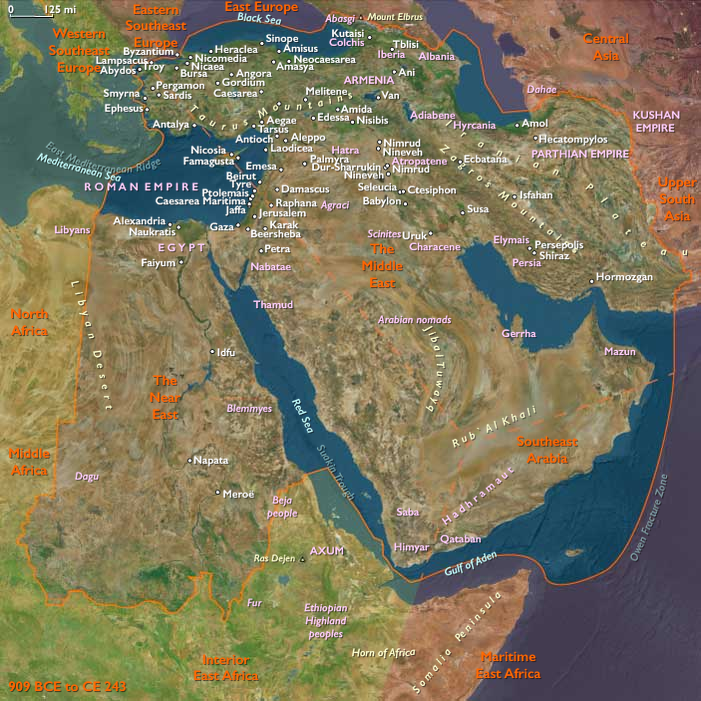
The Near and Middle East
View →Subregions
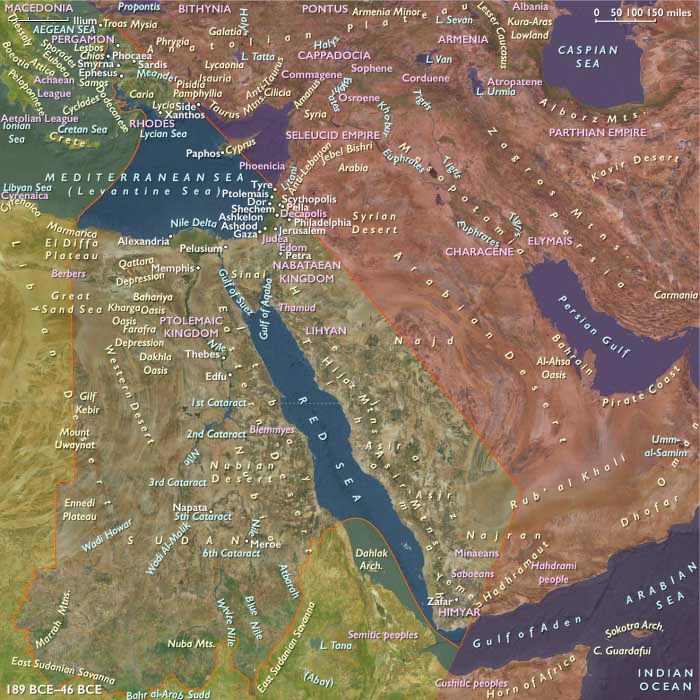
Near East
View →Related Events
No active filters.
Showing 10 events out of 62586 total
The Xiongnu, as their economic and military situation deteriorated, had been willing to renew peace during the reigns of Huyandi Chanyu (r. 85-69 BCE) and Xulüquanqu Chanyu (r. 68-60 BCE), but the Han court had given only one option, tributary submission.
After Xulüquanqu Chanyu's death in 60 BCE, a Xiongnu civil war had broken out in 57 BCE over the succession, which fully fragments the Xiongnu confederation with many contenders.
In the end, only Zhizhi Chanyu and Huhanye Chanyu survive the struggle to power.
After Zhizhi Chanyu (r. 56–36 BCE) inflicts serious losses against his rival Huhanye Chanyu (r. 58–31 BCE), Huhanye and his supporters debate whether to request military protection and become a Han vassal.
In 53 BCE, Huhanye decides to do so and surrenders to the reign of the Han empire.
Huhanye sends his son as a hostage to the Han capital in 53 BCE and personally pays homage to Emperor Xuan in 51 BCE.
Huhanye makes a second visit two years later.
With Han assistance, his strength grows, and Zhizhi, who had previously been stronger, is now forced to move west.
Burebista, king of the Dacians, conquers the economically important Greek cities on the Black Sea coast, from Apollonia to Olbia, after 55, forcing the retreat of the Scythians to …
…the lands east of the Dniester River.
The Geto-Dacian walled city of Pecica is built during the reign of Burebista.
The Middle East: 57–46 BCE
The Parthian Conflict and Roman Setbacks
The era from 57 to 46 BCE marks a critical period in Roman-Parthian relations, characterized by ambitious Roman expansion attempts and significant military setbacks. In 53 BCE, the Roman general Marcus Licinius Crassus, a member of the influential First Triumvirate alongside Julius Caesar and Pompey, leads a major invasion into Mesopotamia, aiming to extend Roman dominance into Parthian territories.
Crassus's campaign ends in disaster at the Battle of Carrhae, where he and his son Publius suffer devastating defeat and death at the hands of Parthian forces under General Surena. This catastrophic Roman loss is considered the worst since the famed Battle of Cannae during the Punic Wars, dramatically altering the political dynamics within Rome itself.
Crassus’s defeat directly contributes to the collapse of the First Triumvirate, exacerbating tensions that eventually ignite the civil wars between Julius Caesar and Pompey. Exploiting Roman vulnerability, the Parthians launch a series of raids into Syria the following year (52 BCE), capitalizing on the confusion and diminished Roman military presence.
In 51 BCE, the Parthians escalate their aggression with a major invasion of Syria, but this advance is effectively halted when Roman forces ambush and decisively defeat them near Antigonea. The Romans, rallying after the humiliation at Carrhae, manage to drive back the Parthians and temporarily secure the volatile frontier.
Thus, this era (57–46 BCE) encapsulates a pivotal moment of Roman vulnerability in the Near East, demonstrating both the limits of Roman power against the formidable Parthian Empire and setting the stage for prolonged future confrontations between these two great ancient powers.
The Roman general Marcus Licinius Crassus leads an invasion of Mesopotamia in 53 BCE with catastrophic results; he and his son Publius are killed at the Battle of Carrhae by the Parthians under General Surena; this is the worst Roman defeat since the Battle of Cannae.
His death leads to the end of the First Triumvirate and the resulting civil wars between Julius Caesar and Pompey.
The Parthians raid Syria the following year, and mount a major invasion in 51 BCE, but their army is caught in an ambush near Antigonea by the Romans, and they are driven back.
The Great Roman Civil War (49–45 BCE), also known as Caesar's Civil War, one of the last politico-military conflicts in the Roman Republic before the establishment of the Roman Empire, begins as a series of political and military confrontations between Julius Caesar, his political supporters (broadly known as Populares), and his legions, against the Optimates (or Boni), the politically conservative and socially traditionalist faction of the Roman Senate, who are supported by Pompey and his legions.
Caesar is appointed dictator in Rome, with Mark Antony as his Master of the Horse; Caesar presides over his own election to a second consulate (with Publius Servilius Vatia as his colleague), then, after eleven days, resigns this dictatorate.
He pursues Pompey to Alexandria, where Pompey is murdered by a former Roman officer serving in the court of King Ptolemy XIII.
Caesar then becomes involved with the Alexandrine civil war between Ptolemy and his sister, wife, and co-regent queen, the Pharaoh Cleopatra VII.
Caesar sides with Cleopatra, perhaps as a result of Ptolemy's role in Pompey's murder; he is reported to have wept at the sight of Pompey's head, which is offered to him by Ptolemy's chamberlain Pothinus as a gift.
In any event, Caesar withstands the Siege of Alexandria, later defeating the Ptolemaic forces in 47 BCE in the Battle of the Nile and installing Cleopatra as ruler.
Caesar and Cleopatra never marry, as Roman Law only recognizes marriages between two Roman citizens, but he continues his relationship with Cleopatra throughout his last marriage, which lasts fourteen years—in Roman eyes, this does not constitute adultery—and may have fathered a son called Caesarion.
Cleopatra visits Rome on more than one occasion, residing in Caesar's villa just outside Rome across the Tiber.
Caesar had again been appointed Dictator late in 48 BCE, with a term of one year.
After spending the first months of 47 BCE in Egypt, Caesar crosses to Asia, where he annihilates King Pharnaces II of Pontus in the Battle of Zela; his victory is so swift and complete that he mocks Pompey's previous victories over such poor enemies.
He thence proceeds to Africa to deal with the remnants of Pompey's senatorial supporters.
He quickly gains a significant victory at Thapsus in 46 BCE over the forces of Metellus Scipio (who dies in the battle) and Cato the Younger (who commits suicide).
After this victory, Caesar is appointed Dictator for ten years.
Near East (57–46 BCE): Innovations in Glass and Craftsmanship
Between 57 and 46 BCE, a notable advancement emerges in the region of Phoenicia with the discovery and development of glassblowing, a revolutionary technique that dramatically broadens the variety and sophistication of glassware. Introduced around 50 BCE, glassblowing greatly enhances both the efficiency and versatility of glass production, enabling artisans to craft objects that are thinner, more uniform, and more transparent than previously possible.
Prior to this innovation, glass objects required labor-intensive molding processes, often resulting in thick-walled and opaque vessels. Now, bottles and other containers can be shaped directly by hand through free-blowing, or partially guided by a simple mold shaping the vessel’s lower half, a technique known as mold-blowing. This process not only accelerates production but also significantly improves the clarity, aesthetic appeal, and practical utility of glass vessels, establishing the foundations for future advances in both artistic and functional glassware throughout the Mediterranean world.
Legacy of the Era
The advent of glassblowing around 50 BCE profoundly impacts craftsmanship and commerce across the Near East and beyond, setting the stage for a flourishing industry that will influence daily life and artistic expression for centuries to come. This transformative technique underscores Phoenicia's enduring role as a center of innovation and craftsmanship within the Greco-Roman world.
Mediterranean Southwest Europe (57–46 BCE): Caesar's Civil War and the Collapse of the Republic
The era 57–46 BCE marks one of the most critical periods in the history of the Roman Republic, dominated by the turmoil and transformation brought about by Caesar's Civil War. This conflict, fundamentally political and military, pits Julius Caesar and his supporters—the Populares—against the conservative faction of the Senate—the Optimates—led militarily by Pompey the Great.
Outbreak of Civil War and Caesar’s Dictatorship
The conflict erupts in 49 BCE, after prolonged political tensions between Caesar and the Senate culminate in Caesar’s dramatic crossing of the Rubicon River, symbolically declaring war against Rome itself. Pompey and most senators flee Rome, regrouping in Greece and other parts of the Republic.
In Rome, Caesar rapidly consolidates power, assuming the role of dictator and appointing Mark Antony as his Master of the Horse. After presiding briefly over his election to a second consulate alongside Publius Servilius Vatia, Caesar resigns the dictatorship after eleven days, though retaining supreme authority through military dominance.
Pompey's Defeat and Death in Egypt
Caesar pursues Pompey to Egypt, arriving in Alexandria shortly after Pompey’s assassination at the hands of the court of Ptolemy XIII. Caesar aligns himself with Cleopatra VII, Ptolemy’s sister and rival, becoming embroiled in the Alexandrine civil war. After surviving a challenging siege, Caesar decisively defeats Ptolemy’s forces at the Battle of the Nile in 47 BCE, establishing Cleopatra firmly as ruler of Egypt.
Despite never marrying due to Roman legal constraints—Roman law only recognizes marriages between Roman citizens—Caesar maintains a significant relationship with Cleopatra, who later visits Rome, residing in Caesar’s villa across the Tiber. Caesar and Cleopatra’s union is historically notable, and Caesar is believed to have fathered a son, Caesarion, with her.
Caesar’s Campaigns and Dictatorship
Caesar’s authority continues to solidify. After his victory in Egypt, he swiftly moves to Asia Minor, defeating King Pharnaces II of Pontus at the Battle of Zela with remarkable speed, famously summarized by his phrase, "Veni, vidi, vici" ("I came, I saw, I conquered").
Returning westward, Caesar decisively confronts and defeats the last remnants of Pompey’s senatorial allies at the Battle of Thapsus in Africa in 46 BCE, where key opponents such as Metellus Scipio and Cato the Younger perish—Scipio in battle and Cato by suicide.
Following Thapsus, Caesar is appointed dictator for ten years, securing unprecedented control over the Roman Republic, effectively signaling the Republic's transition into a period of singular authority.
Expansion and Colonization
Meanwhile, Roman colonization efforts continue. Como, situated in the Lombardy region of northern Italy near Lake Como and historically inhabited by the Celtic Orobii tribe, becomes a Roman colony during this period, indicative of Rome’s continuing expansion and consolidation of its northern territories.
Legacy of the Era
The period 57–46 BCE profoundly reshapes the Roman Republic. Caesar’s victories not only eradicate the immediate political and military opposition but also lay the foundation for a fundamental transformation of Roman governance. Caesar’s ascendance and extended dictatorship directly precipitate the demise of the Republic, paving the way for imperial rule and permanently altering Rome’s historical trajectory.
Mediterranean Southwest Europe (57–46 BCE): Caesar's Civil War and the Collapse of the Republic
The era 57–46 BCE marks one of the most critical periods in the history of the Roman Republic, dominated by the turmoil and transformation brought about by Caesar's Civil War. This conflict, fundamentally political and military, pits Julius Caesar and his supporters—the Populares—against the conservative faction of the Senate—the Optimates—led militarily by Pompey the Great.
Outbreak of Civil War and Caesar’s Dictatorship
The conflict erupts in 49 BCE, after prolonged political tensions between Caesar and the Senate culminate in Caesar’s dramatic crossing of the Rubicon River, symbolically declaring war against Rome itself. Pompey and most senators flee Rome, regrouping in Greece and other parts of the Republic.
In Rome, Caesar rapidly consolidates power, assuming the role of dictator and appointing Mark Antony as his Master of the Horse. After presiding briefly over his election to a second consulate alongside Publius Servilius Vatia, Caesar resigns the dictatorship after eleven days, though retaining supreme authority through military dominance.
Pompey's Defeat and Death in Egypt
Caesar pursues Pompey to Egypt, arriving in Alexandria shortly after Pompey’s assassination at the hands of the court of Ptolemy XIII. Caesar aligns himself with Cleopatra VII, Ptolemy’s sister and rival, becoming embroiled in the Alexandrine civil war. After surviving a challenging siege, Caesar decisively defeats Ptolemy’s forces at the Battle of the Nile in 47 BCE, establishing Cleopatra firmly as ruler of Egypt.
Despite never marrying due to Roman legal constraints—Roman law only recognizes marriages between Roman citizens—Caesar maintains a significant relationship with Cleopatra, who later visits Rome, residing in Caesar’s villa across the Tiber. Caesar and Cleopatra’s union is historically notable, and Caesar is believed to have fathered a son, Caesarion, with her.
Caesar’s Campaigns and Dictatorship
Caesar’s authority continues to solidify. After his victory in Egypt, he swiftly moves to Asia Minor, defeating King Pharnaces II of Pontus at the Battle of Zela with remarkable speed, famously summarized by his phrase, "Veni, vidi, vici" ("I came, I saw, I conquered").
Returning westward, Caesar decisively confronts and defeats the last remnants of Pompey’s senatorial allies at the Battle of Thapsus in Africa in 46 BCE, where key opponents such as Metellus Scipio and Cato the Younger perish—Scipio in battle and Cato by suicide.
Following Thapsus, Caesar is appointed dictator for ten years, securing unprecedented control over the Roman Republic, effectively signaling the Republic's transition into a period of singular authority.
Expansion and Colonization
Meanwhile, Roman colonization efforts continue. Como, situated in the Lombardy region of northern Italy near Lake Como and historically inhabited by the Celtic Orobii tribe, becomes a Roman colony during this period, indicative of Rome’s continuing expansion and consolidation of its northern territories.
Legacy of the Era
The period 57–46 BCE profoundly reshapes the Roman Republic. Caesar’s victories not only eradicate the immediate political and military opposition but also lay the foundation for a fundamental transformation of Roman governance. Caesar’s ascendance and extended dictatorship directly precipitate the demise of the Republic, paving the way for imperial rule and permanently altering Rome’s historical trajectory.