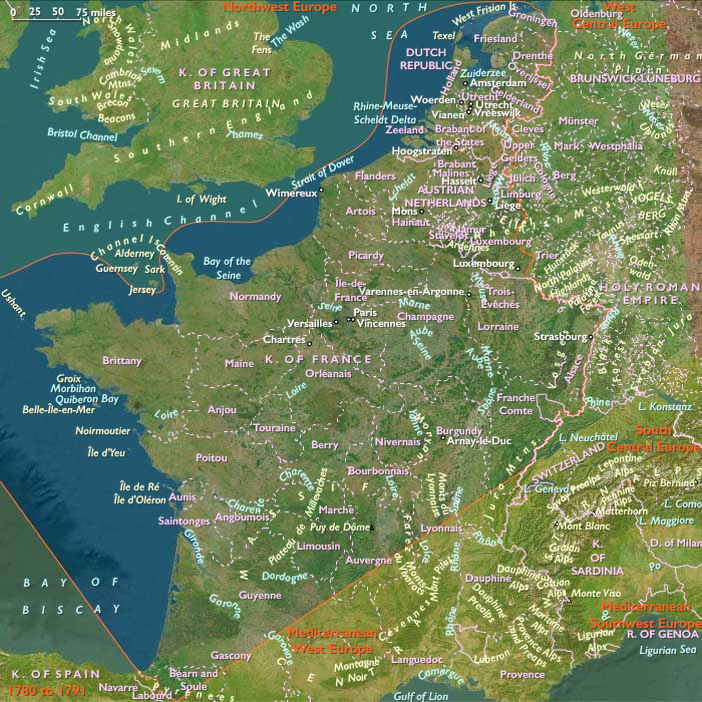
Thomas de Mahy, born in Favras near…
December 1789 CE
At seventeen he was a captain of dragoons, and saw some service in the closing campaign of the Seven Years' War.
In 1772 he became a first lieutenant in the Swiss Guards of King Louis XVI's younger brother, the Comte de Provence.
Unable to meet the expenses of his rank, which is equivalent to that of a colonel in the army, he had retired in 1775.
Favras married in 1776 Victoria Hedwig Karoline, Princess of Anhalt-Bernburg-Schaumburg, whose mother, after being deserted by her husband Karl Louis, Prince of Anhalt-Bernburg-Schaumburg-Hoym in 1749, had found refuge with her daughter in the house of Charles de Rohan, prince de Soubise.
After his marriage, Favras had gone to Vienna to attempt the restitution of his wife's rights, and spent some time in Warsaw.
In 1787 he had been authorized to raise a "patriotic legion" to help the Dutch Republic against the Stadtholder William V and his Prussian allies.
Returning to Paris in 1789, he had become involved in Royalist plans initiated by his former employer, the Comte de Provence, to save the King and end the French Revolution.
In order to finance this venture, Provence (using one of his gentlemen, the Comte de la Châtre, as an intermediary) had commissioned Favras to negotiate a loan of two million French francs from the bankers Schaumel and Sartorius.
Favras had taken the unfortunate step of taking into his confidence certain officers by whom he is betrayed.
It is stated in a leaflet circulated throughout Paris on December 23, 1789 that Favras has been hired by the Comte de Provence to organize an elaborate plot against the people of France.
In this plot, the King, Queen and their children are to be rescued from the Tuileries Palace and spirited out of the country; then, the Comte de Provence is to be declared regent of the kingdom with absolute power
Simultaneously, a force of thirty thousand soldiers is to encircle Paris.
In the ensuing confusion, the city's three main liberal leaders (Jacques Necker, the popular Finance Minister of France, Jean Sylvain Bailly, the mayor of Paris, and the Marquis de La Fayette, the commander of the city's new National Guard) are to be assassinated.
Afterwards, the revolutionary city ia to be starved into submission by cutting off its food supplies.
As a consequence of the leaflet, Favras and his wife are arrested the next day, and imprisoned in the Abbaye Prison.
The Comte de Provence, terrified of the consequences of the arrest, hastens to publicly disavow Favras, in a speech delivered before the Commune of Paris, and in a letter to the National Constituent Assembly.
Locations
People
Topics
Regions
West Europe
View →Subregions