The British in Sierra Leone interact mostly…
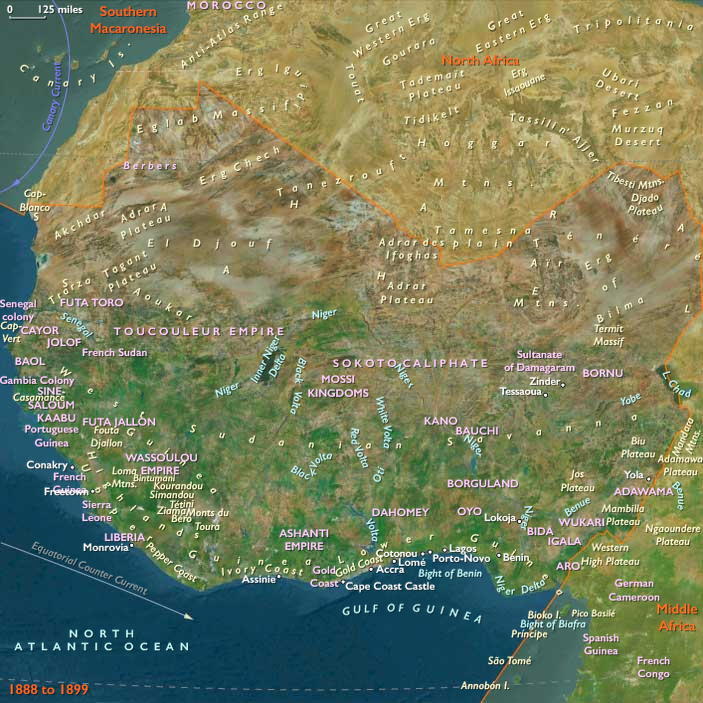
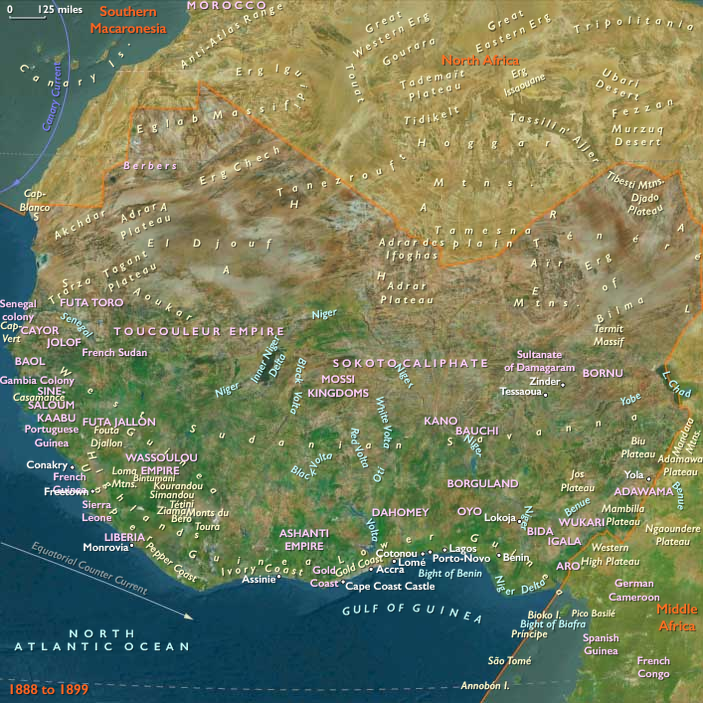
1888 CE to 1899 CE
In addition, educated Krios hold numerous positions in the colonial government, giving them status and good-paying positions.
Following the Berlin Conference of 1884–1885, the UK had decided that it needed to establish more dominion over the inland areas, to satisfy what was described by the European powers as "effective occupation" of territories.
In 1896 it annexes these areas, declaring them the Sierra Leone Protectorate.
With this change, the British begins to expand their administration in the region, recruiting British citizens to posts, and pushing Krios out of positions in government and even the desirable residential areas in Freetown.
In addition, the British annexation of the Protectorate interferes with the sovereignty of indigenous chiefs.
They designate chiefs as units of local government, rather than dealing with them individually as had been previous practice.
They do not maintain relationships even with longtime allies, such as Bai Bureh, chief of Kasseh, a community on the Small Scarcies River.
He will later be unfairly portrayed as a prime instigator of the Hut Tax war in 1898.
Colonel Frederic Cardew, military governor of the Protectorate, in 1898 establishes a new tax on dwellings and demands that the chiefs use their peoples to maintain roads.
The taxes are often higher than the value of the dwellings, and twenty-four chiefs sign a petition to Cardew, stating how destructive this is; their people cannot afford to take time off from their subsistence agriculture.
They resist payment of taxes.
Tensions over the new colonial requirements, and the administration's suspicions about the chiefs lead to the Hut Tax war of 1898, also called the Temne-Mende War.
The British fire first.
The Northern front of majority Temne people is led by Bai Bureh.
The Southern front, consisting mostly of Mende people, enters conflict somewhat later and for different reasons.
For several months, Bureh's fighters have the advantage over the vastly more powerful British forces, but the British troops and Bureh's warriors suffer hundreds of fatalities.
Bai Bureh finally surrenders on November 11, 1898, to end the destruction of his people's territory and dwellings.
Although the British government recommends leniency, Cardew insists on sending the chief and two allies into exile in the Gold Coast; his government hangs ninety-six of the chief's warriors.
Bai Bureh will be allowed to return in 1905, when he resumes his chieftaincy of Kasseh.
Groups
Regions
West Africa
View →Subregions