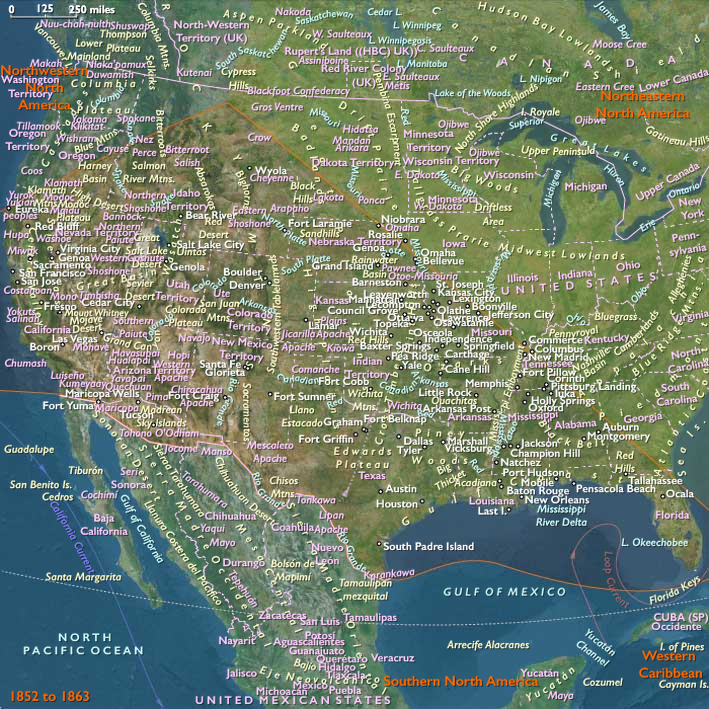
Gulf and Western North America (1852–1863 CE):…
1852 CE to 1863 CE
Gulf and Western North America (1852–1863 CE): Growing Tensions, Conflict, and Transformation
Westward Migration and Indigenous Conflicts
Between 1852 and 1863, westward migration accelerates dramatically, with hundreds of thousands of settlers traveling along routes such as the Oregon, Mormon, and California trails. This influx heightens tensions over scarce resources, leading to multiple conflicts including the ongoing Cayuse War (1848–1855), the Rogue River Wars (1855–1856), and the Yakima Wars (1855–1858). Simultaneously, the Seminole people in Florida engage in the Third Seminole War (1855–1858), resisting forced relocation and encroachment by settlers and the U.S. government.
The American Civil War and Slavery
Tensions over slavery reach a breaking point, triggering the American Civil War (1861–1865). Fundamental differences over the extension of slavery into newly acquired territories, combined with Abraham Lincoln's election in 1860 as president from the anti-slavery Republican Party, lead thirteen southern slave states to secede and form the Confederate States of America. The war becomes the deadliest in American history, with approximately 618,000 soldiers killed. The conflict fundamentally reshapes the nation and ultimately leads to the abolition of slavery.
Indigenous Displacement and Disease
In the Southwest, the United States Army battles the Navajo and Apache (1860–1865), and on the Great Plains, ongoing clashes with the Lakota and Northern Cheyenne escalate into the First Sioux War (1854–1856), initiated by events such as the Grattan Massacre of 1854. The Wichita are forcibly relocated from Texas to Oklahoma in 1859 and ally with the Union during the Civil War, briefly moving to Kansas before being permanently resettled in southwestern Oklahoma in 1867. The Comanche population drastically declines due to smallpox (1817, 1848) and cholera (1849), reducing their numbers from around 20,000 to a few thousand by the 1870s.
Cholera Epidemics and Health Crises
Cholera outbreaks continue to cause significant mortality, particularly affecting black communities in the South and travelers along western migration trails. Between 1849 and 1855, cholera claims approximately 6,000–12,000 lives among settlers journeying to California, Utah, and Oregon, reflecting poor sanitation and healthcare conditions in rapidly growing settlements.
Territorial and Tribal Realignments
The Lakota Sioux consolidate their territorial claims, asserting dominance over lands from the Black Hills of South Dakota to Montana's Big Horn Mountains after 1860. They demand direct negotiations regarding any incursions into their territory. Meanwhile, the Gros Ventres join the Blackfoot Confederacy in 1855, signing treaties that establish shared hunting grounds with various tribes, before leaving the confederacy in 1861.
Economic Expansion and Settlement
The discovery of vast borax deposits in the Mojave Desert during the mid-19th century marks significant commercial development. Meanwhile, St. Joseph, Missouri, becomes a pivotal supply and departure point for settlers moving westward along the Oregon Trail, serving as the westernmost rail-connected city until after the Civil War.
Arapaho Cultural and Trading Influence
The Arapaho maintain active trading relationships with farming villages along the Missouri River, notably the Arikara, Mandan, and Hidatsa. The Arapaho, adept in trading gemstones, bison hides, and beaver pelts, earn a prominent reputation among Plains tribes. They form significant alliances, notably with the Comanche and Kiowa, and one band integrates fully with the Comanche, adopting their language and customs.
Key Historical Developments
-
Rapid escalation of westward migration leads to intensified conflicts with indigenous tribes.
-
The American Civil War reshapes the nation's political, social, and economic landscape, ultimately leading to the abolition of slavery.
-
Devastating impacts of cholera and other diseases on indigenous and settler populations.
-
Forced relocations of tribes like the Wichita and severe population decline of the Comanche due to epidemics.
-
Territorial realignments and strengthened tribal identities among the Lakota Sioux and Gros Ventres.
-
St. Joseph emerges as a critical supply hub for western migration.
Long-Term Consequences and Historical Significance
The era from 1852 to 1863 is marked by dramatic transformation, defined by intense westward migration, the devastating American Civil War, and ongoing displacement and decimation of indigenous populations through war, disease, and forced relocation. These years lay the foundations for profound demographic, cultural, and political changes across Gulf and Western North America, shaping the region's history for generations to come.
People
Groups
Topics
Commodities
Subjects
Regions
Northern North America
View →Subregions