Gustave Courbet achieves new heights in realism,…
1850 CE
Gustave Courbet achieves new heights in realism, the movement he leads.
The Salon of 1850 finds him triumphant with the Burial at Ornans, the Stone-Breakers (destroyed in 1945), and the Peasants of Flagey.
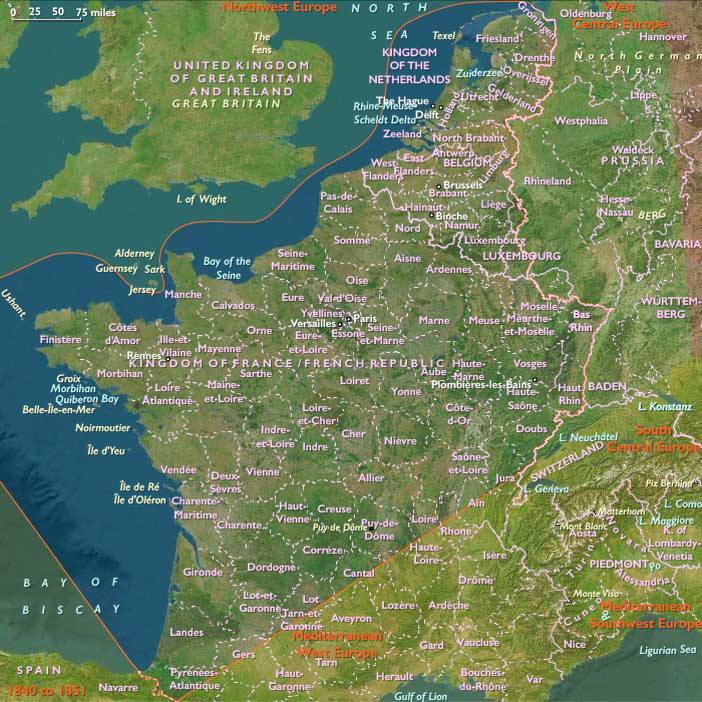
One of his most important works is Burial at Ornans, a canvas recording an event that he had witnessed in September 1848.
Courbet's painting of the funeral of his grand uncle becomes the first masterpiece in the Realist style.
People who had attended the funeral were used as models for the painting.
Previously, models had been used as actors in historical narratives; here Courbet said that he "painted the very people who had been present at the interment, all the townspeople".
The result is a realistic presentation of them, and of life, in Ornans.
The painting causes a fuss with critics and the public.
The enormous work, measuring 10 by 22 feet (3.1 by 6.6 meters), depicts a prosaic ritual on a scale which previously would have been reserved for a religious or royal subject.
Eventually the public grows more interested in the new Realist approach, and the lavish, decadent fantasy of Romanticism loses popularity.
The artist well understands the importance of this painting; as Courbet said: "The Burial at Ornans was in reality the burial of Romanticism
Courbet associates his ideas of realism in art with Socialism, and, having gained an audience, he promotes democratic and Socialist ideas by writing politically motivated essays and dissertations.
To a friend in 1850 he writes, “…in our so very civilized society it is necessary for me to live the life of a savage. I must be free even of governments. The people have my sympathies, I must address myself to them directly.”
Images

Gustave Courbet: A Burial at Ornans (1849-50); oil on canvas; 315 cm (10.3 ft) x 668 cm (21.9 ft); Musée d'Orsay
Locations
People
Subjects
Regions
West Europe
View →Subregions