
Hamazi or Khamazi (Sumerian: a-ma-ziki) is an…
2493 BCE to 2350 BCE
Hamazi or Khamazi (Sumerian: a-ma-ziki) is an ancient kingdom or city-state of some importance that reaches its peak between about 2500 and 2400 BCE.
Its exact location is unknown, but is thought to have been located in the western Zagros mountains roughly between Elam and Assyria, possibly near Nuzi or modern Hamadan.
Hamazi first came to the attention of archaeologists with the discovery of a vase with an inscription in very archaic cuneiform commemorating the victory of Utug (or Uhub), an early king of Kish, over this place, causing fringe theorist Laurence Waddell in 1929 to speculate that it was to be identified with Carchemish in Syria.
It is now generally considered to have been somewhere near the Diyala, a river and tributary of the Tigris that runs through Kurdistan in Iran and Iraqi Kurdistan.
One of the earliest references to Hamazi is found in the epic Enmerkar and the Lord of Aratta, where Enmerkar prays to Enki about the confusion of languages in the various inhabited lands, at the time of the building of the ziggurats in Eridu and Uruk.
Hamazi is the only land mentioned in this prayer with the epithet "many-tongued.” A sequel, Enmerkar and En-suhgir-ana, also mentions that the sorcerer of Hamazi, Urgirinuna, went to Aratta after Hamazi "had been destroyed"; he is later sent by the Lord of Aratta on a failed mission attempting to bring Enmerkar into submission.
According to the Sumerian king list, king Hadanish of Hamazi held hegemony over Sumer after defeating Kish, but was in turn defeated by Enshakushanna of Uruk.
A clay tablet found in the archives at Ebla in Syria bears a copy of a diplomatic message sent from king Irkab-Damu of Ebla to king Zizi of Hamazi, along with a large quantity of wood, hailing him as a brother, and requesting him to send mercenaries in exchange.
Locations
Topics
Commodities
Subjects
Regions
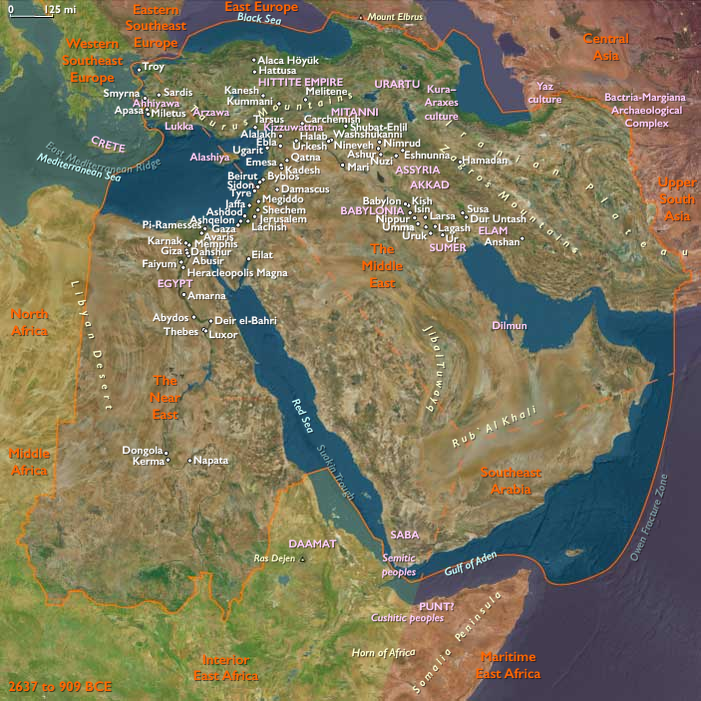
The Near and Middle East
View →Subregions
