
Atlantic West Europe: Consolidation of French Power …
Years: 1480 - 1491
Atlantic West Europe: Consolidation of French Power and the Habsburg Inheritance (1480–1491)
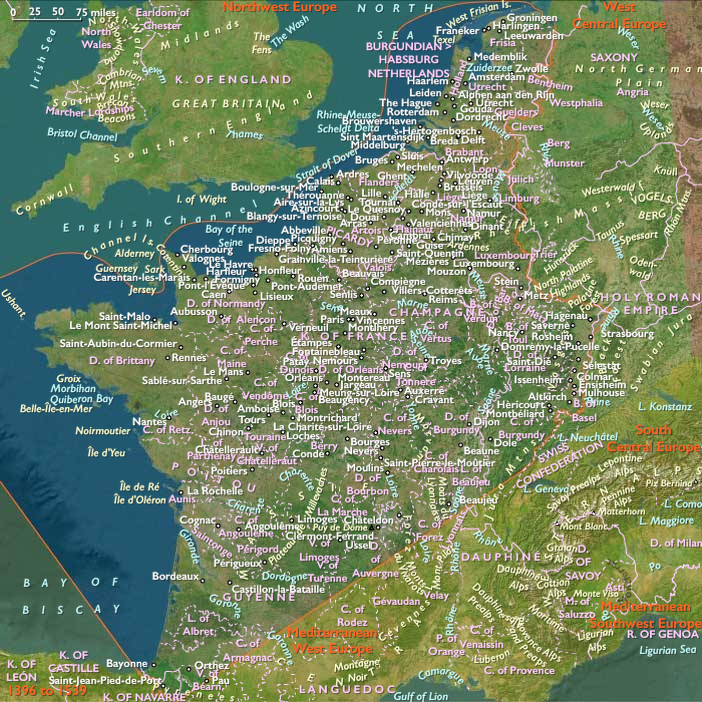
Between 1480 and 1491, Atlantic West Europe undergoes significant transformations, defined by the ongoing consolidation of French royal authority, the Habsburg acquisition of the wealthy Burgundian Low Countries, and notable cultural advancements influenced by the early Renaissance. This era sets the stage for the power dynamics that will shape the continent for generations, notably the emergence of the Habsburg dynasty as a dominant European power, alongside France's continuing internal unification and expansion.
Political and Military Developments
The aftermath of Burgundy's collapse remains the defining political narrative of this period. The Treaty of Arras (1482) solidifies France’s gains, notably incorporating Burgundy proper, Picardy, and other strategic regions, significantly strengthening Louis XI’s control over the kingdom. Upon Louis XI’s death in 1483, France enters a regency period under Anne of Beaujeu, who skillfully navigates internal challenges and further consolidates royal authority.
Simultaneously, the Low Countries pass into Habsburg hands through the marriage of Mary of Burgundy to Maximilian I of Austria, future Holy Roman Emperor. Mary’s sudden death in 1482 leaves Maximilian as regent for their young son, Philip the Handsome, embedding the region firmly within the Habsburg sphere and laying foundations for centuries of Habsburg-French rivalry. Maximilian’s rule faces local resistance, particularly from Flemish cities eager to maintain autonomy.
Economic Developments
Economic prosperity continues in the Low Countries under Habsburg oversight, with Antwerp rising rapidly as an international trading hub. As Bruges slowly declines due to silting waterways, Antwerp thrives by attracting merchants from across Europe. The increasing involvement of the Habsburgs enhances trade networks linking Germany, Italy, and Iberia through Atlantic West Europe, laying a foundation for sustained economic growth into the next century.
In France, Louis XI’s policies encourage internal trade, market growth, and urban prosperity, though significant taxation and royal control are imposed to support centralization and military expenditures.
Cultural and Artistic Flourishing
This era witnesses continued flowering of the Northern Renaissance, particularly in the Burgundian-Habsburg Low Countries. Artists such as Hans Memling and Gerard David produce masterpieces celebrated for their detailed realism, vibrant color, and emotional depth, emblematic of Flemish art. Manuscript illumination, fine tapestries, and courtly pageantry remain prominent expressions of wealth and power, reflecting a high level of cultural sophistication and artistic patronage, increasingly under Habsburg direction.
Technological and Societal Shifts
Artillery and military engineering continue to evolve significantly during these years, transforming the nature of warfare, siege operations, and defense strategies. Societal structures experience gradual shifts, especially as towns grow in economic importance and urban merchants increasingly demand political rights and autonomy, challenging traditional feudal hierarchies.
Long-term Consequences and Significance
The period from 1480 to 1491 decisively shapes the political future of Atlantic West Europe. The permanent division of former Burgundian lands between France and Habsburg Austria creates rivalries and geopolitical tensions that will persist for centuries, particularly driving conflicts like the Italian Wars and later wars between France and Spain. The solidification of royal power in France paves the way for a centralized monarchy under the Valois dynasty, defining French politics into the early modern period. Economically and culturally, this era firmly establishes the Low Countries as a dynamic commercial region, central to European trade and artistic innovation, significantly influencing European history well beyond the medieval age.
People
- Anne of France
- Gerard David
- Hans Memling
- Louis XI of France
- Mary of Burgundy
- Maximilian I of
- Philip I of Castile
Groups
- Flanders, County of
- Austria, Archduchy of
- France, (Valois) Kingdom of
- Holy Roman Empire
- Netherlands, Habsburg
Topics
Commodoties
Subjects
Regions

Subregions
Years: 1480 - 1491
People
- Anne of France
- Gerard David
- Hans Memling
- Louis XI of France
- Mary of Burgundy
- Maximilian I of
- Philip I of Castile
Groups
- Flanders, County of
- Austria, Archduchy of
- France, (Valois) Kingdom of
- Holy Roman Empire
- Netherlands, Habsburg
Topics
Commodoties
Subjects
Regions
Subregions