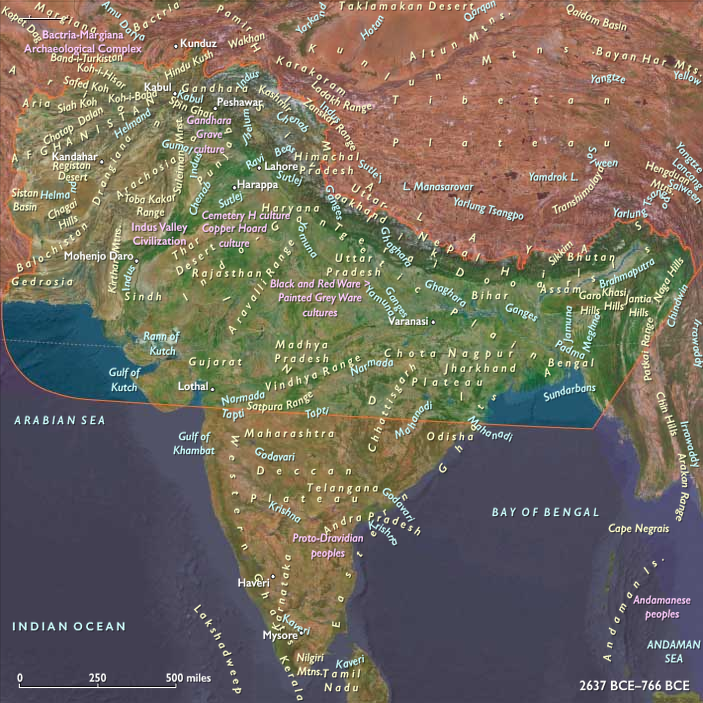
Harappan civilization at its peak covers an…
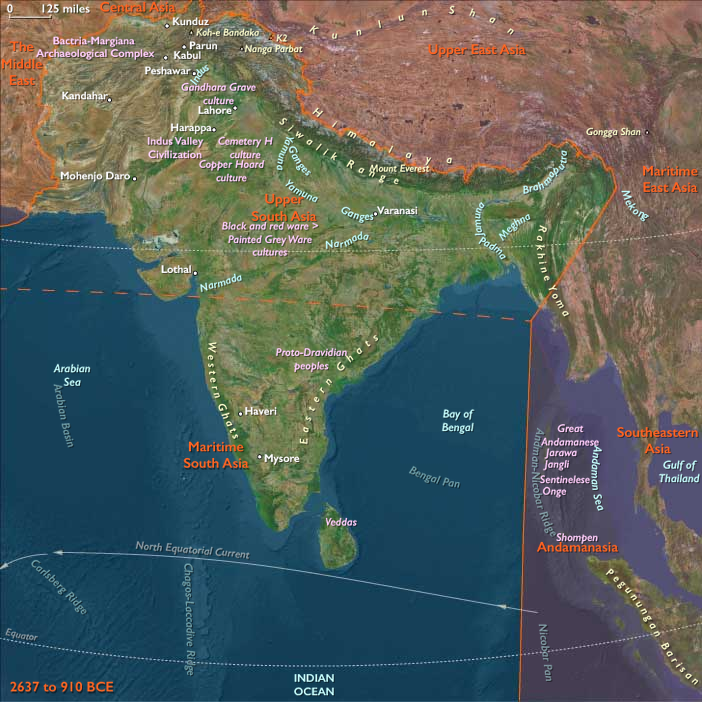
2637 BCE to 910 BCE
Harappan civilization at its peak covers an area of around four hundred and eighty thousand square kilometers (298,258.172 square miles).
Its heartland is in the Indus river valley in Pakistan, but settlements spread as far as the Makran coast, Baluchistan, Afghanistan, eastern Punjab, Kutch, and Saurashtra.
They include cities like Harappa, Mohenjo-daro, Kalimantan, Dholavira, ports like Lothal, Sutkagen-dor and Sotka-koh and numerous villages as well.
They use irrigation to farm and construct cities.
The two main cities, Mohenjo-Daro and Harappa, have sophisticated sewer system channeling the city’s water and waste through earthenware pipes.
There are even baths at one of the villages, besides the great baths of brick in each city.
The houses lining the Harappan culture’s typically straight streets and avenues contain bathrooms.
The Indus script develops: at Harappa and Mohenjo-Daro, low-relief inscriptions made on steatite seals date from around 2500 BCE.
Trade tokens used by the Harappans are a form of early coins.
The earliest known maritime trade between Mesopotamia and the Indus Valley is conducted along the Indian Ocean around 2500 BCE.
Groups
Commodities
Subjects
Regions
South Asia
View →Subregions